World Cup Final AI Predictions Show SMEs Need Evidence Workflows
World Cup final AI prediction chatter shows why SMEs need evidence workflows, approval gates and human-owned decisions.
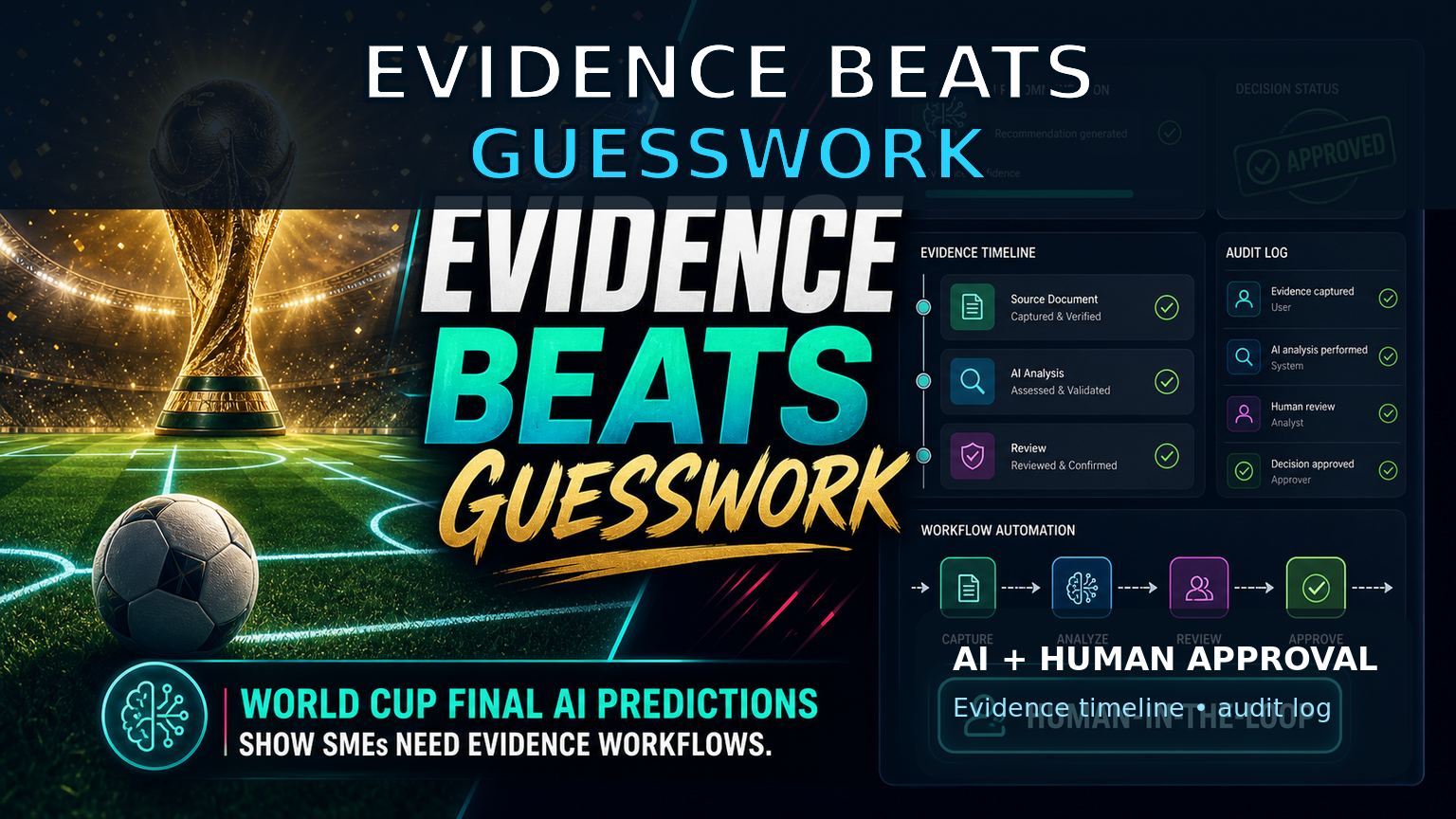
# World Cup Final AI Predictions Show SMEs Need Evidence Workflows Meta description: World Cup final AI prediction chatter shows why SMEs need evidence workflows, approval gates, audit logs and human-owned decisions. #
World Cup Final AI Predictions Show SMEs Need Evidence Workflows
Meta description: World Cup final AI prediction chatter shows why SMEs need evidence workflows, approval gates, audit logs and human-owned decisions.
Quick answer
The FIFA World Cup 2026 final day is not only a football story. At the same time, old Reddit r/soccer RSS showed live fan heat around the Spain vs Argentina final match thread and individual challenge clips. That combination is useful for SMEs because it shows the difference between prediction excitement and operational trust.
GOFTUS does not argue that AI should replace referees, coaches, players or business owners. The lesson is the opposite. AI software is most useful when it helps people see evidence faster, follow the protocol, record the decision and explain the next step in plain English.
For SMEs, the same pattern applies in support, sales, HR, finance, documents, browser tasks and daily operations. An AI agent can draft, check, classify, monitor and route. A human should still own high-impact calls, especially when money, customers, compliance, staff or reputation are involved. The winning workflow is not "let the model decide". It is decision support with evidence, approvals, logs and exception handling.
Why final-day AI prediction chatter matters
Prediction articles are attractive because they feel clean. Ask several models about a final, compare their answers and see which one sounds convincing. That is a fun consumer use case, but it is a weak operating model for a business. A confident prediction does not automatically show the evidence used, the uncertainty, the protocol followed or the person accountable for the outcome.
Football makes that easy to understand. Fans can accept that technology helps officials review angles, timing and context. They are less likely to trust a black-box answer with no evidence trail. A disputed challenge, offside line or penalty review needs a timeline: what was checked, which rule applied, who made the final call and how the result was communicated.
SMEs need the same discipline when AI software enters live work. A support automation that closes a ticket should show the customer history, the answer source and the escalation rule. A sales agent that updates a CRM should show why the lead moved stage. A finance workflow that flags an invoice should keep the document evidence and the approval note. A browser agent that fills a form should pause before submission and log what it changed.
The point is not to remove human judgement. It is to make human judgement faster, calmer and easier to audit.
What this means for SMEs
The first practical step is to separate prediction from decision support. Prediction asks, "what might happen?" Decision support asks, "what evidence do we have, what rule applies, what action is allowed and who approves it?" Most SMEs need more of the second.
In customer support, that means an FAQ automation layer can answer repeat questions, collect lead details and route uncertain cases to a person. In sales, it means an AI assistant can prepare follow-up drafts but should log the source, CRM field changes and approval status. In HR, it means AI can summarise policy documents but sensitive employee decisions need a named reviewer. In finance, it means AI can match documents and surface anomalies, while payments and exceptions route to humans.
GOFTUS builds this control layer around tools such as AI agents, CRM automation, support workflows, document automation, n8n and browser controls. The value is not just connecting apps. It is defining the stop rules, evidence trail, fallback path and review loop before automation touches important work.
A useful SME workflow should answer five questions every time: what did the AI see, what did it suggest, what rule did it follow, who approved the action and where is the log? If those answers are missing, the business has a demo, not an operating system.
Competitor lens
SaaS tools and consultants can help. Zapier, Make, n8n, Bardeen, Gumloop, Lindy, Relevance AI and Stack AI can connect tasks quickly. AI consultancies in the UK, US and EU can also support strategy, prototypes and delivery. Those options are useful when the business knows exactly what should happen.
The gap appears when the workflow is ambiguous. Who handles an exception? When does the agent stop? What evidence is enough? Which action needs approval? How does the team improve the process next month? GOFTUS focuses on that workflow design layer.
For a World Cup final, technology without protocol would not create trust. For an SME, AI without ownership has the same problem. The software needs an operating model around it: evidence timelines, approval gates, audit logs, escalation paths and plain-English explanations.
What SMEs should do next
Pick one high-volume workflow where AI is already tempting the team. Good candidates include support triage, sales follow-up, invoice checks, onboarding documents, browser form work or internal reporting.
Then write the decision pathway before adding more automation. Define the evidence needed, the actions AI can take alone, the actions that need human approval and the exceptions that must stop the run. Add audit logging from the start. If the workflow touches customers, money, employees or compliance, make the explanation readable for a non-technical owner.
Finally, review the logs monthly. Look for repeated exceptions, slow approvals, missing evidence and customer questions that should become FAQ content. GOFTUS can help through /services, /agents and /services#faq-automation by turning these observations into better routes, safer agent boundaries and cleaner handoffs.
Summery for SMEs
World Cup final AI prediction stories are a reminder that smarter software is not the same as trusted operations. Predictions may be interesting, but business workflows need evidence, protocol and accountability.
SMEs should use AI the way good sports technology should be used: assist the people responsible, surface the evidence, follow the rulebook, record the decision and explain the outcome clearly. AI can draft, check, monitor, route and summarise. Humans should own the calls that affect customers, staff, payments, compliance and reputation.
That is where GOFTUS fits. We help SMEs move from isolated AI tools to practical workflows with approvals, logs, exception handling and continuous improvement.
FAQ
Should SMEs use AI prediction tools for business decisions?
They can use predictions as one input, but not as the decision system. A reliable SME workflow should show the evidence, the rule, the approval status and the audit log behind any important action. GOFTUS helps teams design that through /services so AI supports owners instead of quietly replacing judgement.
What is an evidence workflow?
An evidence workflow captures what the AI reviewed, what it suggested, what rule applied, who approved the action and where the result was logged. In practical terms, it connects AI agents, CRM records, documents, support tickets and human review. GOFTUS uses /agents and /services to make that trail visible.
Does GOFTUS think AI should replace referees or managers?
No. The lesson from sport is that technology should assist humans, not remove accountability from them. GOFTUS applies the same principle to SMEs. AI can prepare drafts, checks and routes, while people own sensitive decisions in support, sales, HR, finance, documents and operations.
Source notes
We Asked 5 Models About Sunday's Match", Fast Company, "The World Cup tech innovations that will outlast the tournament", and Lenovo StoryHub, "All 48 Teams Use FIFA AI Pro at FIFA World Cup 2026". These are used as headline-level current-source signals.
Existing-post check: the public GOFTUS posts API showed earlier FIFA angles on hydration-break exception workflows, England vs Argentina AI and VAR governance, and an Egypt vs Argentina dispute. This article avoids those angles by focusing on final-day AI prediction chatter versus evidence workflows.