Workflow Automation for SMEs: When to Build, Buy, or Ask GOFTUS to Manage It
Workflow automation for SMEs: decide when to build, buy, or use GOFTUS managed workflows with approvals, logs, CRM, support, and clear handoff.
# Workflow Automation for SMEs: When to Build, Buy, or Ask GOFTUS to Manage It Meta description: Workflow automation for SMEs: decide when to build, buy, or use GOFTUS managed workflows with approvals, logs, CRM, suppor
Workflow Automation for SMEs: When to Build, Buy, or Ask GOFTUS to Manage It
Meta description: Workflow automation for SMEs: decide when to build, buy, or use GOFTUS managed workflows with approvals, logs, CRM, support, and clear handoff.
Quick answer
Workflow automation is not just a choice between writing custom code and buying another SaaS subscription. For UK, US, and EU SMEs, the better question is which business workflow needs an owner, which steps can safely be automated, and where approvals, logs, exceptions, CRM updates, support handoff, and reporting should sit. A fresh r/cybersecurity discussion asked whether companies are now asking teams to build tools instead of buying them. It still captures a real operator problem: AI has made building small tools easier, but it has not removed the need for workflow design.
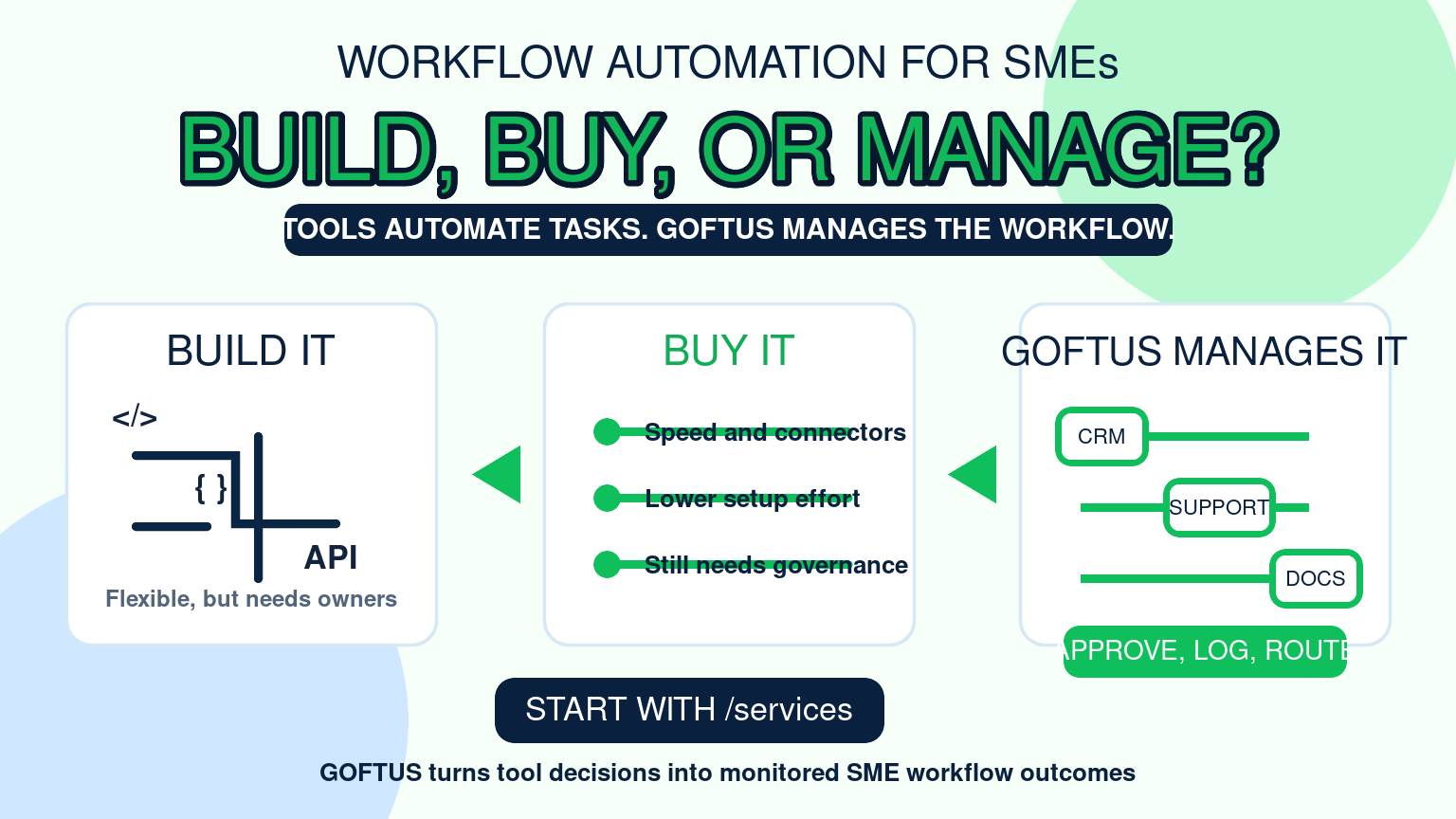
That is where GOFTUS positions workflow automation. Tools automate tasks. GOFTUS automates the workflow around the task. The practical answer is not always build or buy. Sometimes the right path is to use a proven tool like n8n, Zapier, Make, Bardeen, Gumloop, or a CRM platform, then put a managed GOFTUS workflow around the handoffs, human review, and measurement. If your team is comparing options, start with the GOFTUS /services page and map one workflow before adding another tool.
What this means for SMEs
The build option is attractive when the workflow is unusual, the data is sensitive, or the business logic gives the company a real advantage. A custom script can move records, scrape a portal, generate a report, or reconcile a document flow in ways a generic tool cannot. The risk is ownership. If one developer leaves, the team may be left with an undocumented automation that nobody trusts.
The buy option is attractive when the workflow is common. Lead routing, form capture, email follow-up, support triage, basic document processing, and spreadsheet updates often fit tools that already exist. SaaS platforms reduce build time, but they can create fragmented automation. The business feels automated until a customer asks why nobody followed up.
The managed workflow option sits between those extremes. GOFTUS can use existing tools where they are sensible, build custom connectors where the workflow needs them, and add human approval gates where AI or automation should not act alone. The business value comes from connecting those pieces into one monitored workflow with clear stop rules.
Hajikreena's view is simple: do not choose technology before you choose the operating model. Decide who owns the workflow, what success means, what can happen automatically, what needs approval, and what happens when the system is unsure. After that, the build, buy, or managed decision becomes much easier.
How to choose build, buy, or managed workflow automation
Use build when the workflow depends on proprietary logic, unusual data formats, or integrations that off-the-shelf platforms cannot support. Keep the scope narrow. Build one reliable workflow with documentation, alerts, and fallback instructions before expanding.
Use buy when the task is standard and the team mainly needs speed. If a tool already handles the trigger, action, and basic reporting, buying can be sensible. The buyer still needs to check permissions, data access, approval points, and how errors are surfaced.
Use GOFTUS managed workflow automation when the business needs an outcome across several tools. That might include CRM follow-up, customer support automation, document automation, reporting automation, AI agents, or browser-based workflow automation. GOFTUS can help decide which parts should be SaaS, which parts should be custom, and which parts need human review.
For many SMEs, the best first workflow is one with repeated pain and clear value: missed enquiries, slow quotes, repeated support questions, manual status reports, or staff copying data between systems. GOFTUS can turn that into a service map, then decide whether the fastest route is n8n, a custom connector, a CRM automation, an AI agent, or a lighter first step such as FAQ automation.
Competitor lens
Faculty AI, Deeper Insights, Waracle, Brainpool AI, LeewayHertz, Markovate, SoluLab, BairesDev, Addepto, STX Next, Netguru, and 10Clouds can all be useful partners for different AI or software projects. SaaS tools such as Zapier, n8n, Relevance AI, Lindy, Gumloop, Bardeen, Make, and Stack AI can also be excellent building blocks.
What competitors are missing in many SME projects is not capability. It is workflow ownership after the first automation goes live. A consultant may deliver a model or integration. A SaaS platform may automate a step. But the SME still needs exception handling, approval rules, handoff to CRM or support, change monitoring, user training, and monthly improvement. GOFTUS counter-positioning is practical: tools automate tasks. GOFTUS automates the workflow around the task.
That matters because AI is making small internal tools easier to create. The risk is that every team builds something different, without governance, logs, or a clear owner. GOFTUS helps turn that energy into a controlled operating system for the business.
What SMEs should do next
Start with one workflow that already costs time or loses opportunities. Write down the trigger, the tools involved, the human decisions, the data fields, the approval rules, and the output the business needs. Then ask three questions. Can a trusted SaaS tool handle this safely? Is there a custom step that creates real advantage? Does the workflow need GOFTUS to manage the handoffs, monitoring, and review?
If the workflow touches customers, payments, contracts, support replies, supplier portals, or regulated data, do not skip approvals and logs. If the workflow is mostly repeated questions, start with the GOFTUS FAQ automation service at /services#faq-automation. If the workflow involves AI agents or browser actions, review /agents before letting automation take action. If the workflow crosses several systems, /services is the better starting point.
A £100 Startup Kit diagnostic can help an SME pick the first workflow, estimate the effort, and avoid buying or building the wrong thing. The outcome should be a workflow map, not a vague AI roadmap.
Summery for SMEs
The build versus buy debate is useful, but incomplete. SMEs should decide based on workflow ownership, risk, repeatability, and measurement. Build when the workflow is unique. Buy when the task is standard. Ask GOFTUS to manage it when the outcome crosses CRM, support, documents, browser actions, approvals, and reporting. That is where workflow automation becomes operational rather than just another software decision.
FAQ
Should SMEs build workflow automation or buy software?
SMEs should build only where custom logic creates real advantage, buy where the task is standard, and use managed workflow automation when several tools and human approvals must work together.
Where does GOFTUS fit in the build versus buy decision?
GOFTUS helps SMEs map the workflow, choose sensible tools, add custom connectors when needed, and manage approvals, logs, exceptions, and improvement after launch.
What is the safest first workflow to automate?
Choose a repeated workflow with clear business value, such as missed enquiries, quote follow-up, support triage, repeated customer questions, reporting, or document processing.
Source notes
Direct article claims were not copied or treated as independently scraped statistics.