Sysadmins Trust AI Only When Workflows Stay Controlled
A hot sysadmin discussion and fresh AI-adoption survey point to the same SME lesson: AI earns trust when approvals, logs, and workflow ownership are built in.
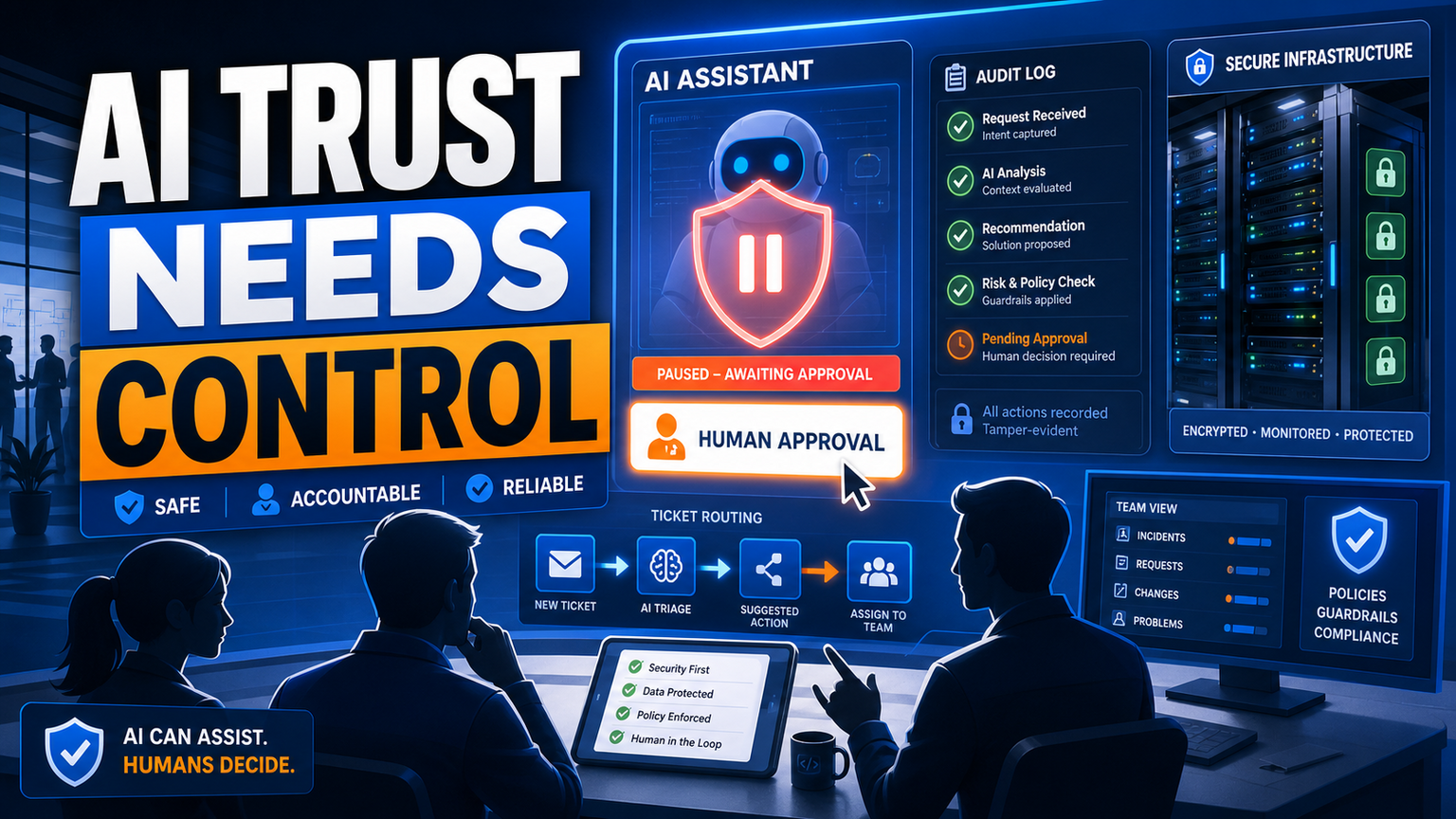
# Sysadmins Trust AI Only When Workflows Stay Controlled Meta description: A sysadmin AI trust discussion and fresh adoption survey show why SMEs need approvals, logs, and workflow ownership before scaling automation.
Sysadmins Trust AI Only When Workflows Stay Controlled
Meta description: A sysadmin AI trust discussion and fresh adoption survey show why SMEs need approvals, logs, and workflow ownership before scaling automation.
The signal is not that IT teams hate AI. It is that operators trust AI when it is bounded by clear workflow controls: what it can read, what it can change, who approves risky steps, where logs live, and how exceptions return to a human.
For SMEs in the US, UK, and Europe, that is the practical automation lesson. Do not buy another AI assistant and hope trust appears later. Build a narrow workflow first, connect it to the right systems, and make every action reviewable. GOFTUS helps teams do that through AI automation services at /services and agent workflow design at /agents.
What this means for SMEs
Sysadmins are usually the first people asked to make AI safe after the business has already adopted it. They see the messy middle: users pasting data into tools, AI-generated scripts being copied into production, vendors promising speed without explaining rollback, and executives asking why automation has not reduced workload yet.
That is why the trust debate matters. AI is useful for summarising tickets, drafting runbooks, classifying alerts, checking configuration notes, preparing customer responses, and routing repetitive requests. But in an operational environment, a helpful suggestion can become risky when it quietly turns into an action. A draft is different from a change. A recommendation is different from a command. A browser agent reading a portal is different from submitting a form.
SMEs should treat AI trust as workflow design, not model selection. The question is not only "which model is safest?" It is also "which step is allowed, which step needs approval, which system is the source of truth, and which log proves what happened?" That is the gap between a demo and a dependable operating system.
Hajikreena's view: IT teams will trust AI faster when business owners stop asking them to approve vague automation and start handing them controlled use cases. Pick one process, such as support triage, CRM follow-up, report preparation, document intake, or internal knowledge search. Define the input, permitted output, approval point, escalation rule, and success measure. Then improve the workflow every month.
AI trust is earned at the workflow layer. A small business does not need a giant governance programme before using AI, but it does need boundaries. The safest starting pattern is simple: AI drafts, classifies, searches, or recommends; a human approves meaningful changes; the system records what happened; exceptions become tasks for the right owner.
This approach is especially important for IT, security, and operations teams because their work touches credentials, customer data, finance records, infrastructure, and regulated documents. GOFTUS builds practical AI automation around those realities. Tools automate tasks. GOFTUS automates the workflow around the task.
Faculty AI, Deeper Insights, Waracle, Brainpool AI, LeewayHertz, Markovate, SoluLab, BairesDev, Addepto, STX Next, Netguru, and 10Clouds can all be useful partners for strategy, data science, application development, or enterprise delivery. SaaS tools such as Zapier, n8n, Relevance AI, Lindy, Gumloop, Bardeen, Make, and Stack AI can also automate important pieces of a process.
What competitors often miss for SMEs is ownership after the first automation works. Who reviews the AI output? Which employee can override it? What happens when the tool is down? Where does a rejected action go? How does the CRM, support desk, reporting sheet, or document store get updated without creating a second manual job?
GOFTUS counter-positions around the operating layer. We design the workflow, integrate the tools, add approval gates, keep logs visible, and make the process easier to maintain. That is why AI trust becomes a measurable habit instead of a one-off implementation.
What SMEs should do next
Start with an AI trust map for one workflow. Write down the steps where AI can safely help and the steps where it must stop. For example, an AI support workflow might classify a ticket, suggest an answer, check a knowledge base, and prepare a CRM note. It should not close the ticket, promise a refund, change account details, or submit a customer-facing response without the right approval.
Then add three controls. First, use a clear approval queue for decisions that affect customers, money, security, compliance, or production systems. Second, keep an action log that shows the source input, AI recommendation, human decision, and final system update. Third, create stop rules for low confidence, missing data, sensitive information, or unusual requests.
This is also where browser-based automation needs care. Many SME processes still live inside supplier portals, dashboards, admin panels, or legacy web apps. A browser agent can save time, but only if it has narrow permissions, login boundaries, visible logs, and human-approved submit actions. GOFTUS can help scope these agent workflows through /agents and broader workflow automation through /services.
If your team is stuck between "AI is risky" and "AI should save time", run a small diagnostic. Pick one repeated process, list the current handoffs, mark where trust breaks, and decide which approvals are needed. A GOFTUS consultation at /contact can turn that map into a practical build plan.
Should SMEs wait until AI is fully trusted before using it?
No. Waiting for perfect trust usually means the business keeps doing repetitive work manually while employees adopt unmanaged tools anyway. A safer approach is to start with narrow AI tasks that have human review, audit logs, and clear escalation. Use AI for drafts, classification, search, and routing first. Add actions only when the approval workflow is proven.
Where should AI not act alone?
AI should not act alone when the action changes money, customer commitments, credentials, legal terms, production systems, personal data, or regulated records. Those steps need a human decision, a log, and a rollback path. The goal is not to block AI. The goal is to let it prepare work while people remain accountable for meaningful outcomes.
What is the GOFTUS starting point?
GOFTUS usually starts by mapping one workflow and finding the safest automation wedge. That might be FAQ automation, support triage, CRM follow-up, reporting automation, document processing, or an internal knowledge assistant. From there, we add approvals, logs, integrations, and improvement cycles so the automation becomes trustworthy in daily work.