OpenAI's Small Business Program Shows SMEs Need Workflow Control
OpenAI's small business push shows why SMEs need workflow control, approval rules and CRM follow-up around AI tools, not more app sprawl today.
# OpenAI's Small Business Program Shows SMEs Need Workflow Control Meta description: OpenAI's small business push shows why SMEs need workflow control, approval rules and CRM follow-up around AI tools, not more app spra
OpenAI's Small Business Program Shows SMEs Need Workflow Control
Meta description: OpenAI's small business push shows why SMEs need workflow control, approval rules and CRM follow-up around AI tools, not more app sprawl today.
Quick answer
Direct retrieval of OpenAI's page was blocked in this cron run, so GOFTUS is treating the official item as a headline-level source signal and the article listing as a cross-check, not as a scraped full-text article.
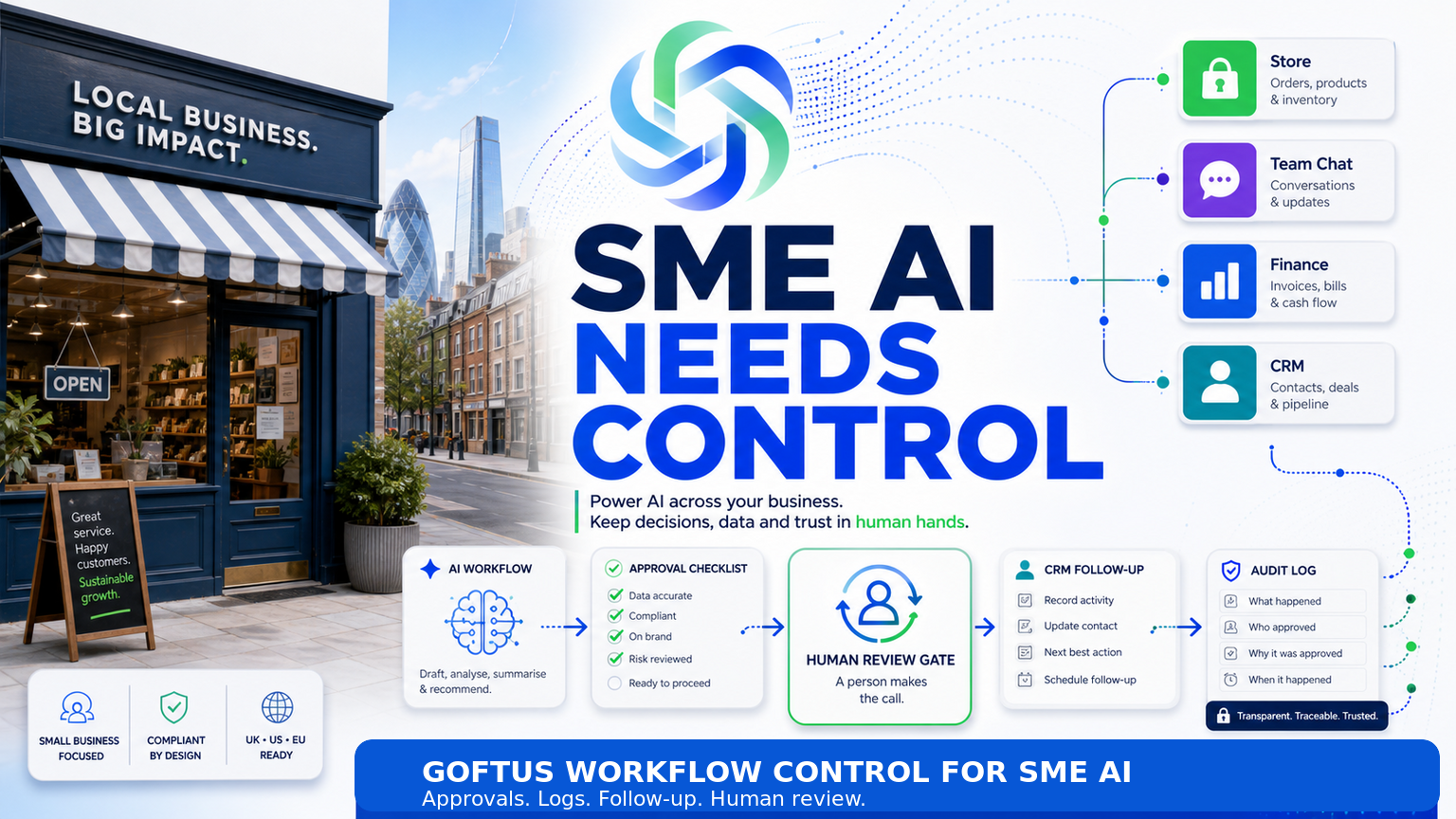
The business lesson is still clear for UK, US and EU SMEs. If frontier AI vendors are packaging more capability for small businesses, the hard part moves from access to control. A shop, agency, distributor, clinic or B2B service firm does not only need ChatGPT inside another app. It needs clear rules for who can ask the AI to act, what it can touch, when a person must approve, how leads are handed to CRM, and how unanswered work is reviewed each week.
Hajikreena's view: small businesses should welcome easier AI access, but they should not mistake app access for operational design. The winners will be the SMEs that turn AI into a controlled workflow system before every team member builds their own disconnected shortcut.
What this means for SMEs
OpenAI's small-business signal lands at the right time. Many SMEs already use chat, browser extensions, no-code automations, note takers, CRM add-ons and support tools. The problem is rarely a lack of AI. The problem is that the AI sits beside the process instead of inside a managed process.
A customer asks a question on the website. A sales lead arrives from a form. A supplier sends a PDF. A staff member asks ChatGPT to draft a reply. A manager checks Slack. Finance updates an invoice. Each step is useful, but the handoffs are often invisible. That is where mistakes happen: no owner, no audit trail, no follow-up, no escalation rule and no simple way to see what the AI changed.
For a small business, workflow control means turning AI into a series of safe lanes. One lane may summarise enquiries. Another may classify leads. Another may draft answers. Another may update CRM after approval. Another may prepare reports for a weekly review. The AI can be powerful, but the business should decide the route.
GOFTUS builds this around the work SMEs already do. That can include CRM/follow-up automation, support triage, document processing, reporting automation, internal knowledge assistants and AI agents that ask before acting. For businesses that are still early, a good starting point is the GOFTUS /services page, then a diagnostic conversation at /contact.
What operators should do next
First, pick one workflow rather than buying another general AI subscription for everyone. Choose something repeated, visible and measurable: inbound enquiries, proposal follow-up, support triage, invoice checking, meeting summaries or lead qualification.
Second, write the approval rule before writing the prompt. Decide which actions AI can only recommend, which actions it can draft, and which actions it can complete after a human review. This is especially important when AI touches customer records, payments, contracts, HR, supplier data or regulated information.
Third, connect the output to the next system of record. If an AI answer creates a sales opportunity, the next step should be CRM. If a support question is unresolved, the next step should be a ticket or owner. If a document is processed, the next step should be a logged exception list. AI without a handoff becomes another inbox.
Fourth, measure exception patterns, not only time saved. Useful review questions include: which questions did the AI not answer, which drafts needed heavy edits, which browser task stopped for approval, which CRM updates were rejected, and which customer journeys still required manual rescue?
This is also where terms such as browser with ai controls matter. A browser agent may help with repetitive web tasks, but it should run inside narrow boundaries: allowed sites, login rules, form-submit approvals, download limits, screen logs and stop rules. GOFTUS connects these controls to /agents and /services so automation can move from demo to dependable operation.
Competitor lens
The market is crowded for good reasons. Faculty AI, Deeper Insights, Waracle and Brainpool AI are visible UK options. LeewayHertz, Markovate, SoluLab and BairesDev are common US comparison points. Addepto, STX Next, Netguru and 10Clouds show the European services market. Zapier, n8n, Relevance AI, Lindy, Gumloop, Bardeen, Make and Stack AI can all help teams automate parts of the job.
Those tools and consultancies can be useful. The risk for SMEs is assuming the tool is the workflow. A connector can move data. A chatbot can answer. An agent can open a browser. A consultant can prototype. But the operator still needs ownership, exception handling, security boundaries, review rhythms and monthly improvement.
Tools automate tasks. GOFTUS automates the workflow around the task.
That difference matters when AI becomes part of customer operations. GOFTUS counter-positioning is practical: design the workflow, connect the systems, put approvals in the right place, monitor the exceptions, improve the automation each month and keep the business owner in control.
Summery for SMEs
OpenAI's small-business push is a useful signal because it makes AI access easier. It also raises the bar for execution. More AI in Shopify, Slack, finance tools or customer apps will not automatically create better operations. SMEs need a workflow layer that turns AI suggestions into controlled outcomes.
Start with one repeatable process. Add a clear owner. Define what the AI can read, draft, recommend and complete. Add human approval where risk is real. Send finished actions into CRM, support, finance or reporting systems. Review unanswered questions and failed automations every month.
If you want that path mapped before buying more tools, GOFTUS can help with a practical workflow diagnostic through /contact, or you can explore the core offers on /services and AI agent options on /agents.
FAQ
Is OpenAI's small business program enough on its own?
No. Easier access to ChatGPT can help teams draft, summarise and research faster, but SMEs still need workflow rules. The business should decide what AI can touch, who approves customer-facing work, and how outputs move into CRM, support or reporting systems.
Where should a small business start with AI workflow control?
Start with one repeated workflow that already costs time or creates missed follow-up. Inbound enquiries, support questions, proposal follow-up, document checking and weekly reporting are good candidates because the success criteria are visible.
How does GOFTUS help compared with a SaaS automation tool?
A SaaS automation tool can connect apps or run a task. GOFTUS designs the surrounding operating system: workflow mapping, approvals, integrations, exception handling, human review, measurement and improvement so the automation keeps working in the real business.
Source notes
Several other Reddit feeds returned 429 rate limits, so Reddit is used as a supporting social context rather than a confirmed news source.