OpenAI Research Signal Shows SMEs Need Proof Workflows Before AI Agents Act
OpenAI research signals show why SMEs need proof workflows, approvals, audit logs, and browser controls before AI agents act.
# OpenAI Research Signal Shows SMEs Need Proof Workflows Before AI Agents Act Meta description: OpenAI research signals show why SMEs need proof workflows, approvals, audit logs, and browser controls before AI agents ac
OpenAI Research Signal Shows SMEs Need Proof Workflows Before AI Agents Act
Meta description: OpenAI research signals show why SMEs need proof workflows, approvals, audit logs, and browser controls before AI agents act.
That is enough to treat this as a serious research signal, not as proof that every business process is ready for autonomous AI.
For SMEs in the UK, US, and Europe, the lesson is practical. Stronger models may produce better plans, proofs, code, analysis, and recommendations. They still need a workflow that verifies evidence, decides when a human must approve, records why an action was taken, and limits what an agent can do inside live systems. GOFTUS helps turn that gap into operating design: /services for workflow automation, /agents for agentic systems, and browser with ai controls when an AI has to work through web tools.
What this means for SMEs
Most business owners will not use frontier research models to solve open mathematics problems. They will use the same capability curve in quieter places: proposal checks, supplier analysis, spreadsheet reconciliation, support triage, document extraction, sales follow-up, and browser-based admin work. The risk is not that AI gets smarter. The risk is that a smarter AI is placed inside a weak workflow and starts producing confident actions without evidence gates.
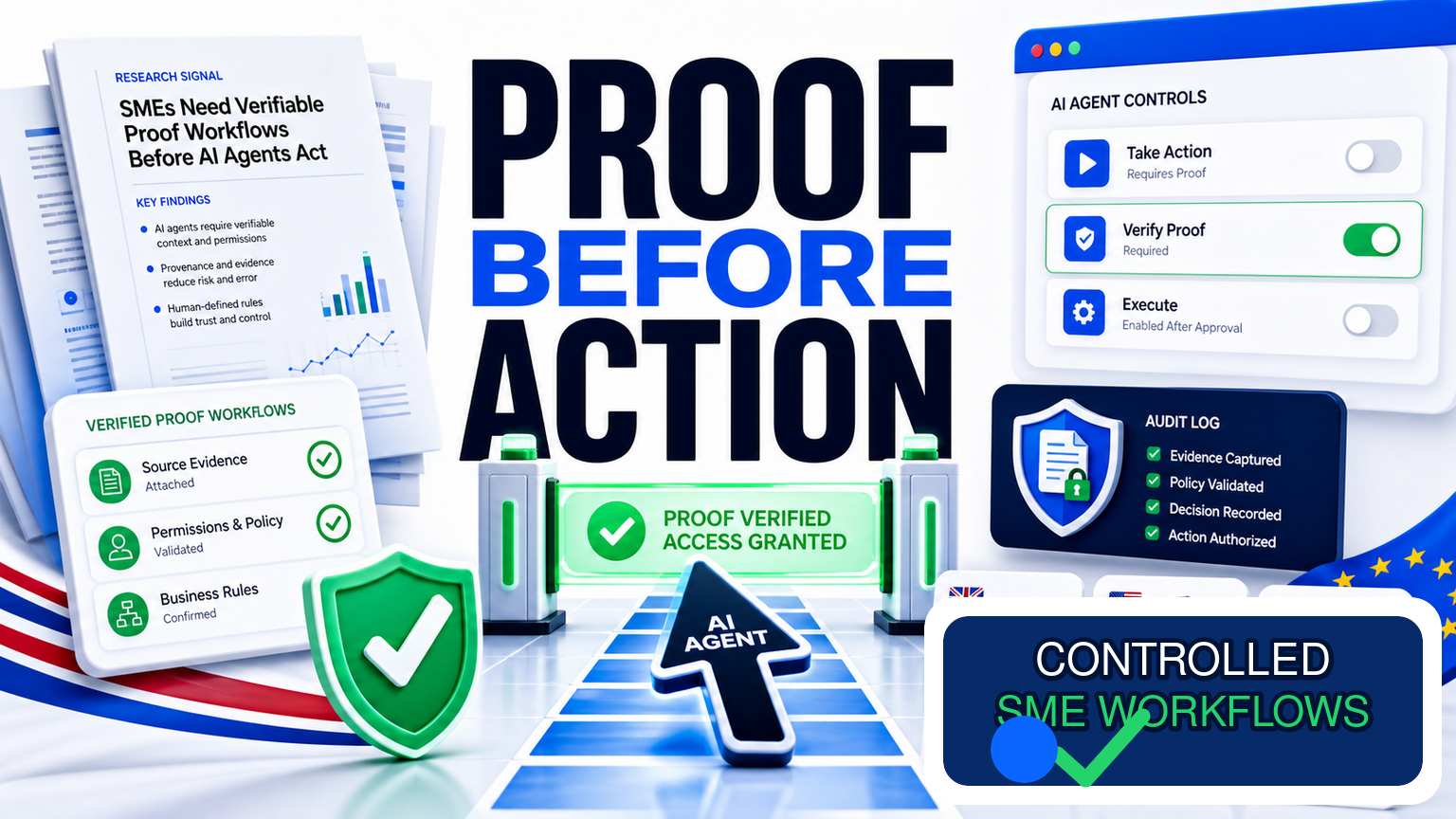
The OpenAI signal matters because it points toward models that can explore alternatives, prepare arguments, and generate work that looks finished. In a business setting, that can be useful only if the company defines what counts as accepted proof. A support answer might need source links from the knowledge base. A CRM update might need a matching email thread. A finance workflow might need a human approval before any portal submission. A browser agent might need allowed domains, blocked fields, pause points, and action logs.
This is where many SMEs should shift the question from "which AI tool is best?" to "which workflow can safely absorb better AI?" If a model improves next month, the workflow should become more useful, not more dangerous. That requires reusable rules, owner review, exception queues, and measurements around outcomes such as response time, missed leads, manual rework, and unresolved questions.
Thirumurugan's view is simple: AI that can reason through harder research problems still needs business proof before it touches customer, finance, CRM, or browser actions. A breakthrough model does not automatically know your policy, margin, customer promise, region-specific regulation, or acceptable risk level.
SMEs should build a proof workflow around any AI agent. Start with one narrow job, such as reading incoming support questions and drafting the next best reply. Add evidence requirements, approval gates, and a route for exceptions. Then connect the workflow to CRM, support, documents, or browser actions only after the checks are stable. For browser-based work, link the design to /agents and /services so the agent is treated as part of the operating system, not as a free-roaming assistant.
Tools automate tasks. GOFTUS automates the workflow around the task.
SaaS tools such as Zapier, n8n, Relevance AI, Lindy, Gumloop, Bardeen, Make, and Stack AI are useful for connecting apps and launching automations. Consultancies such as Faculty AI, Deeper Insights, Waracle, Brainpool AI, LeewayHertz, Markovate, SoluLab, BairesDev, Addepto, STX Next, Netguru, and 10Clouds can also help teams build AI systems. The missing piece for many SMEs is not a connector or a model demo. It is ownership of the full workflow.
GOFTUS counter-positions around the controls that make automation usable after launch: who reviews outputs, which systems can be touched, what evidence is required, where errors are logged, how exceptions reach staff, and how the workflow improves each month. A model that can prepare a strong proof is impressive. A business process that can prove why an AI action was allowed is what operators can actually trust.
What SMEs should do next
First, list the workflows where AI already drafts, recommends, or clicks. Include unofficial usage by staff, not just approved tools. Second, mark the step where the output becomes a business action: a customer reply, a CRM update, a refund decision, a supplier message, a browser submission, or a management report. Third, define the proof needed before that action is accepted.
For many teams, the starting point is not a large AI transformation programme. It is a small diagnostic: one workflow, one owner, one approval rule, one exception queue, and one log that shows what happened. GOFTUS can help map that through /contact, then turn it into an automation plan across /services, /agents, and browser with ai controls where web tools are part of the process.
If the business already uses AI for answers, the next improvement is often FAQ automation or support triage. If it uses AI for research, the next improvement is source verification and report approval. If it uses AI agents, the next improvement is permission design, stop rules, and browser boundaries. The common pattern is the same: better AI increases the value of workflow control.
The direct OpenAI article page returned 403 during retrieval, so this article does not claim direct article scraping.
Should SMEs wait for frontier models before automating?
No. SMEs can start with current tools if they design the workflow properly. The proof, approval, logging, and exception design will still matter when stronger models arrive.
Where does browser with ai controls fit?
It fits when an AI agent needs to work inside browser-based systems that do not have clean APIs. GOFTUS designs those workflows with limited permissions, human approval, logs, and stop rules through /agents and /services.