OpenAI Presence Shows Voice Agents Need Workflow Guardrails
OpenAI Presence signals why SMEs need clear workflow guardrails, approvals, logs and handoffs before voice agents speak or act for the business.
# OpenAI Presence Shows Voice Agents Need Workflow Guardrails Meta description: OpenAI Presence signals why SMEs need clear workflow guardrails, approvals, logs and handoffs before voice agents speak or act for the busi
OpenAI Presence Shows Voice Agents Need Workflow Guardrails
Meta description: OpenAI Presence signals why SMEs need clear workflow guardrails, approvals, logs and handoffs before voice agents speak or act for the business.
Quick answer
OpenAI Presence is being reported as a new enterprise platform for realtime voice agents and chatbots.
The practical lesson for UK, US and EU SMEs is not that every business should rush into voice AI. The lesson is that AI agents are moving closer to customer conversations, sales qualification, support triage and internal service desks. Once an agent can speak in real time, the workflow around that agent matters more than the model demo.
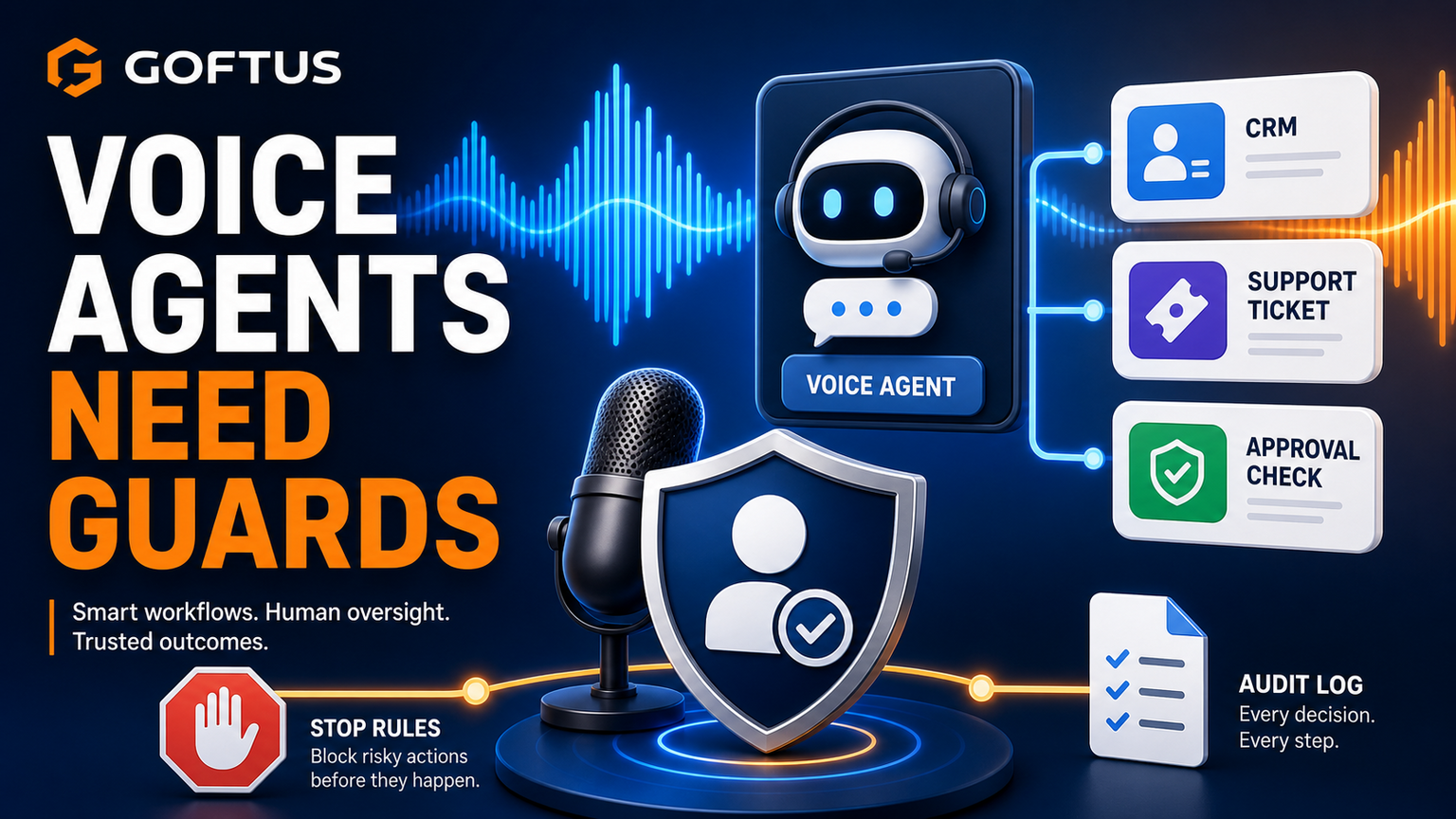
GOFTUS helps businesses design that workflow through AI agent delivery and wider automation services: narrow use cases, approved answer sources, escalation rules, logs, CRM or support handoff, and human approval before risky commitments.
What this means for SMEs
Voice agents can be useful when the task is repetitive, time sensitive and easy to route. A customer calls to ask booking steps. A lead wants to know which documents are needed. A tenant asks for an update. A staff member needs a status summary from a service desk. In each case, a voice or chat agent could collect details, answer known questions, and pass the right record to the right system.
But SMEs should not confuse a smoother conversation with a safer operation. A speaking agent can create risk faster than a back-office automation because customers may treat the answer as a promise. If the agent invents a price, misreads a policy, offers unsupported advice, or fails to flag a complaint, the business inherits the problem.
The useful design starts before the first call. Decide what the agent may answer, which sources it may use, when it must stop, and what counts as an escalation. Then define what happens after the conversation: CRM update, support ticket, follow-up task, internal notification, summary for review, or unanswered-question report. That is where the value sits.
This is also why voice agents should connect with existing customer-answer systems. A business that already has FAQ automation, support triage and clean CRM follow-up is in a better position to test realtime agents. The approved answers exist. The routing rules exist. The review habit exists. Without that base, a voice agent becomes another disconnected tool.
Bharatvaj's view
Bharatvaj's view is that OpenAI Presence should make SMEs ask a control question, not a novelty question. The question is not, can an AI sound human? The question is, what is it allowed to do on behalf of the business?
For many SMEs, the first safe version should not close deals, resolve complaints or change records without review. It should collect context, answer low-risk questions, draft next steps, and route exceptions. If confidence is low, if the customer asks for a commitment, if regulated advice appears, or if the conversation becomes sensitive, the agent should stop and hand over.
That might sound cautious, but it is how businesses get durable automation. A controlled agent that handles narrow work every day is more valuable than a flashy agent that staff do not trust. GOFTUS would rather help an SME launch one measured voice-agent lane than ten experimental scripts with no owner.
Competitor lens
The market already offers useful pieces. Zapier, n8n, Make, Bardeen, Gumloop, Lindy, Relevance AI and Stack AI can connect tools and trigger actions. Consulting firms such as Faculty AI, Deeper Insights, Waracle, Brainpool AI, LeewayHertz, Markovate, SoluLab, BairesDev, Addepto, STX Next, Netguru and 10Clouds can support wider AI projects.
GOFTUS does not position against those options by pretending tools are unnecessary. Tools automate tasks. GOFTUS automates the workflow around the task. For voice agents, that workflow includes answer governance, caller intent capture, approval gates, CRM and support handoff, audit logs, review dashboards and improvement loops.
That distinction becomes important as vendor platforms move from chat boxes into realtime customer and employee conversations. Buying the agent is the easy part. Owning the operating model is the part that protects the business.
What SMEs should do next
Start with one conversation type. Choose a lane such as appointment questions, lead qualification, delivery updates, document checklists, internal helpdesk intake, or first-line support. Avoid broad instructions like answer customer calls. Narrow lanes are easier to test, easier to approve and easier to improve.
Next, prepare the source material. Use approved FAQs, service pages, policy snippets, CRM fields, knowledge-base articles and staff notes. If the business does not know where the answer should come from, the agent should not improvise.
Then design the handoff. Every conversation should end with a clear record: what was asked, what was answered, what was uncertain, which system was updated, and who owns the next step. For browser-based systems where no API exists, a later phase may use browser with ai controls, but only with login boundaries, human-approved actions and visible logs.
Finally, review unanswered and escalated conversations weekly. Those gaps show where the knowledge base, FAQ automation, support process or CRM workflow needs improvement. GOFTUS can help through AI agent workflows, AI automation services, and a practical consultation via /contact.
FAQ
Is OpenAI Presence confirmed as a voice-agent platform?
Direct OpenAI page access was blocked during this run, so this article uses the official listing as a headline-level source signal and the accessible news coverage as cross-checking.
Should small businesses use voice agents now?
Some should test them in narrow lanes, but not as open-ended replacements for staff. Good candidates include repeated intake, simple qualification, appointment questions and internal helpdesk triage. Riskier areas need human review, especially pricing promises, complaints, contracts, regulated advice and sensitive personal data.
How does GOFTUS make AI agents safer?
GOFTUS maps the workflow before deployment: allowed data, approved answer sources, stop rules, escalation triggers, CRM or support handoff, audit logs and review cadence. The goal is not only to launch an agent. The goal is to make the agent useful, measurable and trusted by the people who run the business.
Summery for SMEs
OpenAI Presence is another signal that AI agents are moving from passive chat into live business conversations. SMEs should respond by building guardrails before autonomy: narrow lanes, approved sources, human approval, clean handoff, logs and weekly review. Voice agents can help, but only when the workflow around the voice is owned.
Source notes
The Register page was directly accessible and framed Presence as OpenAI trying a consulting style path for deploying agents. GOFTUS framing connects the signal to SME workflow ownership, AI agents, customer support automation and browser-based controls.