OpenAI Partner Signals Show AI Security Needs Workflow Owners
OpenAI partner signals show SMEs why AI security now needs workflow owners, approval gates, action logs and practical automation handoffs today.
# OpenAI Partner Signals Show AI Security Needs Workflow Owners Meta description: OpenAI partner signals show SMEs why AI security now needs workflow owners, approval gates, action logs and practical automation handoffs
OpenAI Partner Signals Show AI Security Needs Workflow Owners
Meta description: OpenAI partner signals show SMEs why AI security now needs workflow owners, approval gates, action logs and practical automation handoffs today.
OpenAI partner ecosystem news is a useful signal for UK, US and EU SMEs because it shows enterprise AI is moving from model access into implementation, security and operations. Reco's 30 July 2026 announcement that it was named an OpenAI Select Partner for enterprise AI security is not just a vendor badge story. It points to the next buyer question: who owns the workflow after the AI tool is connected?
Reddit feeds were partly rate-limited, so this is treated as adjacent operator context, not confirmed market data. Together, the signals match what GOFTUS sees in SME automation work: teams do not only need more AI access. They need policy checks, approvals, logs, handoffs and review loops around every AI action.
What this means for SMEs
For small and mid-sized businesses, AI security can sound like a large-enterprise problem. It is not. The practical issue appears as soon as an AI assistant can read customer messages, draft replies, update a CRM, change a record, browse a supplier portal or prepare a finance document. The risk is rarely that the model is mysterious. The risk is that nobody has designed the workflow around the model.
That workflow should answer simple questions. Which sources can the AI read? Which fields can it update? When does a human approve? What happens when confidence is low? Where is the action logged? Who reviews recurring exceptions each month? These questions are operational, not academic.
GOFTUS helps SMEs start with a narrow workflow rather than a broad AI rollout. A support triage workflow might let AI classify tickets, suggest answers and prepare CRM notes, while requiring approval before a sensitive reply is sent. A sales workflow might summarize inbound leads and draft follow-ups, while keeping discounting, promises and contract language under human control. A browser workflow might let an agent collect data from a portal, while blocking final submit actions until a person checks the record. That is why /agents and /services matter more than another standalone dashboard.
Bharatvaj's view is that enterprise AI security is becoming a delivery discipline. The model provider, SaaS vendor or consultant can help with important pieces. But an SME still needs one accountable owner for how AI moves through the business.
That owner does not have to be a full-time AI specialist. In many companies it is the operations lead, founder, support manager, finance manager or delivery owner. Their job is to keep the workflow understandable. They decide the allowed inputs, outputs, handoffs and escalation rules. They know when a customer question needs a human, when a browser action needs approval, and when an automation should stop instead of guessing.
This is also where AI security becomes measurable. Instead of asking whether the business is using AI, ask whether repeated actions are logged, exceptions are reviewed, and approvals are visible. Ask whether the team can explain what happened when an AI tool touched a customer record. Ask whether a workflow can be paused without breaking the business. These are the controls that make AI useful rather than risky.
What competitors are missing
The competitor market is busy for good reasons. UK firms such as Faculty AI, Deeper Insights, Waracle and Brainpool AI can help with AI strategy, models and delivery. US firms such as LeewayHertz, Markovate, SoluLab and BairesDev often build custom systems. European teams such as Addepto, STX Next, Netguru and 10Clouds bring engineering depth. SaaS tools such as Zapier, n8n, Relevance AI, Lindy, Gumloop, Bardeen, Make and Stack AI can automate many steps quickly.
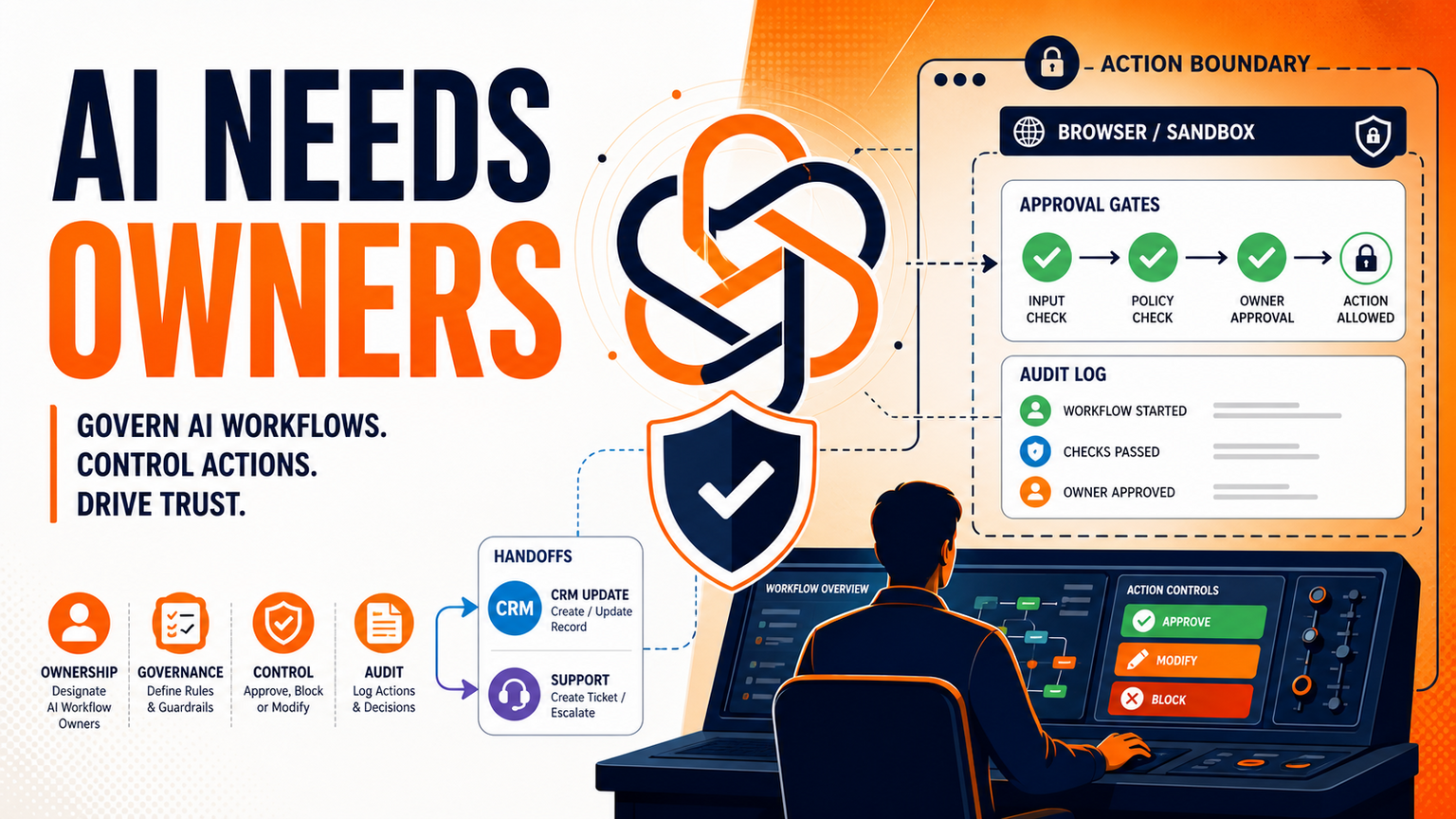
The gap for SMEs is the workflow around the step. Tools automate tasks. GOFTUS automates the workflow around the task. That means the approval gate, the exception queue, the CRM update, the support handoff, the browser boundary, the reporting view and the monthly improvement loop are designed together.
This is not an attack on tools or consultants. They can be useful. The mistake is assuming that buying one is the same as owning the business process. GOFTUS counter-positions around practical workflow ownership: define the action, limit the permission, log the result, route the exception and improve the workflow after real use.
What SMEs should do next
Start with one workflow where AI is already tempting the team. Good candidates are customer support triage, lead follow-up, document intake, meeting summary distribution, invoice checks, reporting updates, or browser-based admin tasks where there is no clean API. Then map five layers before connecting more software.
First, define the source of truth. The AI should not answer from scattered files, old emails and half-remembered policies unless those sources are cleaned or fenced. Second, define the action boundary. Reading, drafting and summarizing are different from sending, submitting and changing records. Third, define the approval gate. Some actions can be automatic, some need review, and some should stay manual. Fourth, define the log. A manager should see what the AI touched, what it suggested and what a person approved. Fifth, define the improvement loop. Every unanswered question, failed handoff or blocked action should make the workflow better.
GOFTUS can help with this through practical AI automation, agentic workflows, support triage, CRM automation, document automation and browser action controls. If the first risk is customer answers, start with the FAQ automation service at /services#faq-automation. If the risk is agents taking action across tools, start with /agents. If the team needs a diagnostic before choosing a build path, use /contact and ask for a workflow review.
The fresh OpenAI partner signal matters because it shows AI adoption is becoming an implementation and security problem, not only a model selection problem. SMEs should not respond by buying every new tool. They should choose one repeated workflow, appoint an owner, define permissions, add approval gates, log actions and review exceptions. That is how AI becomes a safer operating system for the business.
Is this confirmed OpenAI product news?
No. The main source is a Reco announcement that Google News and GlobeNewswire listed on 30 July 2026. It is a partner ecosystem signal, not a new OpenAI product launch.
Why does GOFTUS care about a partner badge?
Because it shows the market is moving toward implementation, controls and security. SMEs need those controls designed around their own workflows.
Where should a small business start?
Start with one workflow where AI touches a customer, record, document or browser task. Keep approvals and logs visible before expanding.
Primary source: GlobeNewswire, "Reco Named an OpenAI Select Partner", listed 30 July 2026 and directly accessible during this run.