OpenAI's Cars24 Signal Shows Support AI Needs Workflow Control
OpenAI's Cars24 signal shows SMEs that support AI only works when answers, approvals, CRM follow-up, logs and workflow controls stay connected.
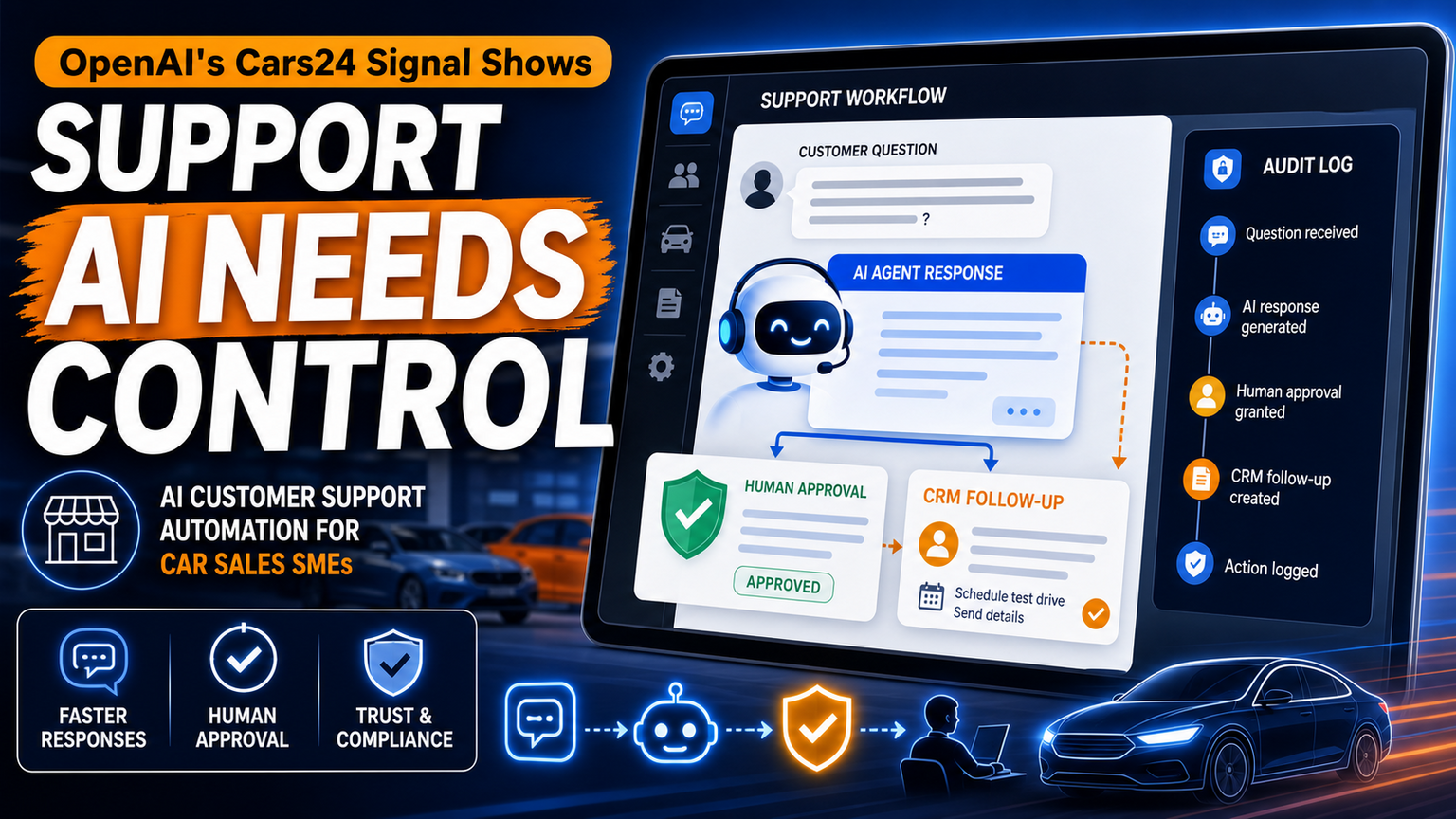
# OpenAI's Cars24 Signal Shows Support AI Needs Workflow Control A fresh r/artificial RSS discussion titled "I thought AI would reduce my mental load" and another popular operator-style thread about founders using AI to
OpenAI's Cars24 Signal Shows Support AI Needs Workflow Control
A fresh r/artificial RSS discussion titled "I thought AI would reduce my mental load" and another popular operator-style thread about founders using AI to do the wrong work quickly both show the tension SME leaders are feeling. AI can reply faster, draft faster and route faster, but the business still needs to decide what should happen next.
Thirumurugan's view is that support AI should not be bought as a faster inbox alone. It should be designed as a support workflow: approved answers, customer context, escalation rules, CRM updates, human review, reporting and monthly improvement. That is where GOFTUS connects AI automation, AI agents, CRM follow-up and workflow automation services into one practical system.
What this means for SMEs
For UK, US and EU SMEs, customer support is often the first place AI feels useful. The questions repeat. The inbox is noisy. Website visitors ask about availability, pricing, delivery, onboarding, documents, account access or refunds. A tool that drafts a response looks like an obvious win.
The risk is that speed hides missing process. If an AI agent answers a question but does not update CRM, the sales team may still miss the lead. If it promises something outside policy, the support team inherits a bigger problem. If it cannot recognise regulated, legal, medical, finance or complaint language, the business may need a human in the loop before any answer is sent.
That is why GOFTUS starts with a narrow workflow map. What questions can be answered automatically? Which answers need approval? What customer details should be captured? Which messages should become tickets, CRM notes or tasks? Where should the audit log live? What should the system do when it is uncertain?
The Cars24 signal matters because car sales support is not a toy example. It involves product information, customer intent, follow-up, appointments and trust. Even when a business is not selling cars, the same pattern appears in professional services, ecommerce, local services, B2B sales, SaaS onboarding and operations teams.
The useful question is not "Can AI answer customers?" The useful question is "Can AI answer the right customers in the right way, then move the work to the right place?" That is the difference between a demo and a workflow.
If support AI is on your roadmap, do not begin with a generic chatbot brief. Begin with the customer journey around the answer. Pick one queue or website path where repeated questions are common and business risk is manageable. Write the approved answer set. Define exceptions. Decide which fields should update in CRM or a support desk. Decide which answers need a human approval step.
A practical GOFTUS build might start with three layers. First, an AI FAQ automation layer answers repeated public questions and captures lead intent. Second, an AI support triage layer classifies messages, drafts replies and routes edge cases to the right person. Third, an AI agent workflow uses browser or API actions only when the action is bounded, logged and approved.
This prevents the common failure mode seen in many AI adoption projects: a business adds a clever tool, then people still copy information between tabs, chase missing context and manually check whether the answer created follow-up work.
A good support workflow should produce evidence. How many repeated questions were answered? How many needed escalation? Which topics are still unclear on the website? Which enquiries became CRM opportunities? Which replies were edited by humans? Those signals help the business improve every month instead of simply adding another AI subscription.
What SMEs should do next
Start with the top twenty support or pre-sales questions from your website, inbox, chat logs and sales calls. Mark each one as safe for automation, safe with approval, or human only. Create plain-English answer rules and stop rules. Then connect the workflow to the place your team already works: HubSpot, Airtable, Google Sheets, Notion, a helpdesk, email, Slack, Teams or a custom admin panel.
Next, decide what must be measured. A small business does not need a giant AI governance programme to start safely. It does need simple logs: question asked, answer source, confidence, action taken, owner, status and follow-up result. GOFTUS often turns this into a lightweight dashboard or reporting automation so leaders can see whether support AI is reducing leakage, not just creating prettier replies.
If browser actions are needed, such as checking a portal, updating a ticket or booking a slot, use the same control logic. Narrow the domain, protect logins, avoid unnecessary data exposure, require approval before submission and log the action. That connects naturally to GOFTUS agentic workflow design rather than uncontrolled browser automation.
The market has useful options. Zapier, Make, n8n, Bardeen, Gumloop, Lindy, Relevance AI and Stack AI can automate pieces of the support journey. Consultancies such as Faculty AI, Deeper Insights, Waracle and Brainpool AI in the UK, LeewayHertz, Markovate, SoluLab and BairesDev in the US, and Addepto, STX Next, Netguru and 10Clouds in Europe can help larger teams explore AI systems.
The GOFTUS counter-positioning is narrower and more operational: Tools automate tasks. GOFTUS automates the workflow around the task.
That means the support answer is only one component. GOFTUS also designs the approval gate, CRM update, exception route, reporting loop, document handoff, FAQ improvement path and human owner. For SMEs, that matters because the result must survive Monday morning, not just a demo call.
Is support AI safe for small businesses?
Yes, if it is scoped around approved answers, escalation rules and clear ownership. Avoid letting AI handle sensitive exceptions without review. Start with repeated, low-risk questions, then expand once logs show the workflow is reliable.
Should SMEs use FAQ automation or a support agent first?
Many should start with FAQ automation because it is visible, limited and measurable. Use FAQ automation service to answer repeated website questions, then connect qualified enquiries to CRM or support follow-up.
Where do AI agents fit?
AI agents fit after the answer workflow is clear. They can check systems, draft follow-ups or move information across tools, but the business should define approval steps, stop rules and logs before agents take action.
These are treated as social discussion signals, not verified market statistics.