Open Weight AI Debate Shows SMEs Need Vendor Control Workflows
Open-weight AI debate shows SMEs need vendor choice, approval gates, audit logs, and workflow controls before model access becomes policy risk.
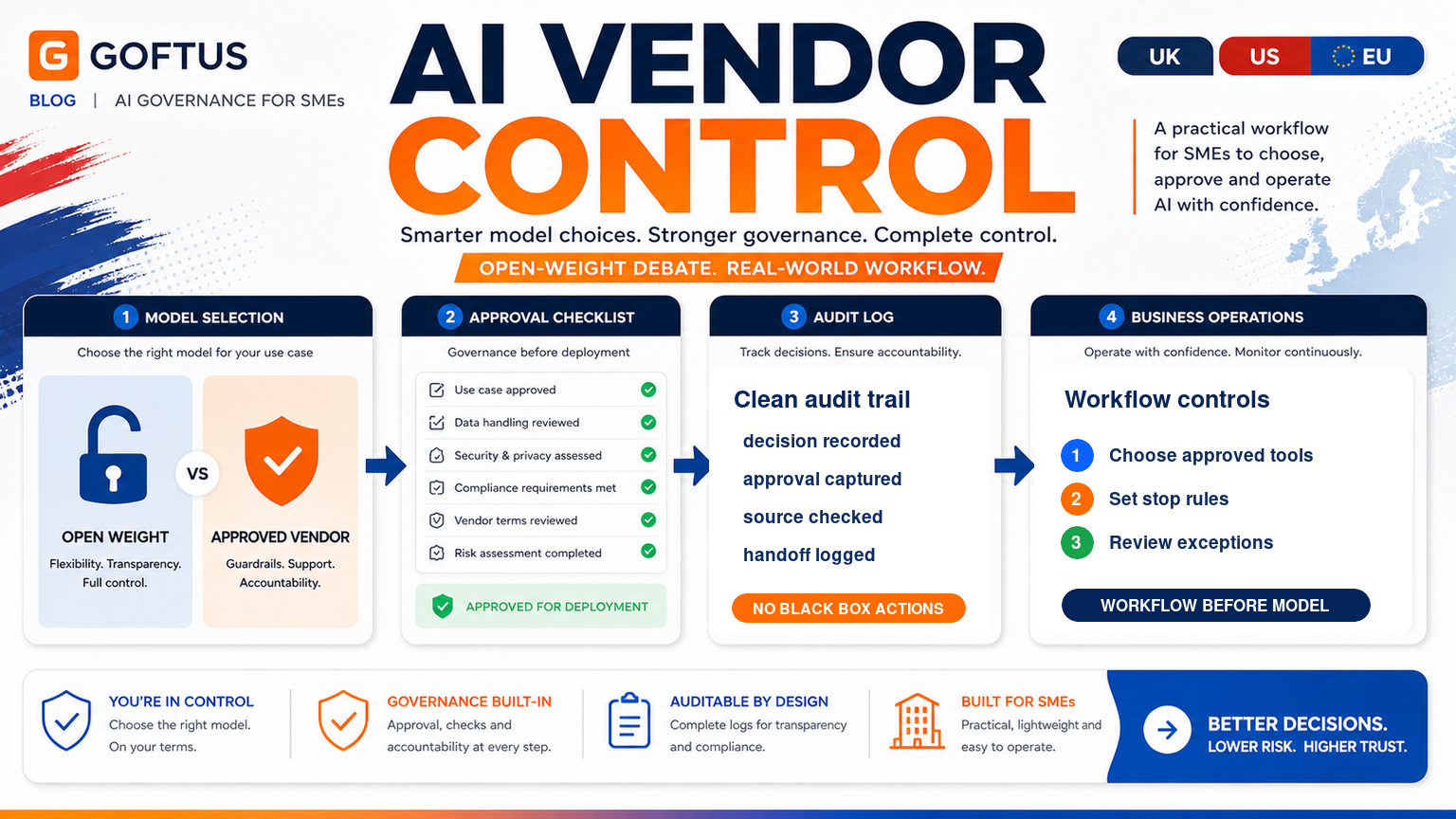
# Open Weight AI Debate Shows SMEs Need Vendor Control Workflows # Quick answer A fresh AI policy debate is putting model choice back into the business agenda. Reddit's r/Anthropic hot feed also surfaced a same-day dis
Open Weight AI Debate Shows SMEs Need Vendor Control Workflows
Quick answer
A fresh AI policy debate is putting model choice back into the business agenda. Reddit's r/Anthropic hot feed also surfaced a same-day discussion titled "Anthropic refuses to sign letter supporting Open weight models," and Hacker News showed a high-activity Axios discussion about OpenAI and Anthropic positions on open models. Direct article access was mixed from this cron environment, so this post treats the signal as headline-level news and social discussion evidence rather than a full scrape of every source.
For SMEs in the UK, US, and EU, the useful lesson is not that one model strategy wins forever. Bharatvaj's view is that businesses need a vendor-control workflow before they depend on any frontier model, open-weight model, or hosted AI platform. The same company may need a secure hosted model for finance, a portable open-weight model for internal documents, and browser with ai controls for approved web tasks. The risk is choosing by hype instead of use case, data boundary, approval need, and exit plan.
What this means for SMEs
The open-weight debate can sound like a policy fight between giant AI companies, chip firms, cloud providers, and regulators. Operators feel it in simpler terms. Can the business still run if a vendor changes access? Can sensitive files stay inside an approved environment? Can staff test a second provider without rebuilding every automation? Can a customer-facing workflow prove which model produced which answer?
Those questions matter because AI is moving from experiments into operations. A small firm may use AI to draft support replies, qualify sales leads, read supplier documents, reconcile CRM records, or prepare reporting packs. If those workflows are wired directly into one model with no approval layer, the business inherits every pricing, policy, availability, and compliance change from that provider.
GOFTUS designs AI automation through /services and AI agent workflows through /agents so the model is only one component. The workflow around the model decides what data is available, which action is allowed, when a person reviews the result, and how exceptions are logged. That is the difference between adopting AI and becoming dependent on a black box.
Why vendor choice needs workflow design
Open-weight models can help with portability, inspection, local deployment, and negotiating leverage. Hosted frontier models can help with capability, speed, managed infrastructure, and support. SaaS agent tools can help teams move quickly. None of those choices removes the need for business controls.
A practical SME should map each AI use case into four buckets. First, data sensitivity: public FAQ, customer details, finance records, HR files, regulated documents, or browser login sessions. Second, action risk: draft only, update CRM, send an email, submit a form, move money, or change a customer record. Third, review need: no review, sample review, approval before send, or manager approval. Fourth, fallback route: another model, manual queue, support desk, or pause rule.
Once that map exists, vendor selection becomes less emotional. A team may run low-risk FAQ drafting on one tool, document classification through a private workflow, and browser-based workflow automation only with human-approved browser actions. This also makes it easier to compare OpenAI, Anthropic, Google DeepMind, Microsoft, NVIDIA-linked ecosystems, Mistral, Hugging Face, Perplexity, xAI, and open model options without rewriting the operating process each month.
What SMEs should do next
Start with one workflow that already costs time every week. Good candidates are repeated customer questions, sales follow-up, document intake, reporting, CRM enrichment, support triage, or supplier email handling. Write down what the AI can read, what it can draft, what it can change, and what it must never do without approval.
Then create a vendor-control checklist. Include approved tools, allowed data categories, prompt storage rules, model fallback options, user permissions, browser login boundaries, stop rules, exception routing, and audit logging. If a workflow uses browser automation, add a clear rule that the system can prepare or navigate but a human approves sensitive submit, purchase, bind, delete, or send actions.
The best early implementation is usually boring and measurable. Capture the request, classify it, draft the response or next action, route uncertain cases to a person, update the system of record, and review missed questions weekly. That pattern connects naturally to GOFTUS /services, /agents, /questions, and /contact because it turns AI from a model choice into a managed workflow.
Summery for SMEs
Open-weight AI is a useful option, not a complete operating model. Hosted AI is also useful, but it should not own the process. SMEs should build vendor-control workflows that make model choice replaceable, approvals visible, and exceptions reviewable.
A good AI workflow should answer five questions before deployment: what data can the model see, what action can it take, who approves risky steps, where does the audit trail live, and what happens if the chosen vendor is unavailable or no longer suitable. If the business cannot answer those questions, switching models will not fix the risk.
Competitor lens
Faculty AI, Deeper Insights, Waracle, Brainpool AI, LeewayHertz, Markovate, SoluLab, BairesDev, Addepto, STX Next, Netguru, and 10Clouds can all be useful partners for larger AI strategy or delivery. SaaS tools such as Zapier, n8n, Relevance AI, Lindy, Gumloop, Bardeen, Make, and Stack AI can also automate individual steps quickly.
GOFTUS takes a workflow-first position for SMEs: Tools automate tasks. GOFTUS automates the workflow around the task. That means model choice, approvals, logging, fallback routes, CRM/support handoffs, document boundaries, and monthly improvement are designed together instead of bolted on after a tool is already live.
FAQ
Should SMEs avoid open-weight AI models? No. Open-weight models can be valuable for portability, inspection, and data-control use cases. The safer question is which workflow deserves which model and which approval rules must surround it.
Should SMEs avoid hosted frontier AI? No. Hosted models can be powerful and convenient. The business should still protect sensitive data, define approval gates, log decisions, and keep a fallback plan.
Where does browser with ai controls fit? Browser controls matter when AI helps with tasks inside web apps. GOFTUS treats browser actions as workflow automation with login boundaries, human approvals, logs, and stop rules, not as unsupervised clicking.
How can GOFTUS help? GOFTUS can review one current workflow, identify vendor and data risks, design the approval path, and build a practical automation through /services or /agents. For teams unsure where to start, /contact is the right place to request a lightweight diagnostic.
Source notes
X was not used because xurl is not installed in this cron environment.