Notion Agents Show Why SME Workflows Need Owners
Notion's AI agent push shows SMEs need workflow owners, approvals, logs and CRM handoffs before agents act across business tools.
# Notion Agents Show Why SME Workflows Need Owners Meta description: Notion's AI agent push shows SMEs need workflow owners, approvals, logs and CRM handoffs before agents act across business tools. ## Quick answer No
Notion Agents Show Why SME Workflows Need Owners
Meta description: Notion's AI agent push shows SMEs need workflow owners, approvals, logs and CRM handoffs before agents act across business tools.
Quick answer
Notion is being discussed again as a workplace hub for AI agents. GOFTUS' 1 August content intelligence surfaced a fresh 100-score keyword cluster around Notion agents, including phrases such as "notion agent which", "agent brings", "agent template" and "one agent". Notion's own AI page also describes agents handling repetitive tasks and governance controls across the workspace.
That matters for UK, US and EU SMEs because the next wave of AI work is not only chat. It is agents acting where teams plan projects, capture customer requests, prepare documents and coordinate follow-up.
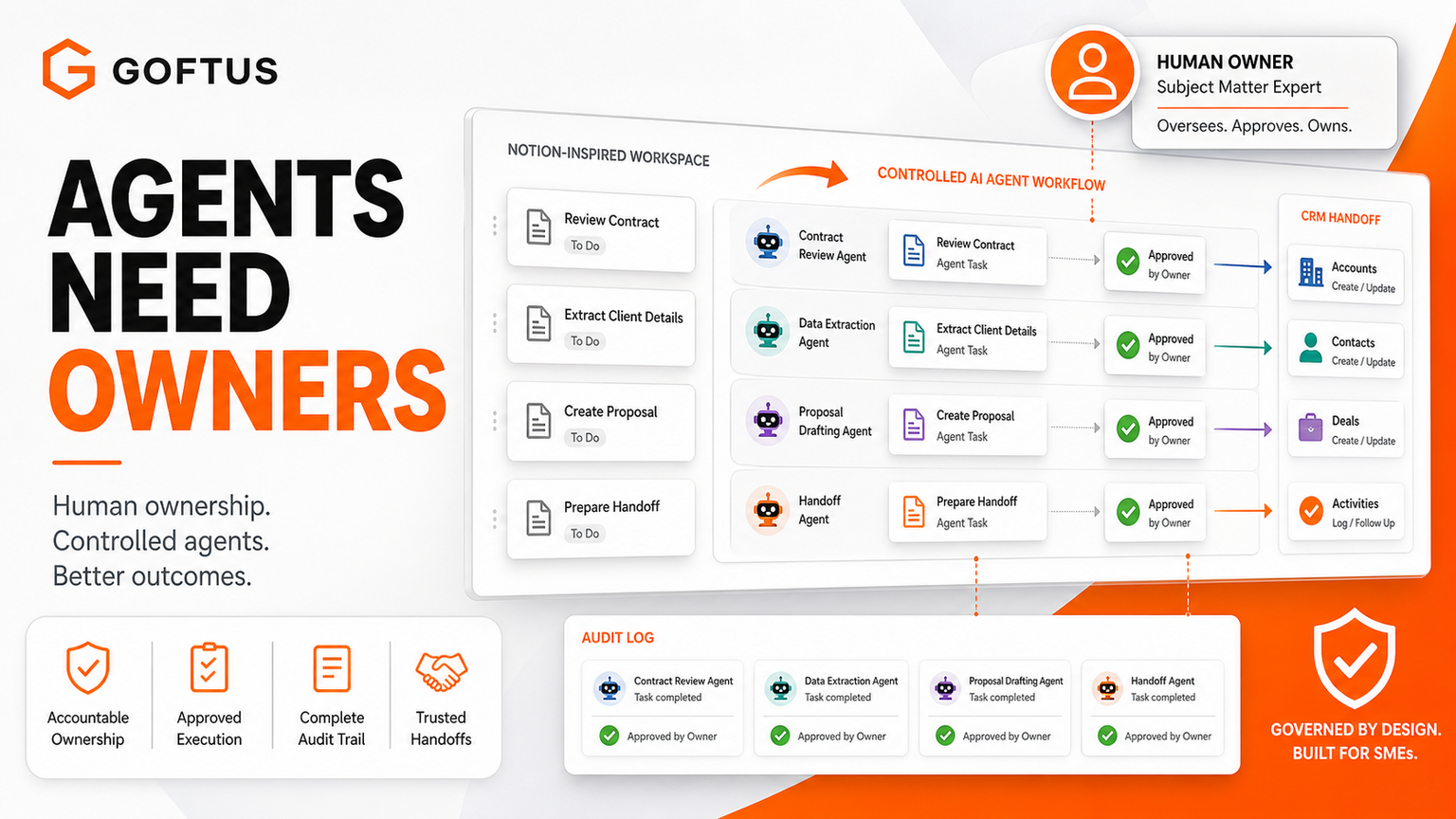
Thirumurugan's view is simple. Workspace agents can be useful, but only if a business names the owner of each workflow. If an agent drafts a proposal, updates a CRM field or prepares a support reply, someone still needs to define rules, approve risky actions and review the audit trail. GOFTUS helps SMEs build that operating layer through AI automation services, AI agents and workflow diagnostics via contact.
Why the Notion agent signal matters
The Notion story is important because it shows a familiar business app moving toward agentic work. A workspace is already full of context: decisions, tasks, meeting notes, sales notes, support snippets, policies, product documents and handoff comments. If an AI agent can read and act across that context, it can reduce a lot of repetitive admin.
But context without control creates risk. A small team may not notice when an agent uses old information, skips an approval, writes to the wrong customer record or treats a draft as an approved answer. The more useful the agent becomes, the more important the workflow boundary becomes.
For SMEs, the practical question is not "which agent looks clever?" The question is "which process should it support, what can it change, what needs approval, and where is the evidence stored?"
That is why this topic connects directly to GOFTUS. A tool can sit inside Notion, a browser, email, CRM or support desk. The business still needs designed intake, sources, approvals, exceptions, updates and measurement.
What this means for SMEs
Many operators are tempted to start with a broad instruction such as "let the agent manage my workspace". That is too wide. A safer first step is to choose one narrow workflow where the steps are repeatable and the risk is understood.
A support team could use an agent to match repeated questions to approved answers, route uncertain questions to staff and log unanswered gaps. A document-heavy business could ask an agent to extract details from forms, compare them with a checklist and create a review task.
In each case, the value is the workflow around the agent. Who owns the source content? Which actions are allowed automatically? Which actions need approval? Which system is the source of truth? How are mistakes corrected? What does the team review every month?
That is where GOFTUS positions AI agents differently from a disconnected tool setup. We design the agent's job, connect it to the existing systems, keep human approval where needed and measure whether the workflow is actually saving time.
Browser controls and action boundaries
The Notion agent signal also fits the search query "browser with ai controls". Many SME workflows still happen in browser-based tools: CRM, support desks, quoting portals, accounting systems and admin dashboards. As AI agents move from notes into actions, businesses need narrow instructions, login boundaries, allowed pages, approval gates, evidence capture and stop rules.
GOFTUS connects this to services and agents: automate the boring browser work, but keep ownership, review and audit evidence visible. That is the difference between an impressive demo and a workflow the owner can trust.
Competitor lens
Faculty AI, Deeper Insights, Waracle and Brainpool AI in the UK, LeewayHertz, Markovate, SoluLab and BairesDev in the US, and Addepto, STX Next, Netguru and 10Clouds in Europe can all help with larger AI or software programmes. SaaS and automation tools such as Zapier, n8n, Relevance AI, Lindy, Gumloop, Bardeen, Make and Stack AI can also connect apps and automate individual steps quickly.
GOFTUS does not need to attack any of them. The gap for SMEs is usually the operating layer. Tools automate tasks. GOFTUS automates the workflow around the task.
That means we care about what happens before and after the AI action. We define intake, permissions, source data, approval gates, CRM or support updates, browser action boundaries, exception queues and monthly improvement. A Notion agent might prepare the work. GOFTUS makes sure the business owns the process.
What SMEs should do next
Start with one workflow where your team already repeats the same admin every week. Good candidates include customer question handling, CRM follow-up, proposal drafting, support triage, document processing, quote preparation, management reporting and internal knowledge search.
Write down the current steps. Mark the parts that are slow, the parts that are risky and the systems that must stay accurate. Then decide what the AI should draft, summarize, classify, route or prepare. Keep human approval for customer-facing, financial, contractual or record-changing actions.
If repeated customer questions are the easiest entry point, start with GOFTUS FAQ automation service. If the workflow involves multi-step actions or browser tools, review GOFTUS agents. If you are not sure where the first project should be, use contact for a Startup Kit style diagnostic.
Summery for SMEs
Notion's agent push is a useful signal for SMEs: workplace AI is moving from answers into actions. The opportunity is real, but the winning pattern is not a loose agent in every tool. It is a named workflow owner, approved source content, narrow permissions, browser controls, CRM or support handoffs, exception queues and monthly review. That is how AI becomes a dependable workflow system rather than another disconnected app.
FAQ
Is a Notion-style agent enough for a small business workflow?
Not by itself. A workspace agent can help draft, summarize and organize work, but SMEs still need rules for ownership, approvals, system updates and exception handling. GOFTUS designs the workflow around the agent so useful outputs become safe business actions.
Where should an SME use AI agents first?
Start where the work is repeated and measurable. Customer questions, sales follow-up, support triage, document extraction and reporting are good candidates. The first workflow should be narrow enough to review and important enough to save real time.
How does this connect to browser with ai controls?
Many SME workflows happen in browser tools. If an agent prepares forms, reads portals or updates dashboards, the business needs approved pages, login boundaries, action logs and human review before risky clicks. GOFTUS can build those controls through agents and services.
Source notes
Social and keyword signal: GOFTUS Reddit and keyword intelligence for 1 August 2026 surfaced multiple 100-score Notion-agent phrases for blog, FAQ and product use.