Non-Developers Building Claude Apps Need Workflow Controls
A hot ClaudeAI Reddit post shows non-developers can build serious AI apps, but SMEs need controls, audit logs, and workflow owners before rollout.
# Non-Developers Building Claude Apps Need Workflow Controls Meta description: A hot ClaudeAI Reddit post shows non-developers can build serious AI apps, but SMEs need controls, audit logs, and workflow owners before ro
Non-Developers Building Claude Apps Need Workflow Controls
Meta description: A hot ClaudeAI Reddit post shows non-developers can build serious AI apps, but SMEs need controls, audit logs, and workflow owners before rollout.
That does not prove every SME can ship regulated software overnight, and it should not be treated as confirmed product performance. It does show something practical. AI tools are moving useful internal app building away from only technical teams and toward operators who understand the job.
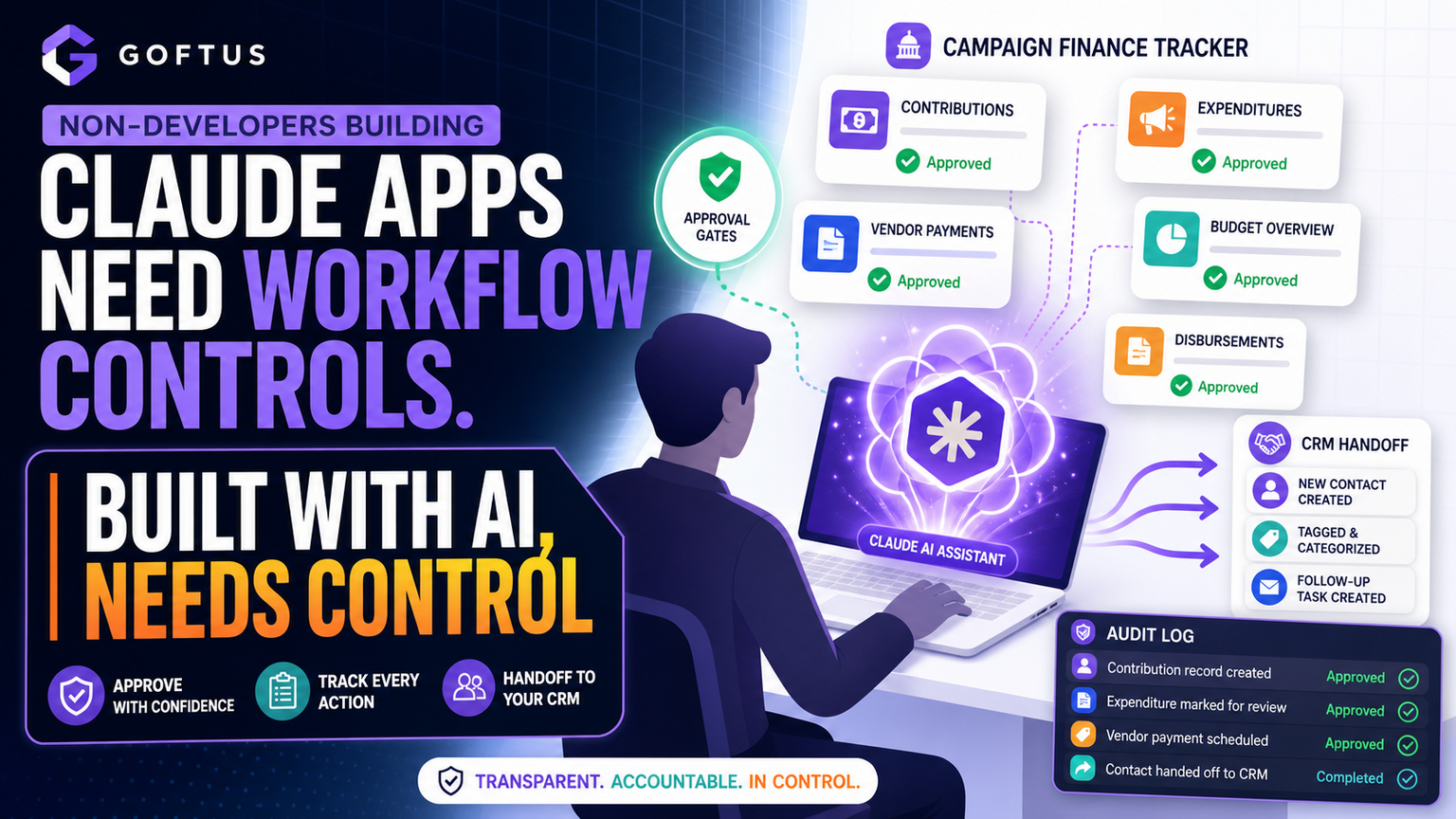
For UK, US, and European SMEs, the opportunity is not just "let everyone build apps." The opportunity is to turn operator-built AI experiments into controlled workflows: scoped use cases, approved data, human review, CRM or support handoff, audit logs, and a monthly improvement loop. GOFTUS sees this as a workflow ownership problem, not a prompt-writing problem.
What this means for SMEs
The Reddit signal is about Claude, but the same pattern applies across ChatGPT, Copilot, Gemini, Perplexity, Notion agents, and low-code tools. A finance, sales, operations, or support person can now describe a process and get a working tracker, dashboard, scraper, document assistant, or follow-up agent much faster than before.
That is powerful because the person closest to the work often knows the edge cases best. They know which customer questions repeat, which spreadsheet columns matter, which approvals delay deals, and where a handoff breaks. Traditional software projects often lose that detail when requirements move from the operator to a project manager and then to an external delivery team.
But the same speed creates risk. A useful Claude-built tracker may pull sensitive records into a file, classify customers incorrectly, omit approval steps, or become a shadow system that nobody monitors. In a small business, the issue is usually not malicious use. It is unmanaged enthusiasm. Someone solves a real pain, shares the tool with colleagues, and suddenly an unofficial workflow is handling live decisions.
That is why GOFTUS recommends a simple rule: encourage AI experiments, but graduate only the safe ones into production workflows. The graduation step should ask five questions. What data can the tool see? Who approves the output? Where does the result get recorded? What happens when the AI is unsure? Who reviews the workflow each month?
Hajikreena's view on the signal
Hajikreena's view is that the important story is not that one Reddit user built a campaign finance tracker. The important story is that non-developers are becoming workflow designers. SMEs that ignore this will either block useful innovation or let uncontrolled tools spread quietly.
The better middle path is a governed builder model. Let the operator prototype the workflow because they know the pain. Then bring in GOFTUS to turn the prototype into a reliable system with permissions, logging, clean handoffs, and measurable outcomes. That can include an internal knowledge assistant, a CRM follow-up automation, a document extraction workflow, a support triage flow, or an AI agent that prepares actions for human approval.
This also changes how SMEs should buy automation. A SaaS subscription alone is rarely enough. Zapier, n8n, Make, Bardeen, Gumloop, Lindy, Relevance AI, and Stack AI can all be useful pieces. But a stack of tools does not decide which workflow matters, how exceptions are handled, or how staff should trust the output.
What operators should do next
Start with a controlled inventory. Ask staff where they are already using AI to draft replies, build spreadsheets, summarize documents, research customers, or prepare reports. Do not punish honest answers. The aim is to find useful patterns before they become hidden risk.
Next, choose one workflow where the benefit is clear and the damage from a mistake is manageable. Good candidates include repeated customer questions, lead qualification, CRM cleanup, meeting notes to tasks, supplier document extraction, support ticket triage, or weekly reporting. Avoid starting with payroll, legal decisions, regulated advice, or irreversible customer actions.
Then design the control layer. Keep a human approval gate for anything that sends, submits, updates a record, or changes money-related data. Log the original input, AI output, reviewer, final action, and timestamp. Add stop rules for low confidence, missing data, unusual amounts, sensitive fields, or customer complaints. If the workflow touches websites or admin portals, pair it with browser with ai controls so the AI can prepare steps without silently clicking through risky actions.
Finally, measure the outcome. Did the workflow reduce response time? Did it capture leads that were previously missed? Did staff spend less time copying information between tools? Did reviewers override the AI often? Those answers matter more than model benchmarks.
Faculty AI, Deeper Insights, Waracle, Brainpool AI, LeewayHertz, Markovate, SoluLab, BairesDev, Addepto, STX Next, Netguru, and 10Clouds can all help with AI or software delivery. SaaS platforms such as Zapier, n8n, Relevance AI, Lindy, Gumloop, Bardeen, Make, and Stack AI can automate parts of the job.
The gap for many SMEs is ownership after the first demo. Who maps the workflow? Who connects the CRM, inbox, website, documents, and reporting stack? Who decides where human approval is mandatory? Who reviews failures and improves the process next month?
Tools automate tasks. GOFTUS automates the workflow around the task. That is the counter-positioning. We do not tell businesses to stop using AI tools. We help turn them into accountable systems that staff can trust.
Non-developers building useful AI apps is a positive signal, not a reason to remove controls. SMEs should treat every operator-built AI tool as a prototype until it has approved data access, a clear owner, logs, review steps, and safe handoffs into existing systems.
If your team is already using Claude, ChatGPT, Copilot, or browser agents to build internal tools, GOFTUS can help turn the strongest prototype into a production workflow. Start with /services for workflow automation, /agents for agentic systems, or /contact for a practical diagnostic.
Should SMEs let non-developers build AI tools?
Yes, but with boundaries. Operators often understand the workflow better than anyone else, so their prototypes can reveal valuable automation opportunities. The mistake is letting those prototypes become production systems without review, permissions, logging, and handoff design.
Where should a non-developer AI app start?
Start with a narrow workflow: repeated customer questions, CRM updates, support triage, document extraction, or reporting. Avoid workflows that make irreversible financial, legal, hiring, or customer decisions until controls are proven.
How can GOFTUS help with operator-built AI tools?
GOFTUS reviews the prototype, maps the surrounding workflow, adds approval gates, connects tools such as CRM or support systems, sets stop rules, and measures whether the automation actually improves business outcomes.
I built a 537-member campaign finance tracker with Claude" on 2026-07-31. This supports the wider business-workflow context, not the specific Reddit user's build.
X signal: xurl was not installed in this cron environment, so X was not used as a source for this run.