Microsoft and Databricks Show Enterprise AI Needs Business Context Workflows
Microsoft and Databricks show why SMEs need business-context workflows, approvals, logs, and clear ownership around enterprise AI.
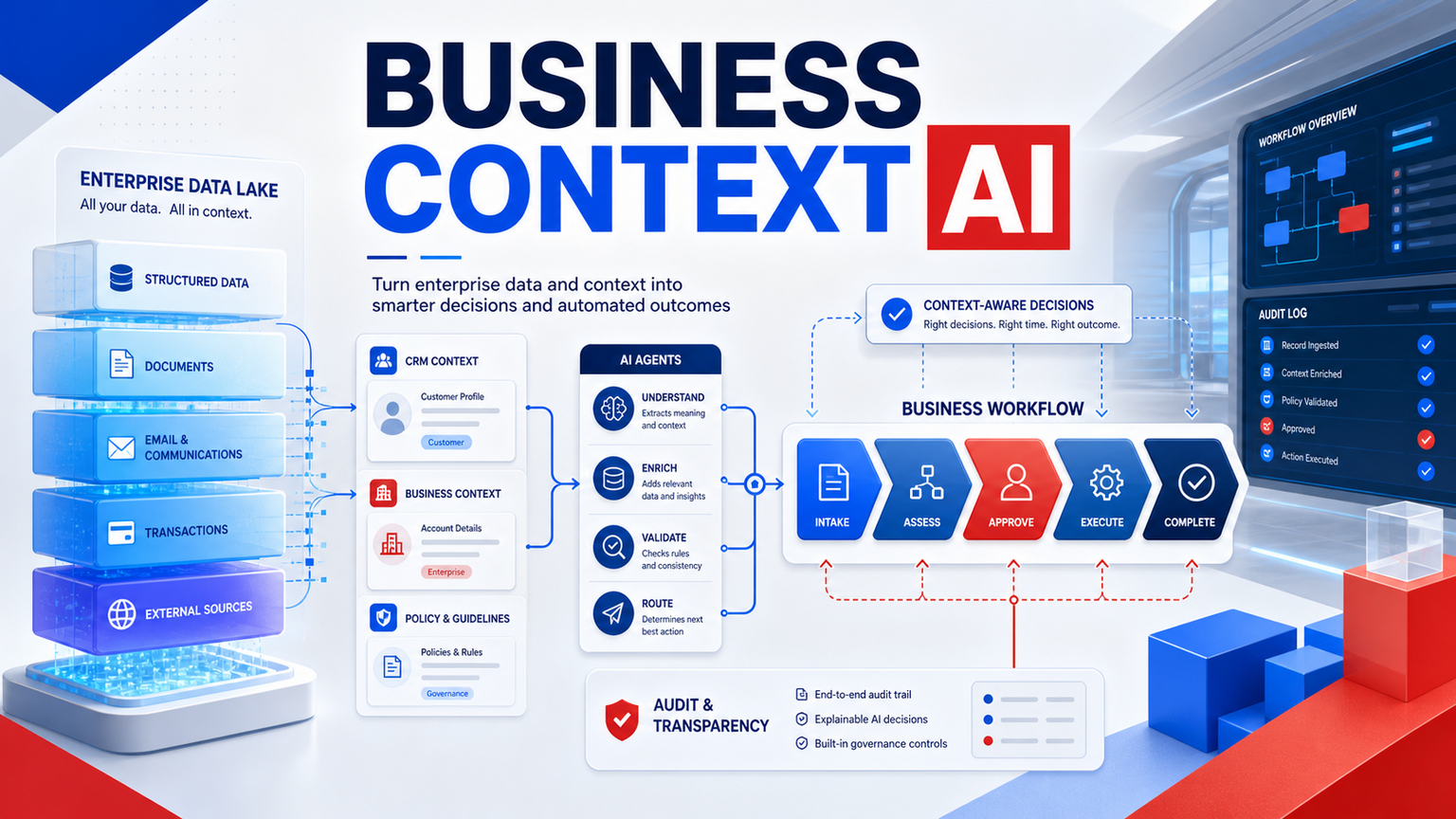
The direct Microsoft and Databricks pages were blocked from this cron environment, so this post treats the signal as a headline-level news cross-check, not as a full article scrape. For SMEs in the UK, US, and EU, the useful lesson is simple: AI gets more valuable when it understands the customer, order, policy, stock, ticket, document, and approval context around a task. It also gets riskier when that context is copied into tools without ownership. Hajikreena's view is that the next SME advantage will not come from buying one more chatbot. It will come from designing the workflow that decides what context an AI can see, what it can change, when a person must approve, and how the result is measured.
What this means for SMEs
Enterprise vendors are moving from isolated prompts to connected AI systems that can use business context. Large companies talk about data platforms, agent data layers, catalogs, and governance. Smaller firms feel the same problem in plainer language: the AI cannot answer well unless it knows the customer record, the latest quote, the support history, the refund policy, and the team member responsible for the next step.
That is why a small business should not start with a generic AI roll-out. Start with one workflow. A sales enquiry becomes a qualified lead, a support question becomes a triaged ticket, a supplier email becomes a task with evidence attached, or a browser form becomes a draft action waiting for approval. GOFTUS builds these practical workflow systems through /services and /agents so the AI is connected to the business process instead of floating outside it.
The risk is context sprawl. If every SaaS tool gets broad access, no one knows which system made the decision, which version of the record it used, or whether a human checked the action. Business-context AI needs clear boundaries: read-only fields, write permissions, approval gates, exception routing, audit logs, and review cycles.
Why business context beats generic automation
A generic automation can copy a row from one app to another. A business-context workflow understands why that row matters. For example, a customer answer should not only use a policy document. It should check whether the person is already a customer, whether there is an open ticket, whether the issue is urgent, and whether the response should be routed to sales, support, finance, or a manager.
The same applies to document automation, reporting automation, CRM follow-up, and browser-based workflow automation. Context turns AI from a text generator into an operational assistant. But context also creates obligations. SMEs need to decide where the source of truth lives, which data is allowed into prompts, which actions need approval, and what happens when the AI is unsure.
A strong first implementation is often a narrow question-to-action loop. Capture the customer question, retrieve the relevant answer, draft the next action, update the CRM or support tool, then log the unanswered question for improvement. That same pattern can later support AI agents, document processing, and browser with ai controls where a human approves sensitive browser actions before anything is submitted.
What SMEs should do next
First, list the ten repeatable decisions that slow the team down. Do not write down broad goals like improve productivity. Write down operational moments such as qualify a website lead, answer a delivery question, chase a quote, route a refund request, summarise a supplier document, prepare a weekly report, or approve a browser form submission.
Second, map the context each decision needs. Include the CRM fields, email threads, support records, documents, spreadsheet columns, policy pages, and owner names. If the answer depends on old or unreliable data, fix that before connecting an AI agent.
Third, set action boundaries. Decide what the AI may draft, recommend, update, or send. A safe first rule is that AI drafts and routes, while people approve customer-facing messages, finance changes, contract language, account access, and browser submissions.
Fourth, measure unanswered questions and exceptions. The most useful AI automation system is not perfect on day one. It improves because every failed answer, unclear handoff, and manual override becomes a backlog item for the next workflow iteration. GOFTUS can help build that operating loop through /services, /agents, and a practical diagnostic via /contact.
The competitor market is crowded for a reason. UK teams such as Faculty AI, Deeper Insights, Waracle, and Brainpool AI can help with data and AI projects. US firms such as LeewayHertz, Markovate, SoluLab, and BairesDev can build custom systems. European providers such as Addepto, STX Next, Netguru, and 10Clouds can support engineering delivery. SaaS tools such as Zapier, n8n, Relevance AI, Lindy, Gumloop, Bardeen, Make, and Stack AI are useful for task automation.
GOFTUS counter-positioning is more specific: Tools automate tasks. GOFTUS automates the workflow around the task.
That means the value is not just a prompt, trigger, or connector. The value is the designed path around it: who owns the workflow, which context is trusted, which system gets updated, which action needs approval, which exception gets escalated, and which metric proves the system is improving. For SMEs, that workflow layer is where AI becomes usable without losing control.
The Microsoft and Databricks signal points to a broader shift: AI is moving closer to operational data and business context. SMEs should welcome that shift, but only with workflow ownership. Before giving an AI more context, define the source of truth, the approval rules, the audit log, and the improvement cycle.
Start small. Pick one workflow where context matters and failure is visible. Connect the right records, keep risky actions behind approval, and measure what the AI cannot answer yet. That is how business-context AI becomes a practical operating system rather than another tool subscription.
Why does business context matter for AI automation?
Business context helps AI understand the actual customer, policy, record, document, and next step behind a request. Without it, automation often produces generic answers. With it, SMEs can route work, draft follow-ups, update systems, and escalate exceptions more reliably.
Should SMEs connect AI directly to every business system?
No. Start with one narrow workflow and limited access. Give the AI only the fields it needs, keep sensitive actions behind approval, and log every decision. Wider access should come after the first workflow proves useful and safe.
How can GOFTUS help with business-context AI workflows?
GOFTUS designs the workflow around the AI task: data boundaries, approvals, CRM or support updates, browser controls, reporting, and monthly improvement. Start with /services or /agents, then use /contact for a practical diagnostic.
Cross-checks included PR Newswire, Reuters, SiliconANGLE, HPCwire, IT Pro, Technology Record, and AI Magazine headlines. Reddit feeds were partially rate limited after r/Anthropic, so no exact Reddit discussion is claimed for this topic.