Microsoft AI Cybersecurity Shows SMEs Need Browser Action Controls
Microsoft's AI cybersecurity push shows why SMEs need controlled browser actions, approvals, audit logs, and practical GOFTUS workflow ownership.
# Microsoft AI Cybersecurity Shows SMEs Need Browser Action Controls Meta description: Microsoft's AI cybersecurity push shows why SMEs need controlled browser actions, approvals, audit logs, and practical GOFTUS workfl
Microsoft AI Cybersecurity Shows SMEs Need Browser Action Controls
Meta description: Microsoft's AI cybersecurity push shows why SMEs need controlled browser actions, approvals, audit logs, and practical GOFTUS workflow ownership.
Microsoft's latest AI security push is a useful signal for SMEs because it points to the next phase of workplace automation: AI will not only read alerts, tickets, inboxes, documents, and browser screens. It will increasingly suggest the next action. That is helpful only when the business has a workflow around the action.
Google News listed Microsoft's official blog post, "Rethinking security for the age of AI," on 27 July 2026. Help Net Security also reported that Microsoft unveiled MAI-Cyber-1-Flash. GOFTUS could not directly retrieve the official Microsoft page during this unattended run because it returned a 403, so this article treats the official Google News listing as a headline-level source and uses accessible security coverage as the cross-check.
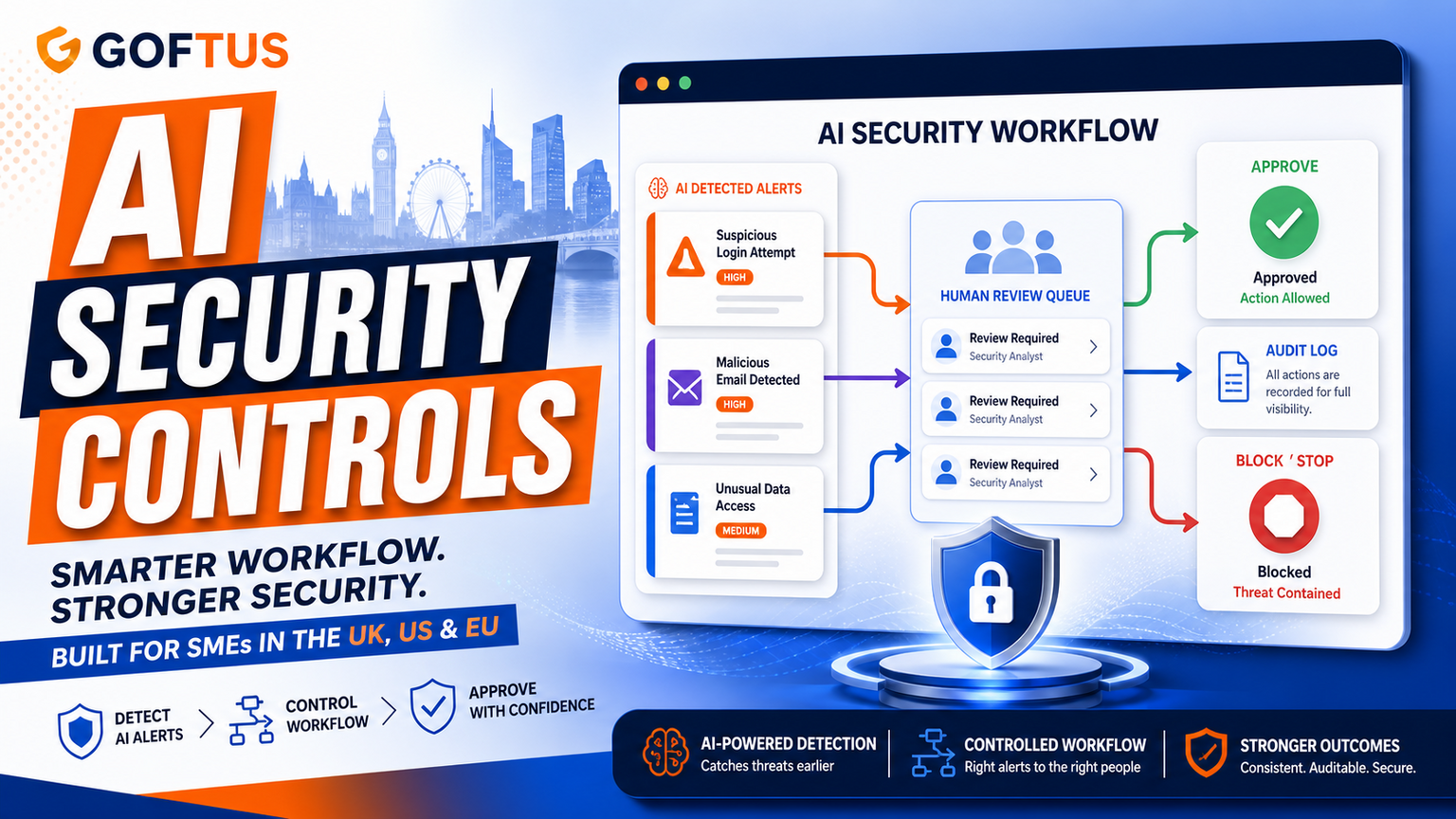
The practical lesson is simple. AI security tools can detect, classify, and recommend. SMEs still need approval gates, browser boundaries, audit logs, CRM or ticket updates, and a clear stop rule before any AI-assisted workflow changes a live system. For browser-based tasks, that connects directly to GOFTUS work on AI agents, workflow automation, and browser with ai controls.
What this means for SMEs
Most SMEs do not have a large security operations centre. They have one operations lead, one IT partner, a helpdesk queue, a few SaaS dashboards, and several people who share responsibility when something urgent happens. That is exactly where AI cybersecurity sounds attractive. A model that summarises suspicious logins, risky emails, unusual data access, or misconfigured SaaS permissions can save time.
The risk is that teams jump from "AI found something" to "AI should fix it" without defining the middle steps. A suspicious login might need a password reset. A failed automation might need a support ticket. A risky browser session might need a human to approve whether an account is locked, a customer is contacted, or a CRM record is changed.
GOFTUS designs this middle layer. We map the repeated security or operations task, decide which systems can be read, define which actions require approval, and record what happened. That makes AI useful without asking a small team to trust a black box.
A practical controlled browser workflow might look like this:
1. AI reads a ticket, alert, or support email.
2. It opens the approved browser workflow only for a narrow task.
3. It prepares the action, such as checking an account, collecting evidence, or drafting an update.
4. A named person approves the action.
5. The result is written back to the CRM, support desk, document store, or reporting dashboard.
6. Exceptions are logged and routed to a human instead of being retried forever.
This is why the phrase "browser with ai controls" matters. Many business systems still live behind browser interfaces. The future is safe browser-based workflow automation with login boundaries, visible queues, and audit trails.
Thirumurugan's view
The Microsoft signal is not only about cybersecurity teams buying another model. It is about a wider operational question: when AI sees risk, who owns the next step?
For SMEs in the UK, US, and EU, the answer should not be "the tool decides." It should be a named workflow owner, a clear policy, and a controlled handoff. AI can triage faster than a person scanning every alert manually. But the business still needs rules for what happens when the AI is uncertain, when a customer account is involved, when a browser login is required, or when the recommended action could affect revenue, access, or trust.
This is where GOFTUS differs from a pure tool setup. We are not trying to replace the judgement of an operations manager, founder, IT lead, or support team. We help them remove repetitive work while keeping approval and evidence in the process.
If an AI agent needs browser access, the first question is not "can it click?" The first question is "what is it allowed to click, who approves it, and where is the proof stored?" That question applies to security alerts, customer support refunds, CRM updates, supplier portals, invoice checks, and internal knowledge workflows.
Faculty AI, Deeper Insights, Waracle, and Brainpool AI can be valuable for larger UK AI programmes. LeewayHertz, Markovate, SoluLab, and BairesDev often position around build capacity in the US. Addepto, STX Next, Netguru, and 10Clouds bring European delivery strength. SaaS tools such as Zapier, n8n, Relevance AI, Lindy, Gumloop, Bardeen, Make, and Stack AI can also move tasks between apps quickly.
The gap for SMEs is usually not whether a task can be automated. It is whether the task sits inside a safe workflow. Tools automate tasks. GOFTUS automates the workflow around the task.
That means GOFTUS looks beyond the connector. We ask which data source is trusted, which browser actions are allowed, when a human approval is needed, what gets logged, how exceptions are escalated, and how the workflow improves after real use. A tool can trigger an action. A GOFTUS workflow explains when that action should happen and who is accountable for it.
What SMEs should do next
Start with one high-friction security or operations process. Good candidates include suspicious login review, customer identity checks, failed payment follow-up, supplier portal updates, support ticket triage, or browser-based CRM cleanup.
Then write down three lists. First, what the AI may read. Second, what it may prepare. Third, what it may never complete without approval. This simple separation prevents a demo from becoming a risky live workflow.
Next, connect the workflow to the systems the team already uses. That may mean a support desk, CRM, inbox, spreadsheet, document folder, n8n workflow, reporting dashboard, or a controlled browser session. GOFTUS can help design this through AI automation services, agentic workflows, or a focused consultation.
Finally, measure the boring outcomes. Did alerts reach the right owner faster? Did fewer tickets go stale? Were actions approved with better evidence? Did the team know when the AI stopped and asked for help?
Microsoft's AI cybersecurity push shows that AI will keep moving closer to operational action. SMEs should welcome the productivity gain, but only with controls around browser access, approvals, logs, and escalation. The winning setup is not an AI agent that acts everywhere. It is a workflow where the AI handles repetitive review, humans approve sensitive actions, and every decision is easy to trace.
How should an SME use AI cybersecurity without losing control? Start with alert triage, evidence collection, and drafted next steps. Keep account changes, customer messages, browser submissions, and access decisions behind human approval.
Where does browser with ai controls fit? It fits when a business process still happens inside a SaaS dashboard or web portal. AI can prepare the browser action, but GOFTUS sets login boundaries, approval rules, and audit logs.
Can this connect to existing tools? Yes. A controlled workflow can update CRM, support, reporting, documents, or n8n automations after approval. The point is to connect action to ownership, not just move data.
Direct retrieval of the Microsoft page returned 403 during this unattended run, so this is used as headline-level official-source evidence.
Help Net Security published "Microsoft unveils MAI-Cyber-1-Flash, promises cybersecurity AI at half the cost" on 27 July 2026 and was accessible for cross-checking.
Hacker News Algolia listed the Microsoft official blog item with light discussion activity.