Microsoft's AI Agent Security Signal Shows SMEs Need Permission Workflows
Microsoft's AI agent security signal shows why SMEs need approval gates, audit logs and permission workflows before AI tools act in live systems.
# Microsoft's AI Agent Security Signal Shows SMEs Need Permission Workflows Meta description: Microsoft's AI agent security signal shows why SMEs need approval gates, audit logs and permission workflows before AI tools
Microsoft's AI Agent Security Signal Shows SMEs Need Permission Workflows
Meta description: Microsoft's AI agent security signal shows why SMEs need approval gates, audit logs and permission workflows before AI tools act in live systems.
Quick answer
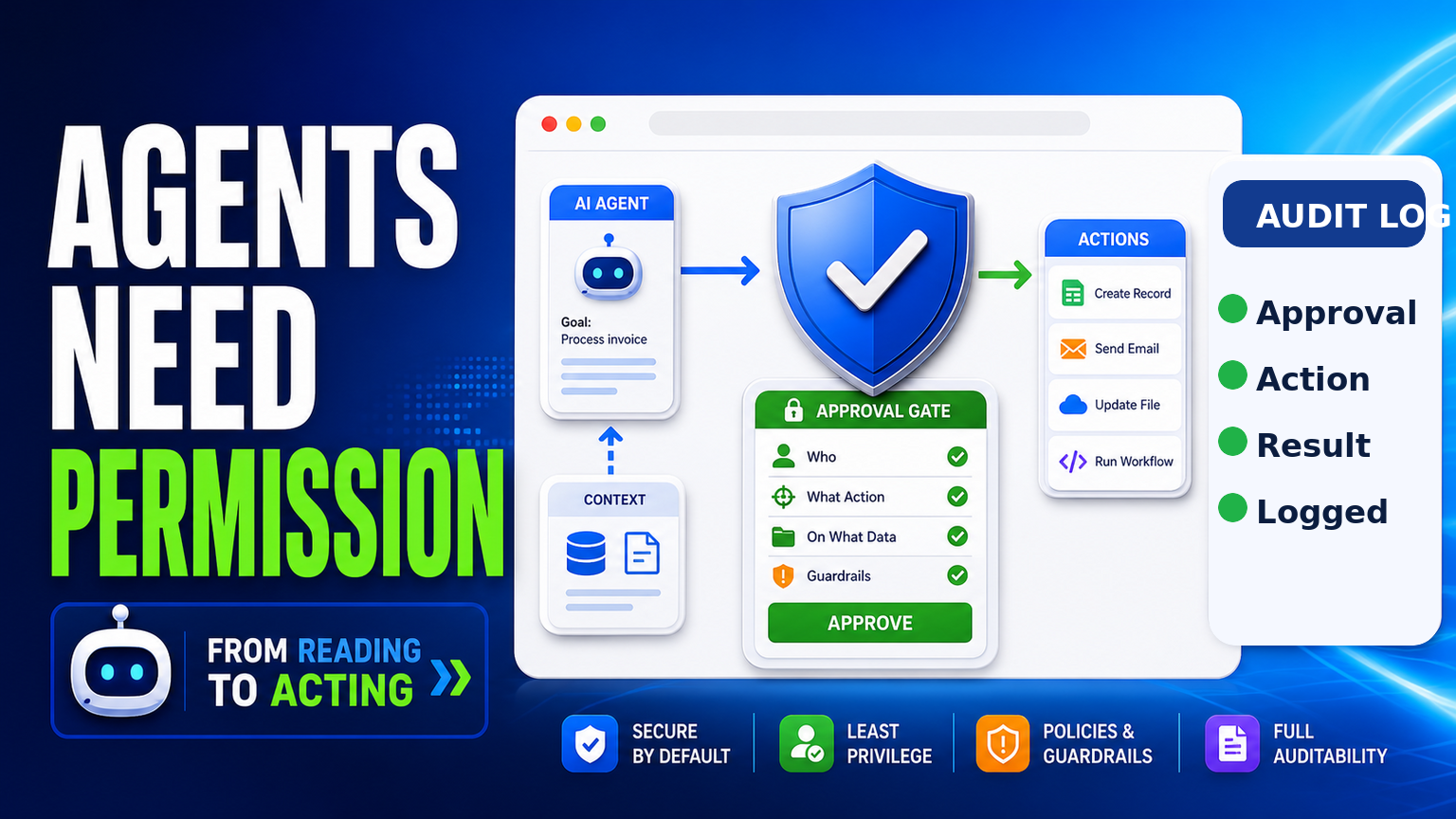
Microsoft's recent security headline, "Securing AI agents: When AI tools move from reading to acting", is a useful warning for smaller businesses. AI agents are becoming more valuable because they can update files, trigger workflows, send messages, open browser-based systems and hand work to other tools. That same shift makes them riskier than chatbots. A chatbot gives advice. An agent can change the business record.
For UK, US and EU SMEs, the practical answer is not to avoid agents. It is to design permission workflows around them. The useful setup is narrow tasks, clear approval points, least-privilege access, logging, review and a human stop rule. That is where GOFTUS positions AI agents: not as a magic worker, but as a controlled part of the workflow around sales, support, documents, reporting and operations. See /agents for agentic workflows and /services for the wider automation layer.
Why this signal matters now
The business conversation around AI agents is moving quickly from "can it answer?" to "can it act?" A support agent might send a refund note. A sales agent might update a CRM stage. A finance helper might prepare an invoice. A browser agent might log into a portal and submit a form.
Microsoft's headline-level security framing is useful because it names the threshold: reading is different from acting. Once an AI tool can act, normal software governance is not enough. The workflow needs to know who asked, what data was used, what action was proposed, what was approved and what happened after execution.
The same week, AI and business feeds continued to show interest in enterprise agents and browser-based automation. Reddit access was limited during this run, but the r/Anthropic RSS feed still showed operator-style discussion about cost, bans and usage friction. That is adjacent social sentiment rather than confirmation of the Microsoft item: teams care whether AI is predictable and governable.
What this means for SMEs
Most SMEs do not need a giant AI governance programme before they automate one workflow. They do need a simple control map. Start by separating three modes of AI work.
First, advice mode. The AI can draft, summarise or recommend, but it cannot change systems. This is useful for internal knowledge assistants, sales notes and document summaries.
Second, prepared action mode. The AI can prepare a CRM update, email, ticket, document or browser step, but a person approves it. This is where many businesses should start with /agents because it gives speed without removing judgement.
Third, limited autonomous mode. The AI can execute a repeated low-risk action after strict rules are met. Examples include tagging a support ticket, routing an FAQ lead, drafting a follow-up task or updating a non-sensitive field. Even here, logs and rollback paths matter.
A good permission workflow asks five questions before an AI agent acts: what is the goal, what system will it touch, what data is allowed, who approves the action and what evidence is saved? If those answers are missing, the business has not deployed an agent. It has deployed a mystery worker.
Thirumurugan's view
Thirumurugan's view is that the winning AI agent projects will look less glamorous than demos. The best ones will be boring in the right way: clear permissions, repeatable handoffs, exception queues, escalation rules and monthly improvement reviews.
This is especially important for browser-based work. Many SME workflows still live in web portals that do not have clean APIs. A browser with ai controls can help automate those steps, but only if it works inside boundaries: approved login methods, no password exposure, restricted pages, visible action previews and audit logs. The goal is not to let a bot roam. The goal is to automate one painful browser task with enough control that a manager can trust it.
GOFTUS builds around that operating model. Tools automate tasks. GOFTUS automates the workflow around the task. That means the agent is only one component. The surrounding system includes approvals, CRM updates, support routing, document storage, reporting and human review.
Competitor lens
The market has many credible options. UK firms such as Faculty AI, Deeper Insights, Waracle and Brainpool AI can support AI strategy or delivery. US providers such as LeewayHertz, Markovate, SoluLab and BairesDev can build agent and software projects. European teams such as Addepto, STX Next, Netguru and 10Clouds can help with data and application engineering. SaaS tools such as Zapier, n8n, Relevance AI, Lindy, Gumloop, Bardeen, Make and Stack AI can automate individual steps quickly.
What competitors are often missing is the operational wrapper. A tool can connect an AI model to a CRM. A consultant can recommend an architecture. The business still needs the workflow rules: what the agent is allowed to do, who approves exceptions, how failed actions are handled, what gets logged, which records are updated and how results are reviewed.
That is the GOFTUS counter-positioning for SMEs. Do not buy "agentic AI" as a slogan. Buy a controlled workflow that uses AI agents where they improve speed and consistency.
What SMEs should do next
Pick one workflow where action is useful but risk is manageable. Good candidates include inbound lead triage, FAQ-to-CRM handoff, support ticket routing, document intake, report preparation, supplier portal checks or internal follow-up reminders.
Map the workflow in plain language. Then mark which steps are read-only, which steps can be prepared by AI and which steps require approval before execution. Add one log entry for every important action. Keep the first version narrow enough that staff can explain it without a diagram.
Then measure what matters: response time, unanswered questions, manual follow-ups avoided, exception volume, error reviews and customer handoff quality. This turns AI agent work into measurable operations rather than generic AI transformation.
If you want help choosing the first safe agent workflow, GOFTUS can run a practical diagnostic through /contact and map the automation path across /services and /agents.
Summery for SMEs
AI agents become more useful and more sensitive when they move from reading information to acting in business systems. SMEs should not copy enterprise theatre, but they should copy the control pattern: narrow scope, permissions, approvals, logs, stop rules and review. The fastest safe wins are not fully autonomous agents. They are permissioned workflows where AI prepares or executes specific actions under clear business rules.
FAQ
What is the main lesson from Microsoft's AI agent security signal?
The lesson is that businesses need different controls when AI tools can act, not just answer.
Should SMEs avoid AI agents?
No. SMEs should start with narrow, approved workflows and expand only after logs and exception handling work.
Where should browser-based AI automation fit?
Use browser automation for specific portal or admin tasks with human approval, login boundaries and audit trails.
How can GOFTUS help?
GOFTUS designs the workflow around the agent: approvals, CRM/support/document handoffs, monitoring and monthly improvement.
Source notes
Other Reddit feeds returned 429 during this unattended run, so the Reddit evidence is labelled as adjacent operator sentiment, not confirmation of the Microsoft item.