Meta AI Task Automation Shows SMEs Need Workflow Controls
Meta AI task automation signals a shift from chat to action. SMEs need approvals, logs and workflow ownership before assistants do real work.
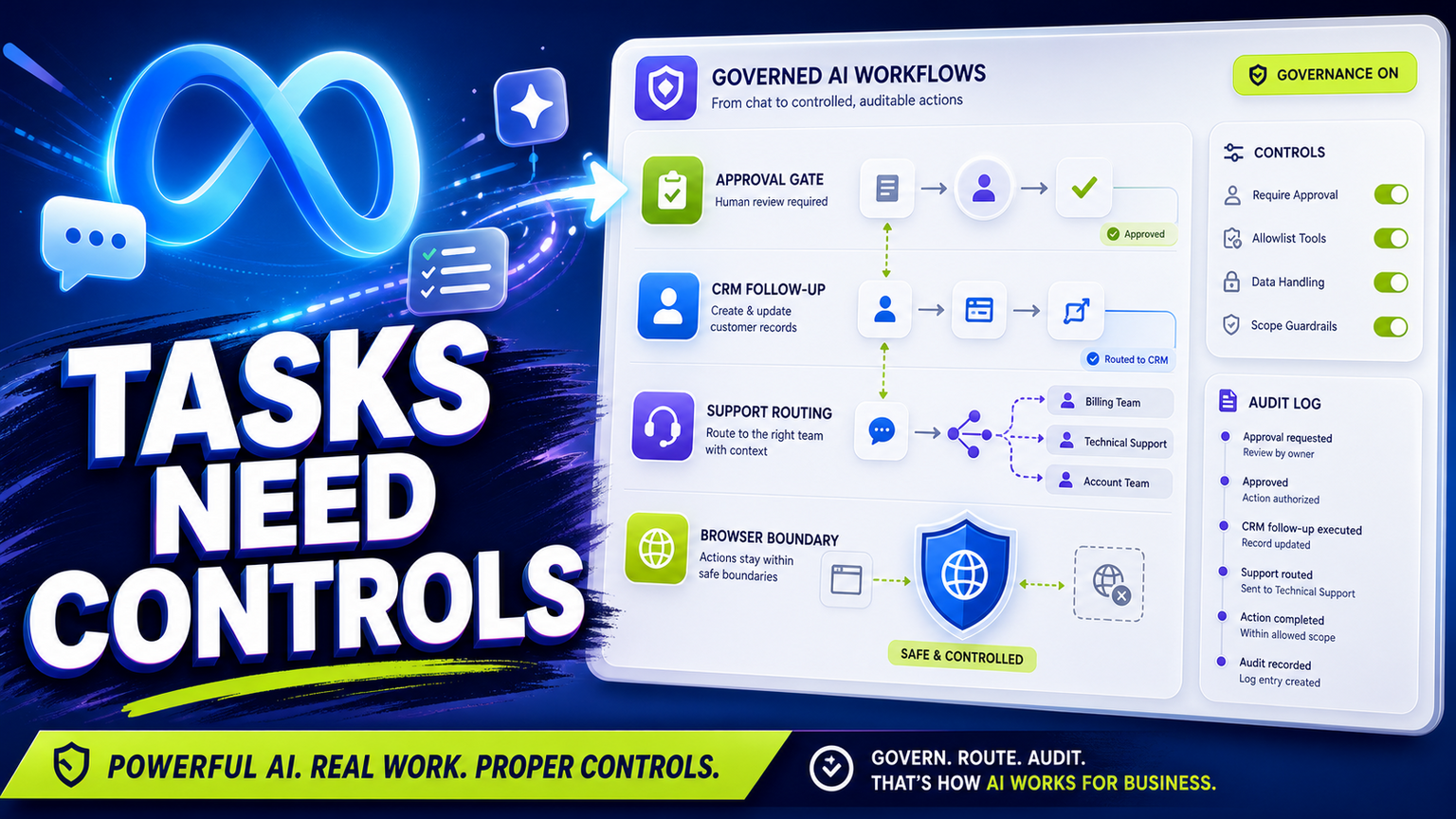
# Meta AI Task Automation Shows SMEs Need Workflow Controls That is a useful signal for SMEs in the UK, US and Europe because it shows where the market is going: AI assistants are no longer just answering questions. The
Meta AI Task Automation Shows SMEs Need Workflow Controls
That is a useful signal for SMEs in the UK, US and Europe because it shows where the market is going: AI assistants are no longer just answering questions. They are being shaped to remember routines, trigger reminders, prepare updates and potentially act inside channels where customers and staff already spend time.
This post treats the Meta story as a news signal, not as proof that every business should rush into consumer AI assistants. The more important point is operational. Once AI moves from chat to recurring action, the value is no longer the model alone. The value is the workflow around the action: who approves it, which data it can see, what happens when it is wrong, and how the business reviews outcomes.
Meta's task automation direction shows that AI assistants are becoming workflow participants. SMEs should not copy the feature list. They should define safe, narrow workflows first: customer follow up, support triage, reminder handling, CRM updates, reporting drafts, and internal knowledge retrieval. GOFTUS helps teams turn these use cases into governed systems through /services and agentic workflow builds through /agents, with human approval, stop rules and review built in.
What this means for SMEs
For an SME, the biggest risk is not that Meta, OpenAI, Microsoft or another vendor adds an automation button. The risk is letting scattered automation grow without a workflow owner. A founder asks an assistant to remind a prospect. A support lead asks another assistant to draft replies. A salesperson lets a tool update a CRM field. A finance admin copies output into a payment or invoice process. Individually those actions look harmless. Together they create a shadow operations layer with no single source of truth.
Hajikreena's view is simple: the assistant should not become the process. The process should decide what the assistant is allowed to do.
That means the first design question is not which model is best. It is which workflow can be safely narrowed. A repeated support question can be answered from approved FAQ content. A new website lead can be captured, classified and routed to the right owner. A sales follow up can be drafted, but not sent until a human approves it. A monthly report can gather evidence from trusted systems and show the source behind each claim. A browser-based admin task can use browser with ai controls only when login boundaries, action logs and stop rules are clear.
This is where GOFTUS positions AI automation differently from one-off tools. The deliverable is not a prompt library. It is a working route from input to outcome: trigger, data source, AI step, approval, system update, notification, exception path and measurement.
Why task automation needs controls before scale
Recurring AI tasks are attractive because they promise less admin. But recurring mistakes also scale. If an assistant misunderstands a customer issue once, a person can correct it. If it repeats that misunderstanding across dozens of replies, the business now has a service problem. If a reminder is sent to the wrong prospect, it is a small embarrassment. If a workflow updates the wrong CRM stage across a pipeline, it can distort forecasting.
The practical answer is not to ban AI automation. It is to give each automation a boundary. GOFTUS typically looks for five controls before AI is allowed to act repeatedly.
First, the workflow needs a named owner. Someone should know why the automation exists and what a good result looks like. Second, the data source needs to be explicit. Approved FAQs, CRM records, ticket history and document folders should be separated from general web guessing. Third, the action level should be set. Draft, recommend, update, send and submit are different risk levels. Fourth, exceptions need a route. Low confidence, missing data, angry customers and compliance language should move to a human queue. Fifth, review should be routine. Operators should see what was answered, what was escalated, what failed and what should be improved next month.
Those controls turn AI from a novelty into a managed operating system for routine work.
The market gives SMEs several useful routes. Zapier, n8n, Make, Bardeen, Gumloop, Lindy, Relevance AI and Stack AI can connect tasks quickly. Consultancies such as Faculty AI, Deeper Insights, Waracle, Brainpool AI, LeewayHertz, Markovate, SoluLab, BairesDev, Addepto, STX Next, Netguru and 10Clouds can support larger AI projects.
The gap appears when the business needs end-to-end ownership rather than another tool in the stack. Tools automate tasks. GOFTUS automates the workflow around the task. That includes deciding which tool should be used, where the approval sits, how CRM or support records are updated, how browser actions are bounded, what evidence is logged, and how the workflow improves after launch.
That is especially important for SMEs without a large internal AI operations team. A company may not need a big transformation programme. It may need three high-friction workflows fixed properly: answer repeated questions, route leads, and produce weekly management reporting from real data.
What SMEs should do next
Start with a workflow inventory. List the recurring tasks that interrupt staff every week: repeated customer questions, manual lead routing, quote follow ups, ticket triage, spreadsheet reporting, document checks, invoice chasing or portal updates. Then mark each task by risk. Could AI draft only, or could it update a system? Does a customer see the output? Does the task involve money, compliance, credentials or personal data?
Next, pick one narrow workflow. For many service businesses the best first move is a support or FAQ workflow because the source material is visible and the escalation path is obvious. For sales-led teams, lead capture and follow up may be stronger. For operations teams, reporting automation or document processing may create faster internal relief.
GOFTUS can help with that diagnostic through /contact. The goal is to find a workflow that produces measurable time saved or faster response without handing control to a black box.
Meta's task automation signal matters because it confirms the direction of travel: AI assistants are moving from conversation into recurring work. SMEs should prepare by designing controls around action, not by chasing every new assistant feature.
The winning pattern is practical. Keep humans in charge of approvals. Use trusted business data. Log the action. Route exceptions. Review outcomes. Then expand from one safe workflow into broader automation across CRM, support, documents, browser tasks and reporting.
Should SMEs use consumer AI task assistants for business workflows?
Only for low-risk reminders or drafting unless the workflow has clear data boundaries and human approval. Business-critical work should be connected to approved systems and reviewed through a managed process.
Where should a small business start with AI task automation?
Start with one repeated workflow that has a clear input and output, such as customer question routing, CRM follow ups, ticket triage, report drafting or document processing.
How does GOFTUS make automation safer?
GOFTUS designs the workflow around the AI step: trigger, data source, approval, system update, exception path and measurement. That makes automation easier to trust and improve.
Reddit rate limits blocked several broader subreddit feeds during this run, so those are treated as unavailable rather than as evidence.