Machine Identity Is Becoming the Hidden Control Layer for AI Agents
Gartner Tokyo and fresh developer signals show why SMEs need identity, permissions, approvals and logs before AI agents act across business systems.
# Machine Identity Is Becoming the Hidden Control Layer for AI Agents Meta description: Gartner Tokyo and developer signals show why SMEs need identity, approvals and audit logs before AI agents act across business syst
Machine Identity Is Becoming the Hidden Control Layer for AI Agents
Meta description: Gartner Tokyo and developer signals show why SMEs need identity, approvals and audit logs before AI agents act across business systems.
AI agents are moving from helpful assistants to systems that can touch data, draft updates, open browser sessions, trigger workflows, and hand tasks between SaaS tools. The same sourcing pass surfaced identity and agent-governance coverage from Security Boulevard, SC Media and TechCrunch around the operational mess created when non-human actors start using business systems.
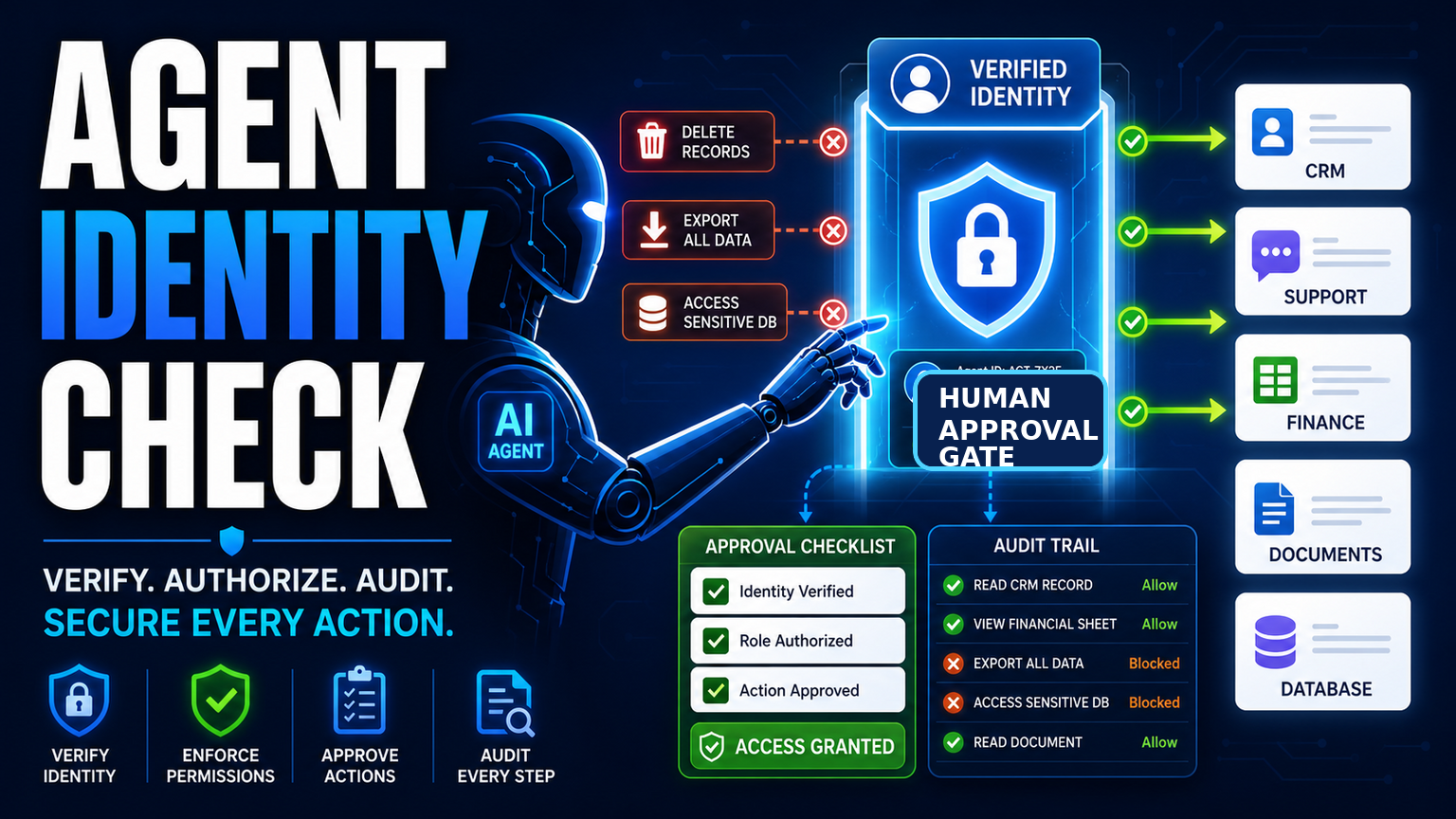
The practical lesson for UK, US and EU SMEs is not that every company needs enterprise-grade identity architecture tomorrow. It is that every AI workflow needs a named owner, a permission boundary, an approval rule, and a log before it performs business action. If an agent can read CRM records, draft support replies, open a browser tab, update a document, or prepare a finance handoff, the business needs to know who approved that action and where the stop line sits.
GOFTUS helps SMEs turn that principle into working AI automation services, controlled AI agents, CRM follow-up automation, document processing, support triage, and browser-based workflow automation. Tools automate tasks. GOFTUS automates the workflow around the task.
What this means for SMEs
Most small and mid-sized teams do not have a clean map of every permission used by staff, contractors, SaaS integrations, scripts and shared inboxes. AI agents add another layer. They may not be employees, but they can still create business consequences: a customer receives an answer, a sales lead is updated, a document is sent for review, or a browser workflow clicks into a portal.
That is why machine identity matters as a business control, not only as a cybersecurity phrase. A useful SME version is simple. Give every agent or automated workflow a defined job. Limit the systems it can touch. Decide which actions are read-only, which actions can be drafted, and which actions require human approval. Keep an audit trail that says what the agent saw, what it suggested, what it changed, and who accepted it.
This is especially important for companies experimenting with browser agents and SaaS automation. A browser with ai controls can save time when the task is narrow, repetitive and rule-based. The safer pattern is a controlled workflow: allowed domains, no unrestricted credential use, approval before submit actions, logs for every step, and a clear stop rule when the agent sees sensitive or unexpected data.
Thirumurugan's view
The interesting part of the Gartner signal is that agentic AI and machine identity are being discussed together. Businesses will not get durable value from AI agents if every workflow depends on trust-me access. The better question is, can we prove what the agent was allowed to do, what it actually did, and where a person reviewed the outcome?
For an SME, the first version does not need to be complex. Start with one workflow that already wastes staff time. It might be qualifying inbound enquiries, preparing document packs, chasing missing information, or checking a portal for status changes. Then write the control rules before choosing the AI tool. What data can the workflow read? What output can it draft? What must a person approve? What should be logged? What happens when confidence is low or the request is outside the normal case?
That framing keeps the work practical. The agent becomes a controlled worker inside a business process, not a magic box connected to everything.
Faculty AI, Deeper Insights, Waracle and Brainpool AI can help larger UK organisations with AI strategy, modelling and advisory work. LeewayHertz, Markovate, SoluLab and BairesDev often position around custom AI builds for US buyers. Addepto, STX Next, Netguru and 10Clouds bring European delivery capability. SaaS tools such as Zapier, n8n, Relevance AI, Lindy, Gumloop, Bardeen, Make and Stack AI can be very useful for connecting tasks quickly.
The gap appears after the first demo. A connector can move data. A low-code agent can call a tool. A consultant can describe the target state. But a business still needs workflow ownership: permissions, exception paths, approval queues, CRM handoffs, support escalation, document review, reporting, and monthly improvement.
That is where GOFTUS counter-positions. Tools automate tasks. GOFTUS automates the workflow around the task. The goal is not to replace useful SaaS platforms. The goal is to make them operate inside a controlled process that staff can review and improve.
What SMEs should do next
First, list the top three actions you would not want an AI agent to perform without approval. Common examples include sending customer messages, changing CRM stages, submitting forms, downloading sensitive files, deleting records, issuing refunds, or updating finance data. Those become stop rules.
Second, choose one low-risk automation wedge. For support-led teams, FAQ automation service can answer repeated questions, capture leads, route complex issues and measure unanswered questions before deeper agents are introduced. For sales or operations teams, a CRM follow-up workflow can draft next steps while leaving final outreach to a human. For document-heavy teams, an AI workflow can extract fields and prepare review packs without sending anything externally.
Third, add identity and audit from day one. Even a simple workflow should have a named owner, allowed systems, a human approval point, and a log of inputs and outputs. If a workflow uses a browser, define allowed domains, login boundaries and what the agent must never click.
Finally, review the workflow monthly. AI systems drift because business rules, customer questions, pricing pages, support policies and internal tools change. A monthly review catches failed handoffs and permissions that are too broad.
AI agents are becoming business actors, so SMEs need identity, permission and approval rules before connecting them to real systems. The newest signal is not only about security teams. It is about everyday operators who need to know what an agent can read, draft, update, submit or escalate.
GOFTUS can help design controlled AI agents, AI automation services, support workflows, document automation, CRM follow-up and browser-based automation with human approvals and audit logs. The safest first step is a narrow workflow with clear ownership, plain stop rules and measurable outcomes.
What is machine identity for AI agents?
Machine identity means the business can recognise a non-human actor, such as an AI agent, automation script or integration, and define what it is allowed to do. For SMEs, the practical version is a named workflow, limited permissions, approval gates and logs.
Should SMEs block AI agents from browser tasks?
Not always. Browser automation can help when a workflow is narrow and controlled. The important controls are allowed domains, login boundaries, no silent submissions, human approval for sensitive actions, and audit records for each step.
How does this connect to GOFTUS services?
GOFTUS designs the workflow around the AI task. That can include agent permissions, CRM handoffs, FAQ automation, support triage, document processing, reporting automation and browser controls. The aim is practical business output, not a generic AI experiment.