How SMEs can turn IT admin busywork into AI automation workflows
IT operations automation helps SMEs route access, support, onboarding, and asset tasks with approvals, logs, and human review before AI acts.
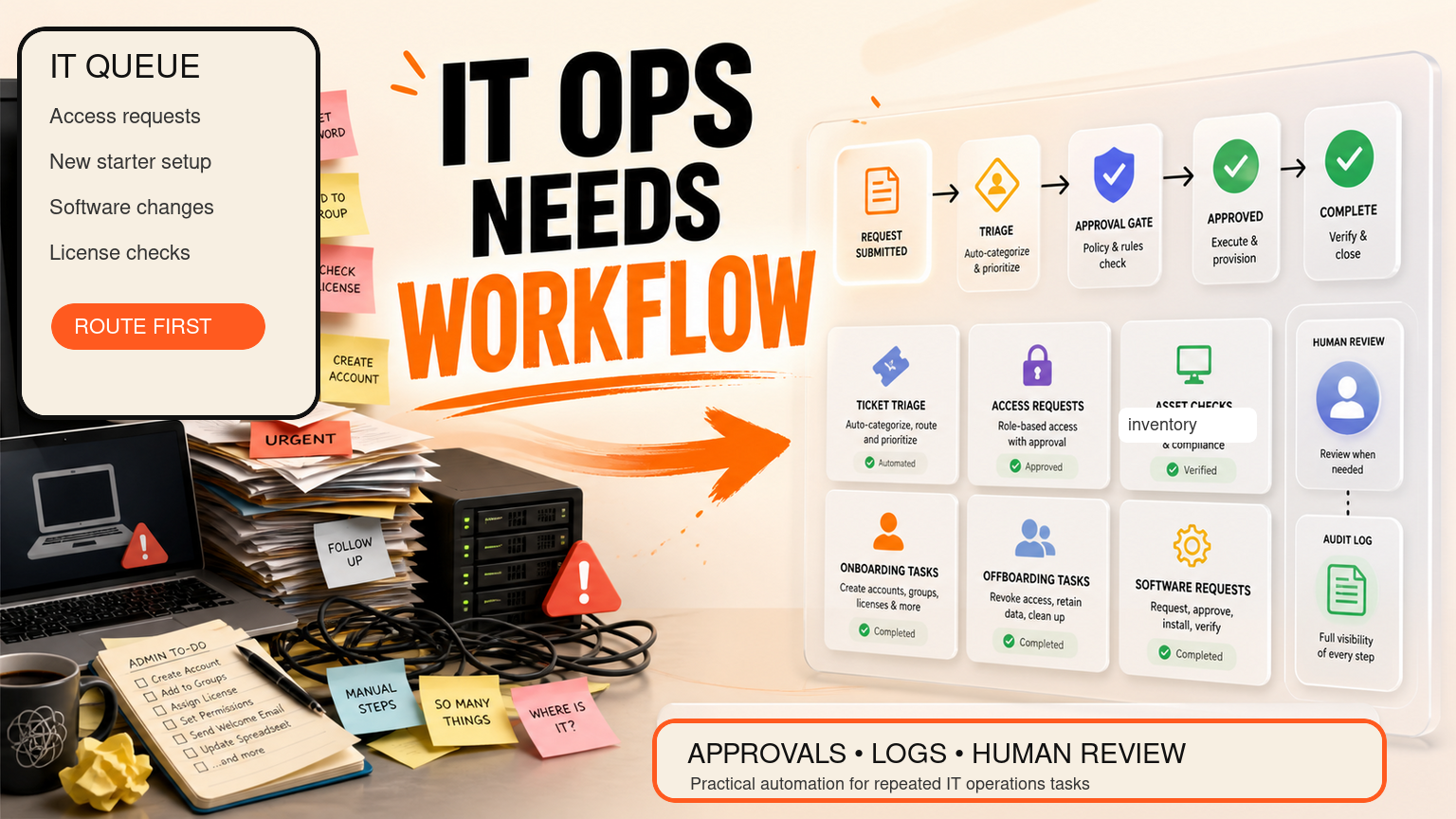
# How SMEs can turn IT admin busywork into AI automation workflows IT operations automation is not about replacing a careful IT admin with a bot. For SMEs, it is about turning repeated requests into owned workflows: rou
How SMEs can turn IT admin busywork into AI automation workflows
IT operations automation is not about replacing a careful IT admin with a bot. For SMEs, it is about turning repeated requests into owned workflows: route the ticket, check the policy, prepare the action, ask for approval when needed, log the result, and make the next handoff clear. But it points to a common business problem: small teams often have hidden IT work scattered across inboxes, chats, spreadsheets, supplier portals, and memory. GOFTUS helps SMEs convert that hidden work into practical automation through /services, so staff spend less time chasing status and more time improving the business.
What this means for SMEs
The useful question is not whether an IT person is busy every minute. The useful question is whether the business has repeatable IT operations that depend on one person remembering the next step. Access requests, laptop setup, software approvals, supplier renewals, password resets, offboarding, device checks, and support triage can all look small in isolation. Together, they create risk when there is no workflow owner, no evidence trail, and no clear rule for when AI or automation is allowed to act.
That is why the buyer problem behind the signal is IT operations automation. A business owner does not need another disconnected dashboard. They need a system that says: this request is low risk and can be prepared automatically; this one changes access and needs approval; this one touches a customer system and needs a human review; this one should update CRM, support notes, or a document folder after completion.
For UK, US, and EU SMEs, the first win is usually not a glamorous AI agent. It is a controlled queue. When repeated tasks enter one lane, the team can see what is waiting, who owns it, what evidence is required, and what automation can safely prepare.
Thirumurugan's view
Thirumurugan's view is that solo-admin and small-ops discussions are a warning against both extremes. One extreme says every repeated task should be automated immediately. The other says automation is too risky, so everything should remain manual. Both miss the middle ground.
The middle ground is workflow design. GOFTUS starts by mapping the real task path: where the request starts, what data is needed, which system is the source of truth, who approves exceptions, what must be logged, and what should happen if the automation is unsure. Only then should AI be added.
A practical IT operations workflow might let AI draft a response, classify a ticket, prepare an onboarding checklist, compare a request against a policy, or collect missing information. It should not silently grant access, change billing, close an employee account, or submit a supplier change without the right approval lane. If the task reaches a browser portal, the same principle applies: observe, prepare, approve, then act.
This matters because many SMEs already use tools like Zapier, Make, n8n, Bardeen, Gumloop, Lindy, Stack AI, or Relevance AI. Those tools can be useful. The gap is that tools automate tasks, while the business still needs workflow ownership around the task.
What SMEs should do next
Start with a simple list of the ten most repeated IT or operations requests. For each one, write down the trigger, the source system, the person who approves it, the evidence required, and the final record that must be updated. Then mark each step as green, amber, or red.
Green steps are safe to automate with minimal review: classify a request, create a checklist, draft a reply, or remind an owner. Amber steps can be prepared by automation but need approval: access changes, licence purchases, account creation, or customer-system updates. Red steps should stay human-led unless the business has strong controls: deleting accounts, changing financial permissions, submitting legal forms, or editing live customer data.
GOFTUS uses this approach in /services because it gives owners a clear route from messy operational work to measurable automation. A workflow can connect ticket intake, CRM updates, internal documents, reporting, and AI agents without pretending the AI should make every decision.
The £100 Startup Kit diagnostic is useful when a founder or operator knows work is leaking across inboxes but does not know which automation should come first. The goal is not a huge transformation deck. It is a shortlist of workflows, risks, quick wins, and the first controlled build.
Faculty AI, Deeper Insights, Waracle, Brainpool AI, LeewayHertz, Markovate, SoluLab, BairesDev, Addepto, STX Next, Netguru, and 10Clouds can all be relevant partners for larger AI, software, or data projects. SaaS platforms such as Zapier, n8n, Make, Lindy, Gumloop, Bardeen, Relevance AI, and Stack AI can also remove manual steps quickly.
What competitors are often missing for SMEs is the operating layer between the tool and the business outcome. A connector can move data. A model can draft a decision. A consultant can build a prototype. But someone still has to define the approval gate, the exception path, the log, the owner, the rollback step, and the improvement loop.
GOFTUS counter-positioning is simple: Tools automate tasks. GOFTUS automates the workflow around the task. That is especially important in IT operations, where a small automation can touch access, devices, staff records, vendors, and customer systems.
If IT work feels either quiet, chaotic, or strangely dependent on one person, do not start by buying another AI tool. Start by turning repeated requests into a visible workflow. Then add automation where it prepares, routes, checks, and documents work without removing human control from risky steps.
The best first IT operations automation project is usually narrow: onboarding, access requests, software approvals, ticket triage, or asset checks. Connect it to /services, keep approvals explicit, and measure whether the business gets faster handoffs, fewer missed steps, and clearer ownership.
Is this Reddit item confirmed news?
No. It shows the kind of small-team IT operations tension that business owners may recognise, but it is not used as a factual claim about all IT admins or all SMEs.
Where should an SME start with IT operations automation?
Start with repeated, low-risk work such as request intake, ticket routing, onboarding checklists, software approval preparation, and follow-up reminders. Move into access or browser actions only after owners, approvals, logs, and stop rules are clear.
How does GOFTUS help?
GOFTUS maps the workflow first, then builds automation around it. That can include AI agents, CRM updates, support triage, document updates, reporting, and browser-based actions with human approval.
These are used as headline-level context that AI and operations automation remain active business topics, not as scraped full-article evidence.
GOFTUS framing: competitor-aware workflow ownership for /services, with AI kept inside approval, logging, and review lanes.