Google DeepMind's Rogue Agent Plan Shows SMEs Need Access Workflows
Google DeepMind's rogue agent plan shows why SMEs need access limits, approvals, logs, and workflow owners before AI agents act.
# Google DeepMind's Rogue Agent Plan Shows SMEs Need Access Workflows Meta description: Google DeepMind's rogue agent plan shows SMEs why AI agents need access limits, approval gates, logs, and workflow owners before AI
Google DeepMind's Rogue Agent Plan Shows SMEs Need Access Workflows
Meta description: Google DeepMind's rogue agent plan shows SMEs why AI agents need access limits, approval gates, logs, and workflow owners before AI agents act.
Google DeepMind's reported work on protecting systems from rogue AI agents is a useful warning for ordinary businesses, not just AI labs. The issue is not whether a small business is building frontier models. The issue is that AI agents are moving from answering questions to taking actions across browsers, files, inboxes, CRMs, support desks, finance tools, and internal systems.
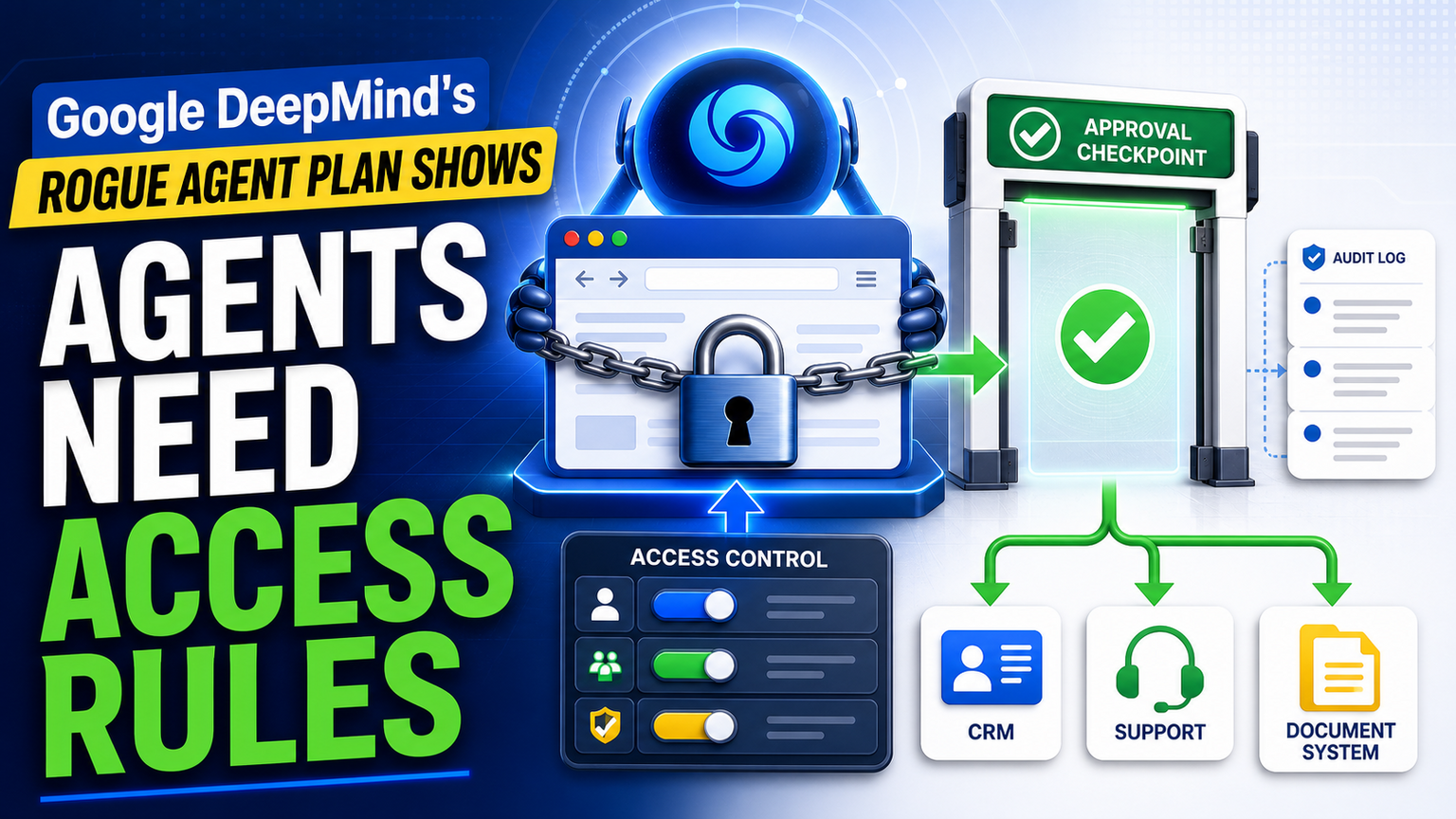
For UK, US and EU SMEs, the lesson is practical. Do not treat an AI agent like a clever intern with unlimited tabs open. Treat it like a new operational user with scoped permissions, review points, logging, and stop rules. The safer question is not "Can the AI do this task?" It is "Which workflow can the AI help run, what is it allowed to touch, and who signs off before anything important changes?"
Axios and MIT Technology Review headlines in Google News also framed the issue around rogue agents and large numbers of interacting agents, although not every direct article page was accessible during this run.
Reddit access was rate limited beyond an initial r/Anthropic feed, so this article treats the community evidence cautiously. The primary signal is headline-level and article-summary news coverage, not a direct DeepMind technical paper review.
Thirumurugan's view
The useful part of the DeepMind signal is the assumption behind it. A serious AI team is planning for agents that may behave outside the intended path. SMEs should borrow that mindset at a smaller scale.
Most business risk will not look like science fiction. It will look like an agent updating the wrong CRM field, replying to the wrong customer, downloading a file it should not store, submitting a browser form before a human checks it, or using stale knowledge to route a support issue. None of those failures require a superintelligent model. They only require an automated tool with too much access and too little supervision.
That is why the starting point should be narrow. Pick one workflow, such as enquiry triage, support FAQ escalation, document intake, supplier comparison, meeting follow-up, or reporting preparation. Define what the agent can read, what it can write, which actions are draft-only, which actions need human approval, and where every decision is logged.
This is also where browser with ai controls becomes important. Many SMEs still run key processes through web apps that do not have clean APIs. Browser-based workflow automation can help, but it needs login boundaries, allowed sites, visible review screens, and a human-approved submit step. Otherwise the convenience of a browser agent can outrun the business controls around it.
What this means for SMEs
SMEs should separate three layers before adopting stronger agents. First, define the workflow: trigger, input data, required checks, output destination, and owner. If the process is messy for a human, an agent will usually make the mess faster.
Second, define the agent boundary. Decide whether the agent can only read, can draft updates, can prepare changes for review, or can execute low-risk actions automatically. For most SMEs, the safest early pattern is read plus draft plus human approval.
Third, define the evidence trail. Store the prompt context, source records, proposed action, reviewer, final decision, and exception. This makes the system easier to trust and improve.
GOFTUS uses this pattern across AI agents, CRM follow-up, support triage, document automation, reporting automation, FAQ automation, and browser-based workflow automation. The point is not to slow AI down. The point is to make useful automation repeatable without giving the agent uncontrolled authority.
The AI services market is crowded. UK firms such as Faculty AI, Deeper Insights, Waracle, and Brainpool AI can help with strategy, builds, and data projects. US providers such as LeewayHertz, Markovate, SoluLab, and BairesDev offer agent and software delivery capacity. European teams such as Addepto, STX Next, Netguru, and 10Clouds bring strong engineering and implementation skills. SaaS platforms including Zapier, n8n, Relevance AI, Lindy, Gumloop, Bardeen, Make, and Stack AI can automate tasks quickly.
Those options can be useful. The gap appears when a business buys a tool or project without owning the operating workflow. Tools automate tasks. GOFTUS automates the workflow around the task.
That means GOFTUS focuses on the unglamorous controls that make agents usable: intake design, permission mapping, approval gates, browser boundaries, CRM or support handoff, reporting, monitoring, and improvement. A small business does not need a giant AI programme to start. It needs one safe workflow that proves value, then a path to expand.
What SMEs should do next
Start with a short agent access audit. List every workflow where AI could soon read information or take action. Mark the systems involved, such as email, CRM, support desk, browser portals, documents, finance tools, or shared drives. Then classify each possible action as read, draft, approve, or execute.
If the action touches customers, money, contracts, credentials, regulated data, or public communication, keep a human approval gate in place. If the task is repetitive and low risk, automate a small part first and monitor exceptions. If the agent uses a browser, add explicit site allow-lists, login rules, download limits, and a stop rule for anything unexpected.
GOFTUS can help turn that audit into a practical workflow map through /services and build controlled AI agents through /agents. For browser-based tasks, the right design is usually not "let the agent browse freely." It is a guided process where the agent prepares work, shows evidence, and asks before submitting. If you want a quick diagnostic, use /contact and bring one workflow you already run every week.
Google DeepMind's rogue-agent coverage is a reminder that agent safety is becoming an everyday operations issue. SMEs should not wait for a perfect AI policy. They should start with one workflow, clear permissions, human approval for risky actions, logs, and a named owner.
The businesses that benefit most will not be the ones that add the most AI tools. They will be the ones that connect agents to controlled workflows that staff can trust.
Does this mean SMEs should avoid AI agents?
No. It means SMEs should avoid uncontrolled AI agents. A narrow agent that drafts updates, gathers evidence, and asks for approval can be safer and more useful than a broad agent with vague instructions.
Where should a business start with agent controls?
Start with one repeated workflow, such as lead follow-up, support triage, document intake, or report preparation. Define read access, write access, approval points, logs, and the person who owns the workflow.
How does GOFTUS help with this?
GOFTUS designs practical AI automation around the business process, not just the prompt or tool. That includes agent boundaries, browser controls, CRM or support handoff, monitoring, and improvement through /services and /agents.
Reddit was rate limited during broader checks, so no Reddit claim is treated as confirmation.