Google's Agent Evaluations Show SMEs Need Browser Workflow Controls
Google's agent evaluation launch shows SMEs why browser with AI controls need approvals, logs, CRM handoffs, and safer workflow ownership.
# Google's Agent Evaluations Show SMEs Need Browser Workflow Controls Meta description: Google's agent evaluation launch shows SMEs why browser with AI controls need approvals, logs, CRM handoffs, and safer workflow own
Google's Agent Evaluations Show SMEs Need Browser Workflow Controls
Meta description: Google's agent evaluation launch shows SMEs why browser with AI controls need approvals, logs, CRM handoffs, and safer workflow ownership.
Quick answer
The direct Google Cloud page path was not fully retrievable in this cron environment, so this post treats the Google item as a headline-level official-source signal rather than a full article-body scrape.
The business point is clear enough for UK, US and EU SMEs. AI agents are moving from chat into tested, managed work. When an agent can plan, call tools, use a browser, update records, or trigger follow-up, the question is no longer whether the model sounds clever. The question is whether the workflow has tests, approvals, logs, stop rules, and a responsible owner before it touches live business systems.
That is why the phrase browser with ai controls matters. Browser-based work is where many small businesses still run operations: supplier portals, CRMs, quote tools, inboxes, support desks, spreadsheets, finance screens, and admin dashboards. GOFTUS helps businesses turn those messy manual paths into narrow, reviewed workflows through /agents and /services, not loose agents clicking around the internet.
What this means for SMEs
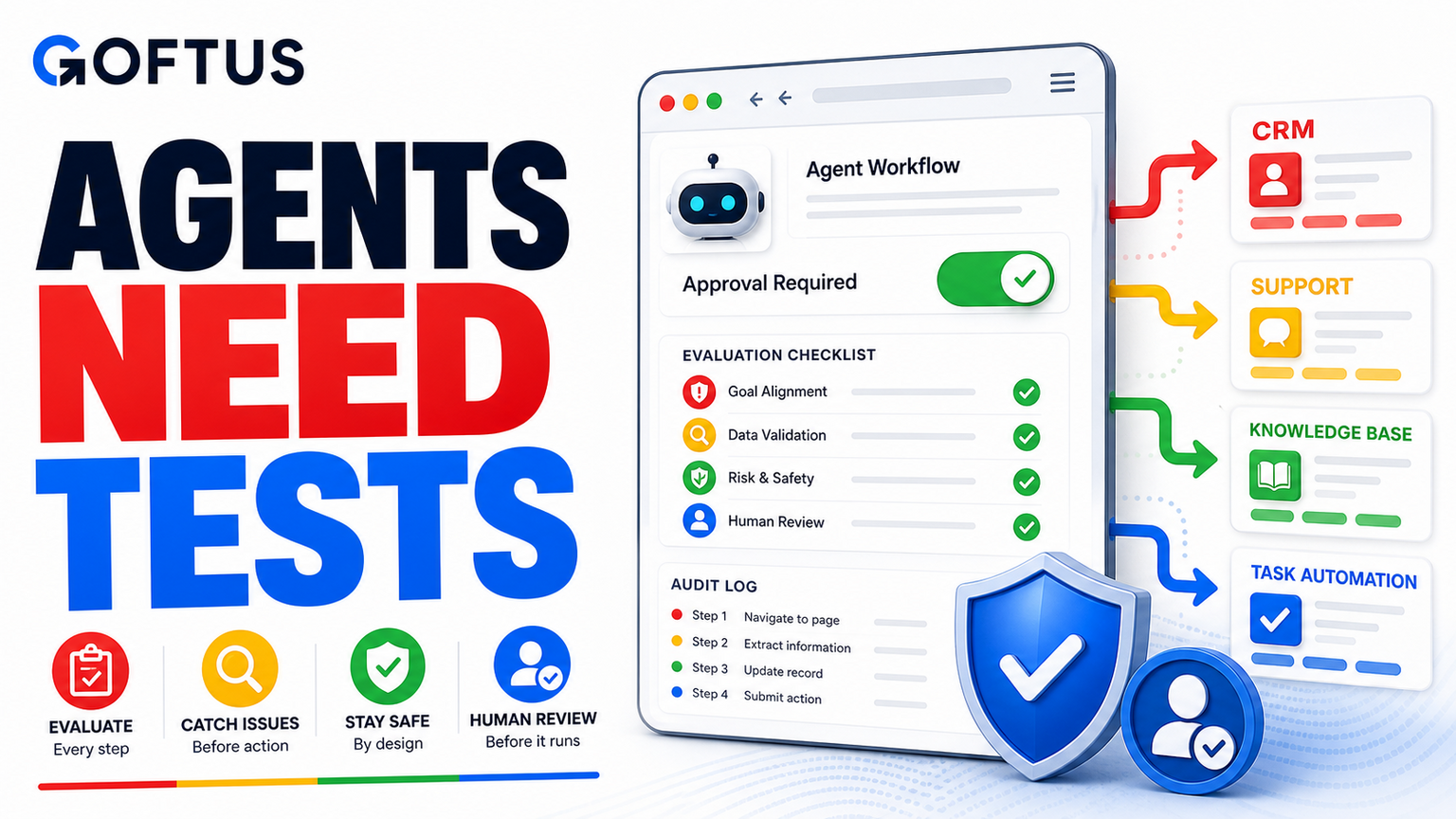
Agent evaluation is not only an enterprise-platform feature. It is a habit SMEs should copy before putting any AI agent into production. A simple evaluation asks: what task is the agent allowed to perform, what input should it trust, what output should it create, what action is too risky, and what evidence must be shown to a human before anything changes.
For example, a sales operations team may want an agent to read a new enquiry, check the website form, enrich the CRM, draft a reply, and create a follow-up task. That sounds useful. It also crosses several risk boundaries. The agent sees customer data, uses judgment, moves between tools, and may prepare communication that a prospect will read. Without controls, the business cannot easily explain what happened when an error appears.
A safer workflow starts smaller. The agent can classify the enquiry, pull approved context from the website or knowledge base, suggest the CRM update, and draft the response. A person approves the send, unusual cases are routed to staff, and every action is logged. Over time, the business reviews what was approved, what was edited, what was rejected, and what questions remained unanswered.
That is the practical value of agent evaluations for SMEs. They turn AI from a one-off demo into an operating system improvement loop.
Hajikreena's view
The biggest mistake in SME AI adoption is treating the model as the project. The model is only one component. The real project is the workflow around it.
If Google, Microsoft, OpenAI, Anthropic and other vendors are investing in agent platforms, evaluations and governance features, smaller businesses should not copy the technology stack blindly. They should copy the control pattern. Define the job. Test the job. Approve the risky step. Log the result. Improve the process monthly.
GOFTUS often frames this as workflow ownership. The business should know who owns the automation, who reviews exceptions, who updates the source material, who checks reports, and who can turn the agent off. That is more useful than buying another agent tool and hoping the team will remember how it behaves.
Competitor lens
There are many credible providers and tools in this market. UK firms such as Faculty AI, Deeper Insights, Waracle and Brainpool AI can help with advanced AI programmes. US providers such as LeewayHertz, Markovate, SoluLab and BairesDev can build custom systems. European teams such as Addepto, STX Next, Netguru and 10Clouds can support engineering delivery. SaaS tools including Zapier, n8n, Relevance AI, Lindy, Gumloop, Bardeen, Make and Stack AI can automate useful steps quickly.
The gap for SMEs is usually not access to a tool. It is workflow design. A business needs to decide which step should be automated, which step should stay human-approved, which systems are allowed, what evidence is required, and how the result will be measured.
Tools automate tasks. GOFTUS automates the workflow around the task. That means the browser action, CRM update, support handoff, document check, reporting loop, and exception route are designed together. The point is not to attack tools or consultants. The point is to make them usable inside a real operating process.
What operators should do next
Start with one browser-heavy workflow that already wastes time. Common examples include checking a supplier portal, copying lead details into a CRM, updating support tickets, downloading documents, reconciling order information, or preparing a quote.
Write the workflow as plain steps. Mark every step as read-only, draft-only, human-approved, or forbidden. If the workflow touches customer data, financial details, contracts, passwords, regulated information, or outbound messages, keep the final action human-approved.
Next, create a test set with normal cases, messy cases, missing data, duplicate records, policy exceptions, and pages that should stop the agent. A useful agent should not only complete easy tasks. It should also know when to pause.
Finally, track time saved, edits required, approvals rejected, unanswered questions, customer response speed, and exception reasons. That turns browser-based workflow automation into a managed business capability rather than a risky shortcut.
If you want a practical starting point, GOFTUS can map one workflow, identify the approval gates, and design an agent or automation path through /agents, /services, or a short diagnostic via /contact.
Summery for SMEs
Google's agent evaluation signal is another reminder that AI agents need operating controls before they handle real work. For SMEs, the priority is not a larger model or a flashier demo. It is a safer workflow: narrow task scope, tested examples, human approval for risky browser actions, clear logs, CRM or support handoff, and a monthly improvement loop.
The best first project is usually a repetitive browser or admin workflow where staff already copy data between systems. Add browser with ai controls before allowing the agent to submit forms, change records, send messages, or access sensitive portals. GOFTUS can help turn that into a measured workflow system instead of a loose automation experiment.
FAQ
What is browser with ai controls?
Browser with ai controls means an AI agent can help with browser-based work, but only inside rules the business defines. It should have allowed websites, blocked actions, approval gates, logs, and clear stop rules.
Should SMEs use AI agents for browser work now?
Yes, but only for narrow workflows first. Start with draft, classify, check, extract, or prepare tasks before letting an agent submit, send, purchase, delete, or change records.
How can GOFTUS help?
GOFTUS maps the workflow, chooses the safest automation pattern, connects CRM, support, document or reporting tools, and builds review loops through /agents and /services.
Source notes
Additional Reddit searches hit 429 rate limits, so Reddit is treated as weak adjacent operator context, not confirmation of the Google item.