FIFA Hydration Break Review Shows SMEs Need Exception Workflows
FIFA's World Cup hydration-break review shows why SMEs need AI exception workflows with approvals, audit logs and plain-English handoffs.
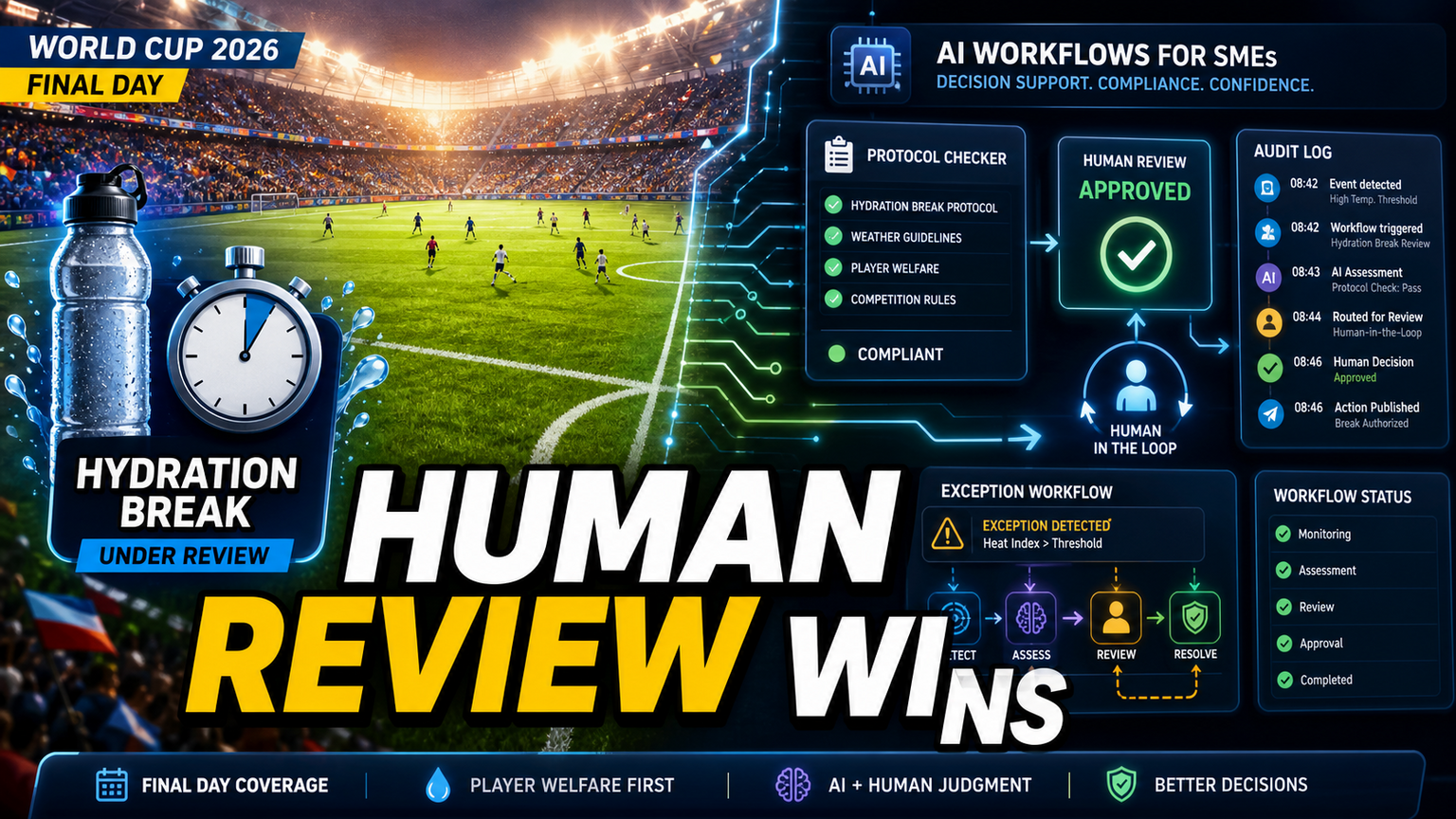
FIFA World Cup 2026 final-day coverage is not only about Spain vs Argentina. For SMEs, the useful comparison is human-led decision support. High-pressure operations need software around the people who stay accountable. Hydration breaks are a simple example: a rule exists, the context changes, customers and participants react, then leaders need evidence, protocol checks, impact review and clear communication. That same pattern belongs in support, sales, HR, finance, documents, browser tasks and daily operations.
The final-day FIFA story
In the same final-day news cycle, a separate operations issue had heat: hydration breaks.
Why hydration breaks are a workflow lesson
Hydration breaks look small compared with VAR or match tactics, but they are a useful business analogy because they sit at the intersection of rules, safety, timing, experience and public trust. A policy can be sensible in one condition and disruptive in another. A protocol can help protect people and still create customer frustration if it is applied without context or explanation.
That is exactly where AI software can help SMEs. AI should not own the final decision, but it can collect evidence, check the policy, flag exceptions and prepare a plain-English summary for the person responsible. In a business, that might mean:
A support workflow that spots repeated complaints and routes them to an owner instead of letting a chatbot repeat the same answer.
A sales workflow that flags a risky discount, missing approval or unusual contract clause before a rep sends it.
A finance workflow that holds a payment above a threshold until a manager reviews the reason, supplier and audit trail.
A HR workflow that checks policy steps before a sensitive response goes out.
A browser-agent workflow that can gather information, but must ask before submitting forms, changing records or downloading files.
The lesson is not more automation for its own sake. The lesson is better exception handling around automation.
What this means for SMEs
SMEs often buy AI tools as point solutions: a chatbot, a CRM assistant, a document summariser, an n8n workflow, a browser agent or a reporting dashboard. Those tools can be useful, but the business value appears when they are connected to a proper operating model.
A World Cup-style review process maps neatly to SME automation:
1. Define the protocol. What should happen when the work is normal?
2. Define the exception. What makes this case risky, urgent, emotional, regulated or commercially important?
3. Capture evidence. What did the system see, what source did it use and what changed?
4. Route to a person. Who owns the decision when impact is high?
5. Explain the outcome. What plain-English reason should the customer, staff member or manager see?
6. Improve the workflow. What should change next month based on repeated exceptions?
This is where GOFTUS positions AI automation differently from a generic SaaS tool. Software vendors can provide useful features. Consultants can provide advice. GOFTUS focuses on the workflow around the tool: integration, approval gates, monitoring, logs, routing and continuous improvement across support, sales, HR, finance, documents, browser tasks and operations.
A generic AI chatbot might answer customer questions quickly. A standalone dashboard might show a spike in tickets. A SaaS automation template might move data from one app to another. Those are helpful pieces, but they do not solve the deeper problem: who owns the exception when the workflow becomes sensitive?
GOFTUS builds for that ownership layer. The practical contrast is simple:
Tools generate suggestions. GOFTUS designs the handoff.
Dashboards show signals. GOFTUS connects signals to owners, tasks and review loops.
Agents can act. GOFTUS defines what they can do alone, what needs approval and what must be logged.
Automations move work faster. GOFTUS makes sure important decisions still have evidence and accountability.
For SMEs, that is the difference between looking automated and actually operating with control.
A practical AI workflow pattern
If you want the FIFA hydration-break lesson inside your business, start with one workflow that already causes friction. Do not begin with a broad AI transformation project. Pick a workflow where customers or staff already complain about delay, inconsistency or unclear ownership.
A simple GOFTUS-style pattern looks like this:
Intake: capture the request from the website, inbox, CRM, support form or browser task.
Classification: let AI label the topic, urgency, risk and likely owner.
Evidence: attach the source message, customer record, document, policy note and previous actions.
Protocol check: compare the case with approved rules or service promises.
Approval: ask a human before refunds, contract changes, payroll edits, compliance replies, payments or irreversible browser actions.
Explanation: generate a plain-English summary the owner can edit before sending.
Audit log: record what AI suggested, who approved it and what happened next.
Review: look monthly for repeated exceptions that deserve a better FAQ, CRM rule, document template or n8n workflow.
This gives teams the speed of AI software without pretending software should own every judgement.
The final day of the FIFA World Cup 2026 is a useful reminder that even simple operational rules need review when real people, pressure and public trust are involved. Hydration breaks are not just a football story. They are a workflow story: define the protocol, monitor the impact, capture evidence, route exceptions and explain decisions clearly.
SMEs need the same approach when adding AI automation. Let AI agents, dashboards and workflow tools assist with evidence, summaries and routing. Keep humans accountable for high-impact decisions. Log the handoff. Improve the process after repeated exceptions.
Should SMEs use AI to make final decisions?
No. SMEs should use AI to support decisions, not to own high-impact outcomes. AI can summarise evidence, check rules, draft responses and flag risk. Humans should approve sensitive actions such as refunds, contract changes, HR responses, finance approvals, compliance replies and irreversible browser tasks.
What is an exception workflow?
An exception workflow is the process that takes over when normal automation is not enough. It defines what counts as risky or unusual, what evidence must be attached, who reviews it, what approval is required and how the decision is logged.
Where can GOFTUS help first?
A strong starting point is support or FAQ automation because repeated customer questions reveal where the business already has friction. GOFTUS can connect FAQs, CRM notes, support routing, document templates and AI agents so common requests move faster while complex issues reach the right person. See /services#faq-automation for the practical entry point.