Fastly and Experian Show AI Web Traffic Needs Trust Workflows
Fastly and Experian show AI web traffic needs trust workflows. SMEs should verify agents, approve actions and log customer-facing automation.
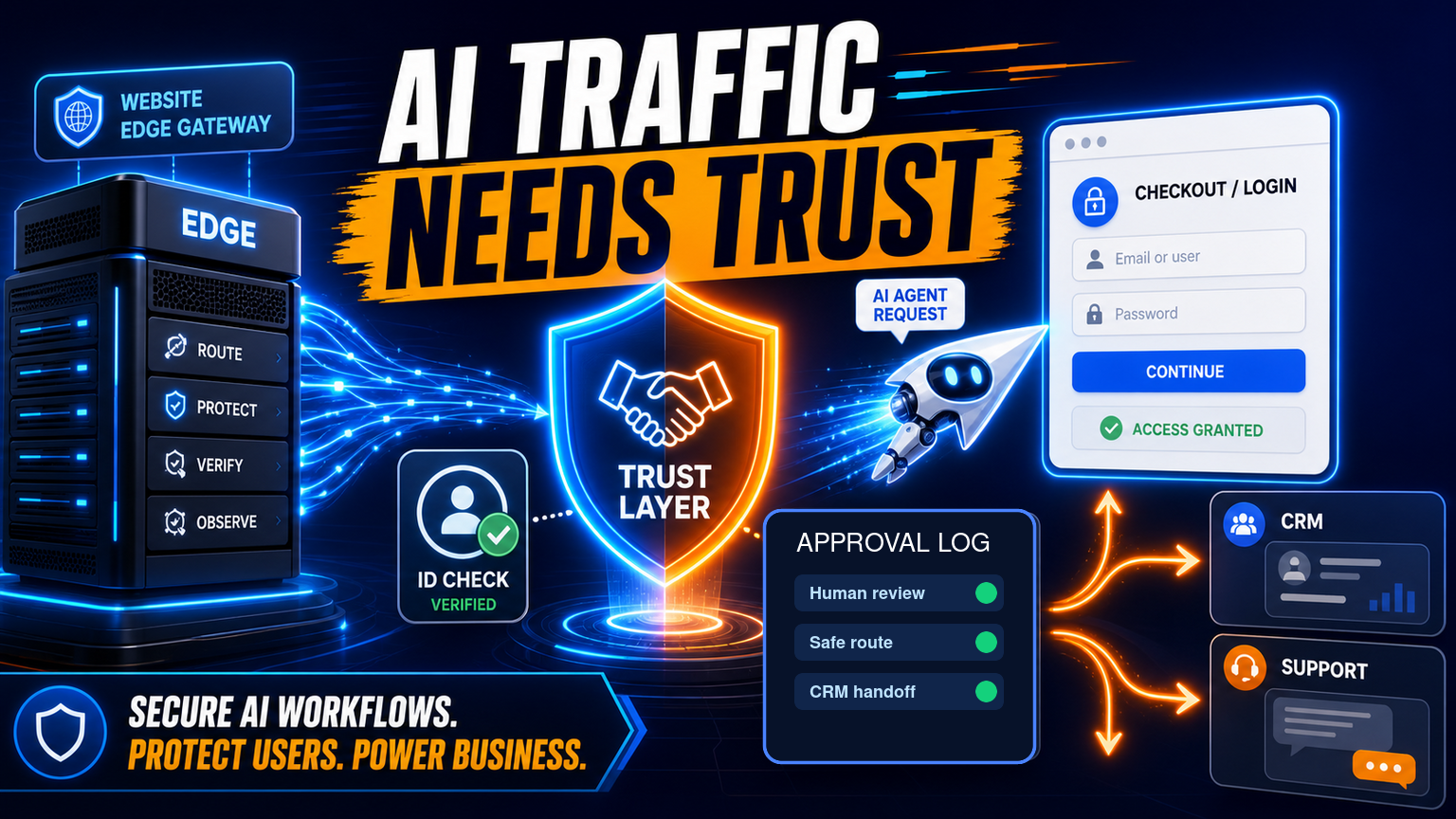
# Fastly and Experian Show AI Web Traffic Needs Trust Workflows Fastly joining Experian's Agent Trust ecosystem is a useful signal for SMEs because it moves the AI-agent conversation away from demos and into traffic, id
Fastly and Experian Show AI Web Traffic Needs Trust Workflows
Fastly joining Experian's Agent Trust ecosystem is a useful signal for SMEs because it moves the AI-agent conversation away from demos and into traffic, identity and permission checks. Treat that as a headline-level news cross-check rather than a full independent scrape of every article body.
The business lesson is simple. As more AI agents browse sites, fill forms, request information and trigger actions, companies will need a way to tell helpful automation from spam, fraud, scraping and poorly governed bot traffic. This is not just an enterprise edge-security topic. It affects any UK, US or EU business that relies on web forms, booking flows, quote requests, customer portals, partner dashboards or support pages.
For GOFTUS clients, the point is not to chase another standalone security tool. It is to design the workflow around browser and agent activity: what the agent is allowed to do, when a person must approve, which records are updated, which exceptions are stopped, and how the business reviews the trail later.
Quick answer
AI web traffic is becoming operational traffic. SMEs should not wait until bots, browser agents and customer-facing automations are mixed together in the same inbox. They should define trust workflows now: identify the request source, limit what an agent can do, require approval for risky actions, log every handoff, and connect approved activity back to CRM, support or reporting systems. GOFTUS builds these controlled automation paths through /services and agent workflows through /agents.
What this means for SMEs
Most SMEs already have some browser-based work that is awkward to automate. Staff copy enquiry details from portals into a CRM. Support teams check dashboards for order status. Operations teams log into supplier sites, download documents, update spreadsheets and chase missing fields. AI browser agents make those tasks easier to automate, especially when APIs do not exist.
The risk is that browser automation can look productive while quietly becoming unmanaged. If an agent can enter a portal, click buttons, submit forms or update records, the business needs more than a prompt. It needs login boundaries, approved domains, field-level rules, submit checks, audit logs and stop conditions. Otherwise the same workflow that saves time can also create wrong customer records, duplicate tickets, missed consent checks or unexplained actions.
The Fastly and Experian signal matters because it points to a wider shift. The web is no longer only human visitors and old-style crawlers. Businesses will increasingly see traffic from assistants, procurement agents, monitoring agents, partner bots and internal automations. Some will be valuable. Some will be noisy. Some will be risky. A practical operator needs a trust layer that can decide what happens next.
Bharatvaj's view
My view is that SMEs should treat AI web traffic like a workflow-design problem, not only a cybersecurity alert. A security product can classify traffic. A browser agent can perform a task. A SaaS connector can move data. The missing piece is often the operating model between them.
For example, an approved agent request might be allowed to read delivery status, create a draft CRM note and alert a human for confirmation. It should not be allowed to change payment details, submit a binding quote or overwrite a customer record without review. That distinction has to be written into the workflow before the agent is turned on.
This is where GOFTUS positions its work. We help define the safe path, build the automation around existing tools, and make sure the business can see what happened. That may include browser with AI controls for portal tasks, AI agents for internal routing, document automation for uploaded files, and reporting automation so managers can review exceptions instead of guessing.
Competitor lens
Faculty AI, Deeper Insights, Waracle and Brainpool AI in the UK, LeewayHertz, Markovate, SoluLab and BairesDev in the US, and Addepto, STX Next, Netguru and 10Clouds in Europe can all help businesses adopt AI. SaaS tools such as Zapier, n8n, Relevance AI, Lindy, Gumloop, Bardeen, Make and Stack AI can also automate individual steps.
The gap for many SMEs is not whether a tool can click, classify or sync. It is whether the surrounding workflow is safe enough to run repeatedly. Tools automate tasks. GOFTUS automates the workflow around the task. That means the CRM update, the approval rule, the exception queue, the support handoff, the customer note and the review dashboard are designed together.
This matters even more when traffic is coming from AI agents or automated browsers. A business may need one path for trusted customer agents, another for internal staff agents, another for suspicious traffic, and another for manual review. A single automation recipe rarely covers that whole chain.
What SMEs should do next
First, map the web workflows where staff still copy data between tabs. Look for quote forms, supplier portals, customer support dashboards, booking tools, finance portals and admin panels. These are often good candidates for controlled browser automation.
Second, decide which actions are read-only, which can create drafts, and which require approval before submission. A browser agent that gathers information is very different from one that commits a change. The approval line should be explicit.
Third, connect the workflow to the system of record. If the agent helps with a lead, it should update CRM. If it helps with a support issue, it should update the ticket. If it reads a document, it should store the extraction and confidence notes. GOFTUS can help design this through /services and agent builds through /agents.
Fourth, review the unanswered and blocked cases. The most useful automation metric is often not how many clicks the agent completed. It is which cases still needed a human, why they needed review, and what should be improved next month.
Summery for SMEs
AI web traffic and browser agents are becoming part of normal operations. The opportunity is faster portal work, cleaner follow-up and better customer response. The risk is unapproved action. SMEs should put trust workflows around agents before they let them act: approved domains, login boundaries, human review, audit logs, CRM or support handoff, and clear stop rules. GOFTUS helps turn those controls into practical automation systems rather than isolated experiments.
FAQ
Should SMEs block all AI agent traffic?
No. Some AI traffic may be useful, especially when customers, partners or internal teams use agents to gather information or complete safe tasks. The smarter move is to separate trusted, limited activity from risky or unknown traffic.
Where should browser automation start?
Start with narrow, repetitive workflows where staff already follow a checklist: checking a portal, copying details, drafting a CRM note, routing a support case or preparing a report. Keep final submission behind approval until the workflow has been tested.
How does GOFTUS help?
GOFTUS designs the workflow around the automation. That includes the agent boundary, human approval point, data handoff, exception route and improvement loop. Businesses can start with /services, /agents or a consultation through /contact.