FAQ Automation Should Turn Website Questions Into Support Triage
FAQ automation turns website questions into customer answers, lead capture, support triage, CRM routing, and measurable workflow automation for SMEs.
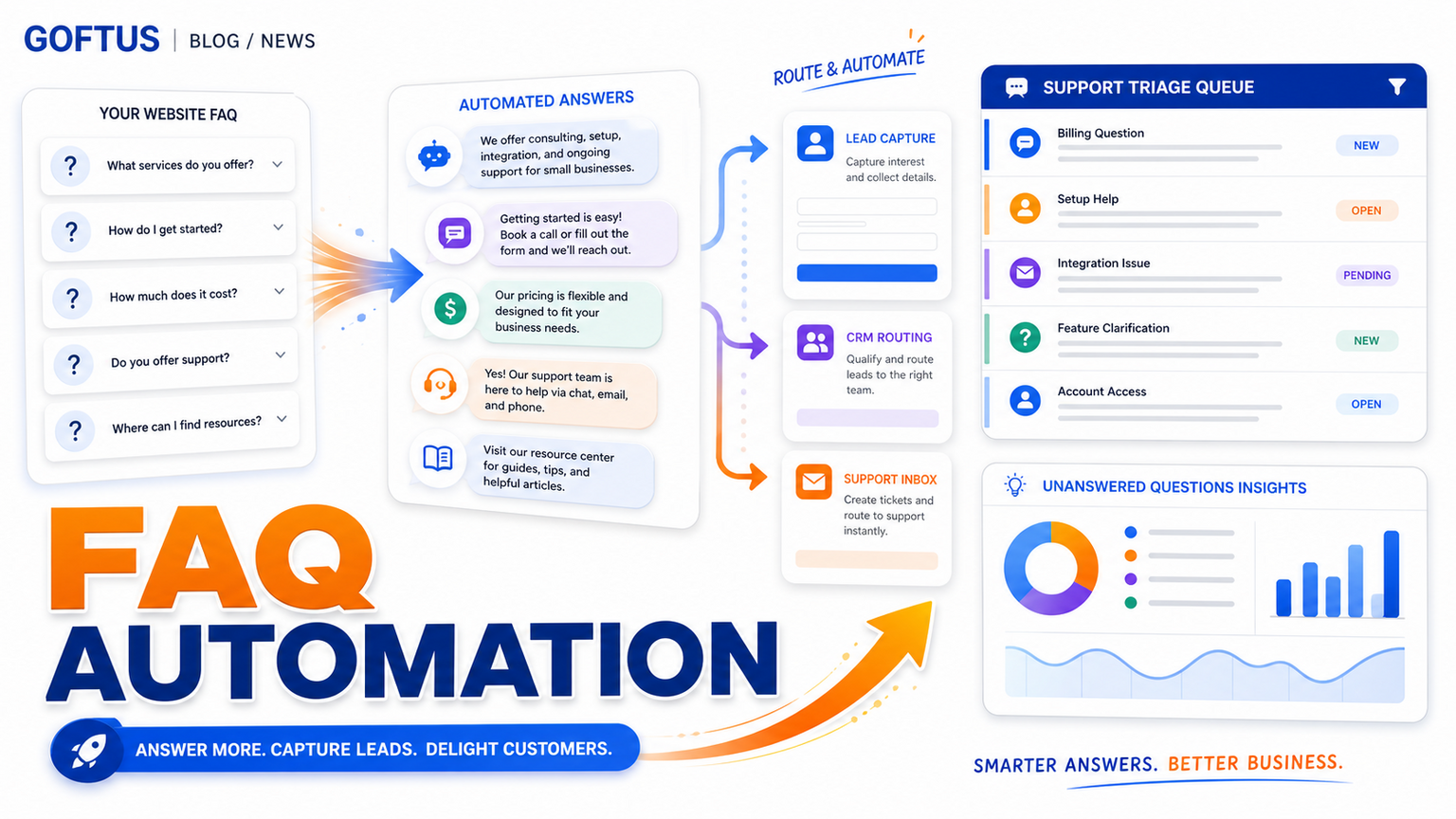
# FAQ Automation Should Turn Website Questions Into Support Triage Meta description: FAQ automation turns website questions into customer answers, lead capture, support triage, CRM routing, and measurable workflow autom
FAQ Automation Should Turn Website Questions Into Support Triage
Meta description: FAQ automation turns website questions into customer answers, lead capture, support triage, CRM routing, and measurable workflow automation for SMEs.
Quick answer
A useful FAQ automation system is not just a website chatbot with a few canned answers. For UK, US, and EU SMEs, it should turn repeated website questions into answered enquiries, captured leads, support tickets, CRM updates, and clear follow-up work for the right person. That is why today's GOFTUS daily FAQ automation cluster focuses on support triage: the moment when a simple answer becomes a workflow.
The source signal is practical rather than sensational. Google News is surfacing 2026 buyer guidance from Salesforce, G2, IBM, Sprout Social, and Business.com around customer-service automation, conversational support platforms, digital assistants, and AI customer support risks. Reddit's r/smallbusiness hot feed also showed an operator post on 28 July about leaving simple one-page answers after jobs and seeing more repeat calls.
GOFTUS reads that signal this way. FAQ automation should be the first customer-answer layer, not a detached widget. Start with the questions buyers already ask on your website. Give trusted answers. Capture intent. Route complex issues. Then improve the answer base from the questions the system could not resolve.
What this means for SMEs
Many SMEs buy a chatbot when the real issue is an unanswered-question process. A prospect asks about pricing, service area, onboarding, support, delivery time, integrations, documents, refunds, or whether the business can handle a special case. If the answer is hidden in a long page, trapped in a staff member's inbox, or answered differently by each team member, the business loses trust before anyone has a sales call.
AI FAQ automation fixes the front of that workflow. It maps repeated questions, approves the answer set, places those answers where buyers search, and turns unclear questions into structured actions. A website FAQ chatbot can answer the easy question immediately, but the stronger system also asks a short follow-up, records the lead, tags the issue, and routes it to sales, support, delivery, or an owner for review.
That is the difference between content automation and operational automation. The first publishes answers. The second changes what happens next.
For a small business, the first useful version can be narrow. Pick 20 to 40 recurring questions. Separate safe answers from questions that need human approval. Connect the FAQ layer to a CRM, inbox, helpdesk, spreadsheet, or task board. Track which questions were answered, which created leads, which needed escalation, and which should become new public content.
GOFTUS builds this as part of its FAQ automation service, then links it into wider AI automation services when the pattern is proven.
Bharatvaj's view
Bharatvaj's view is simple: most businesses do not need a bigger chatbot first. They need a better customer-answer workflow.
If five customers ask the same question every week, that question should not depend on whoever checks the inbox first. It should have an approved answer, a clear escalation path, and a record of what happened. If a buyer asks something the FAQ cannot answer, the system should not pretend. It should collect context, create a follow-up task, and show the team where the answer base needs improvement.
This is where AI FAQ automation becomes a wedge into workflow automation. The FAQ layer captures demand. The routing layer assigns work. The CRM layer keeps the relationship alive. The reporting layer shows which questions block buyers. Once that loop works, the business can extend automation into onboarding, document collection, quotes, renewals, and customer support triage.
What competitors are missing
Competitors and tools have a place. Zapier, n8n, Make, Bardeen, Gumloop, Lindy, Relevance AI, and Stack AI can move data and trigger actions. Consultancies such as Faculty AI, Deeper Insights, Waracle, Brainpool AI, LeewayHertz, Markovate, SoluLab, BairesDev, Addepto, STX Next, Netguru, and 10Clouds can support larger AI programmes.
The gap for SMEs is usually ownership of the whole customer-answer workflow. A SaaS chatbot may answer questions but ignore the messy handoff. A consultant may define a strategy but leave the team with a tool stack they cannot maintain. Tools automate tasks. GOFTUS automates the workflow around the task.
For FAQ automation, that means GOFTUS focuses on approved answers, lead capture, CRM or support routing, exception review, measurement, and monthly improvement. The business gets a system that answers customers and creates work for humans only when humans are actually needed.
What SMEs should do next
Start by collecting real questions. Use website forms, chat transcripts, sales calls, email threads, support tickets, and search queries. Group them into repeatable themes: pricing, availability, implementation, integrations, documents, support, security, and next steps.
Then assign each theme a rule. Some questions can be answered instantly. Some should show a short answer and offer a consultation. Some should create a ticket. Some should route to sales. Some should stay human-only because the answer depends on risk, pricing, legal terms, or account context.
After that, connect the FAQ layer to the tools the team already uses. A practical first stack might be website FAQ cards, a simple AI answer assistant, CRM lead capture, inbox or helpdesk routing, and a weekly unanswered-question review. If the process touches browser portals or back-office dashboards, connect it carefully with AI agents and human approvals rather than letting an agent act freely.
The goal is not to replace staff. The goal is to stop staff from answering the same basic question all day while important follow-up gets missed.
Summery for SMEs
FAQ automation is the safest first step into customer-facing AI because it starts with known questions and approved answers. The business value appears when the FAQ layer is connected to follow-up: leads, support tickets, CRM notes, owner review, and better content over time. Treat it as a workflow system, not a chatbot purchase.
FAQ
Is FAQ automation only for websites?
No. A website is the best starting point because buyers already ask questions there, but the same answer base can support sales emails, support inboxes, internal knowledge assistants, onboarding forms, and CRM follow-up.
How many questions should an SME automate first?
Start with the questions that appear every week. A focused set of 20 to 40 approved answers is usually more useful than a large unreviewed knowledge base.
When should a question go to a person?
Send a question to a person when it involves pricing exceptions, legal terms, account-specific details, complaints, security requirements, or anything the approved answer base cannot answer with confidence.
Source notes
This is labelled as a social/operator signal, not a verified industry statistic.
X signal: xurl was not installed in this unattended environment, so no X search was used.
If your team wants to turn repeated website questions into customer answers, lead capture, and support routing, start with the GOFTUS FAQ automation service or book a practical diagnostic through contact.