FAQ Automation for SMEs: Turn Website Questions Into Sales and Support Follow-Up
FAQ automation helps SMEs turn website questions into approved answers, CRM follow-up, support routing, and measurable weekly support insight.
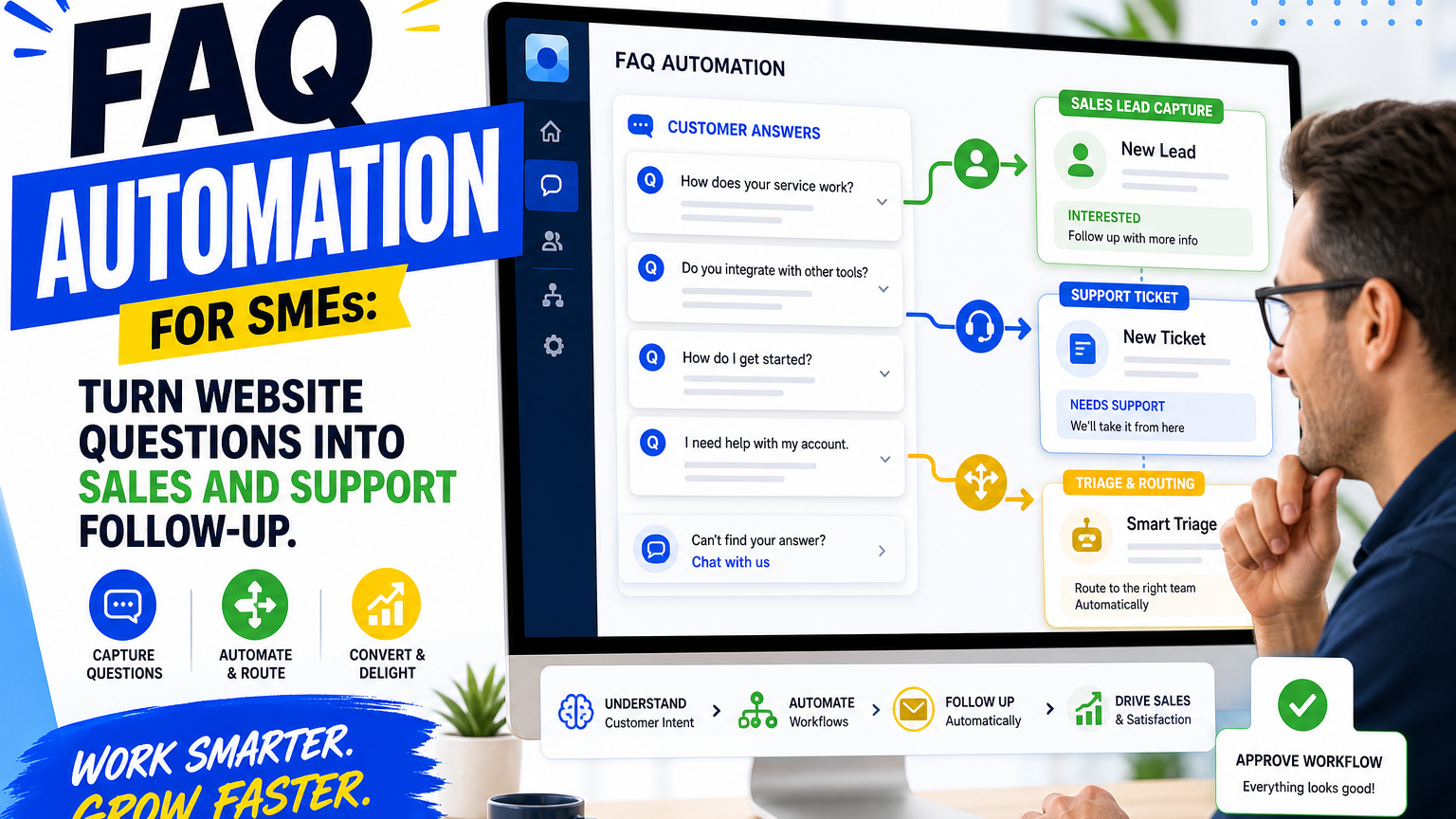
# FAQ Automation for SMEs: Turn Website Questions Into Sales and Support Follow-Up Meta description: FAQ automation helps SMEs turn website questions into approved answers, CRM follow-up, support routing, and measurable
FAQ Automation for SMEs: Turn Website Questions Into Sales and Support Follow-Up
Meta description: FAQ automation helps SMEs turn website questions into approved answers, CRM follow-up, support routing, and measurable weekly support insight.
Quick answer
FAQ automation is not just a cheaper website chatbot. For UK, US, and European SMEs, the useful version captures real customer questions, answers approved topics, routes complex requests, and turns buying intent into sales or support follow-up.
The business problem is simple: customers ask questions before they buy, renew, complain, or leave. If those questions sit inside inboxes, chat logs, website forms, or staff memory, the business loses context. FAQ automation should create the first customer-answer layer, then hand the workflow to CRM, support, documents, or a human reviewer when needed. GOFTUS treats this as a workflow system, not a standalone bot. The natural starting point is the GOFTUS FAQ automation service at /services#faq-automation.
What this means for SMEs
Most smaller businesses already answer the same questions again and again. A prospect asks about pricing, delivery, onboarding, service area, booking steps, integrations, or refund terms. A support customer asks how to change details, find a document, cancel, escalate, or speak to a person. Staff know the answers, but the answers are scattered across old emails, sales calls, help pages, spreadsheets, and individual memory.
That creates three problems. First, response speed depends on who is available. Second, the same question can receive different answers from different people. Third, useful buying signals never reach the follow-up system. A customer who asks whether a service works in Manchester, Dubai, New York, or Berlin may be ready to buy, but if the question is treated like a normal FAQ, the lead can go cold.
Good FAQ automation fixes the handoff. The website can answer approved questions instantly. It can ask one or two qualifying questions when intent is unclear. It can create a CRM task when a visitor shows buying intent. It can open a support ticket when the issue is sensitive. It can route policy, finance, or account changes to a person before anything is promised.
The key is not to automate every answer. The key is to define which questions are safe, which need review, and which should trigger another workflow. That is where many DIY chatbot projects fail. They install a widget, load a knowledge base, and hope the tool knows when to stop. SMEs need a clearer operating design.
Hajikreena's view
Hajikreena's view is that FAQ automation should be owned by the business process, not by the chatbot screen. A useful FAQ layer starts with the real questions customers already ask. Those questions should be grouped into answer, qualify, route, and improve categories.
Answer questions are low risk and repeated. They can use approved copy from the website, proposal, support guide, or product page. Qualify questions need one extra detail, such as location, order type, company size, or urgency. Route questions should create a task for sales, support, finance, or operations. Improve questions show where the website is unclear, because customers keep asking what the page should have answered.
This makes FAQ automation measurable. The weekly review should ask: which questions were answered, which were escalated, which led to CRM follow-up, which were unanswered, and which website page needs improvement. That is more valuable than simply counting bot conversations.
What SMEs should do next
Start with a narrow workflow. Pick one service page, one product area, or one support category where repeated questions slow the team down. Collect the last fifty real questions from forms, inboxes, calls, chat, and sales notes. Remove private data. Turn them into approved answer groups.
Next, decide the stop rules. The automation should stop before legal advice, medical advice, regulated finance, refunds, contract changes, account access, payment promises, or anything the team has not approved. The answer can say that the team will review the request and create a follow-up task.
Then connect the handoff. If the visitor asks a buying question, the system should create a CRM lead or update an existing contact. If the visitor asks a support question, it should open or enrich a ticket. If the question needs a document, it should pull from the approved document process. If the next action requires a browser portal, the business can later add browser with ai controls through /agents and /services so human approval, logs, login boundaries, and stop rules are in place.
Finally, review the gaps weekly. The most useful FAQ automation report is not just a chat transcript. It is a list of unanswered questions, repeated objections, missed lead signals, and pages that need clearer copy. That is how FAQ automation becomes a first step toward wider workflow automation.
Competitor lens
Tools such as Zapier, n8n, Make, Bardeen, Gumloop, Lindy, Relevance AI, and Stack AI can be useful for connecting triggers, chat steps, and follow-up actions. Consultants such as Faculty AI, Deeper Insights, Waracle, Brainpool AI, LeewayHertz, Markovate, SoluLab, BairesDev, Addepto, STX Next, Netguru, and 10Clouds can also help with larger AI delivery programmes.
The gap for many SMEs is ownership of the workflow around the answer. A tool can reply to a question. A consultant can build a model or chatbot. But the business still needs approved content, routing rules, CRM handoff, support ownership, review cadence, and improvement loops. Tools automate tasks. GOFTUS automates the workflow around the task.
That is why GOFTUS positions FAQ automation as an operating layer. The answer is only one part of the job. The workflow must decide what happens next, who owns the exception, what is logged, and how the customer receives a reliable response.
Summery for SMEs
FAQ automation should help SMEs capture customer questions before they go cold. The strongest first build is not a giant chatbot. It is a controlled answer and routing workflow for repeated questions, buying intent, support triage, and unanswered-question review.
For a practical starting point, GOFTUS can map the customer questions already reaching your website, inbox, CRM, and support tools, then design the approved answers and handoffs. Start with the FAQ automation service at /services#faq-automation, then expand into /services, /agents, or /questions when the first customer-answer layer is working.
FAQ
Is FAQ automation the same as a website chatbot?
No. A chatbot is the interface. FAQ automation is the workflow behind it: approved answers, question capture, lead routing, support handoff, review logs, and improvements to pages that create confusion.
What should SMEs automate first?
Start with repeated low-risk questions that staff already answer every week, then add CRM or support handoff for buying intent and complex issues.
When should a human review the answer?
Use human review for account changes, refunds, regulated advice, legal wording, payment promises, urgent complaints, and anything outside the approved answer set.
How does this connect to GOFTUS services?
GOFTUS maps the question flow, builds the answer layer, connects CRM or support follow-up, and reviews unanswered questions through /services#faq-automation.