FAQ Automation for SMEs: Turn Website Questions Into Qualified Follow-Up
FAQ automation helps SMEs answer repeated website questions, qualify interest, route support issues, and turn missed enquiries into follow-up.
# FAQ Automation for SMEs: Turn Website Questions Into Qualified Follow-Up Meta description: FAQ automation helps SMEs answer repeated website questions, qualify interest, route support issues, and turn missed enquiries
FAQ Automation for SMEs: Turn Website Questions Into Qualified Follow-Up
Meta description: FAQ automation helps SMEs answer repeated website questions, qualify interest, route support issues, and turn missed enquiries into follow-up.
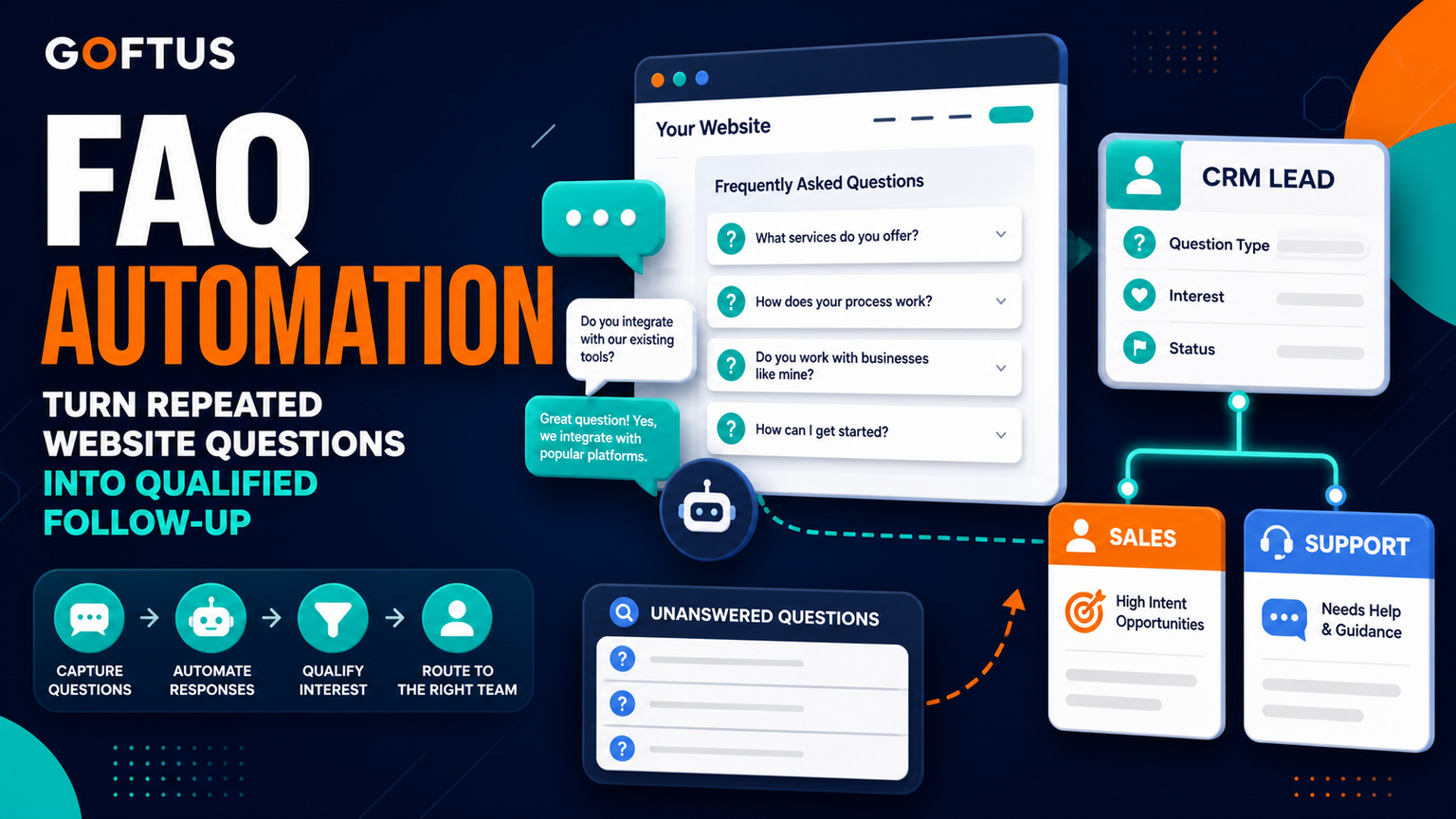
FAQ automation is not just a chatbot that gives fast replies. For a small or mid-sized business, it should capture repeated website questions, answer safe questions instantly, qualify buying intent, route complex issues to the right person, and record unanswered questions so the team can improve the website and sales process. GOFTUS builds this as an FAQ automation service that connects customer answers to CRM, support, and follow-up workflows.
What this means for SMEs
A fresh r/smallbusiness RSS search this morning surfaced an operator-style discussion about losing hours to the same customer questions.
The useful lesson is not that every SME needs another generic chatbot. The lesson is that repeated questions are operational data. If the same pricing, delivery, fit, booking, onboarding, or support question appears again and again, the business needs a workflow for answering it, learning from it, and moving the right enquiries forward.
That is where FAQ automation becomes a practical first layer. It gives customers a fast answer when the question is known. It asks for context when the answer depends on business type, region, service level, or urgency. It routes sensitive or complex issues to a person. It logs unanswered questions so the company can update service pages, sales scripts, help articles, and product onboarding.
For a lean SME, this matters because website traffic is expensive. Ads, SEO, referrals, and LinkedIn outreach all push people toward the site. If visitors ask a question and leave, the business pays for attention but loses the conversation. FAQ automation should convert that moment into a qualified follow-up, a support triage item, or a clear answer that reduces manual interruption.
Hajikreena's view is simple: the best FAQ automation starts with the team inbox, not with the model. Before adding AI, list the 20 questions staff answer every week. Mark which ones are safe to answer automatically, which ones need a guided form, and which ones require human review. Then decide where each answer should send the customer next.
A weak setup answers questions in isolation. A stronger setup turns questions into actions. A prospect asking whether you work with companies like theirs can be asked for sector, company size, and deadline, then sent into CRM with a clear next step. A support user asking about a fault can be routed to the support queue with product, urgency, and account context. A buyer asking about price can receive a careful explanation and an option to book a diagnostic without forcing a hard sell.
GOFTUS treats FAQ automation as the entry wedge into wider workflow automation. The public FAQ layer is only one part. Behind it, the business needs answer governance, lead capture, escalation rules, CRM updates, support routing, reporting, and monthly improvement. That is why the right internal link for this topic is the GOFTUS FAQ automation service, not a generic AI tool page.
What SMEs should do next
Start with a question audit. Pull common questions from contact forms, WhatsApp, email, live chat, sales calls, support tickets, and meeting notes. Group them by intent: buying, support, onboarding, trust, pricing, delivery, and edge cases. Keep the wording customers actually use, because that wording should shape both the website answer and the automation trigger.
Next, separate answers by risk. Low-risk answers can be automated with approved copy. Medium-risk questions should ask for extra context and offer a human handoff. High-risk questions, such as complaints, legal terms, finance issues, personal data, or account-specific promises, should be routed to staff rather than answered freely by AI.
Then connect the answer to a workflow. Buying questions should create or update a CRM lead. Support questions should create a triage record. Product-fit questions should offer a booking or a diagnostic. Unanswered questions should be stored in a review queue so the business can improve its FAQ library, service pages, and sales messaging.
Finally, measure the right things. Do not only ask whether the AI answered a question. Ask whether fewer repeated questions hit the inbox, whether more qualified enquiries reached sales, whether support tickets arrived with better context, and whether the team learned which questions the website still fails to answer.
SaaS tools such as Zapier, n8n, Make, Bardeen, Gumloop, Lindy, Relevance AI, and Stack AI can be useful for automating pieces of the flow. Larger consultancies and AI studios such as Faculty AI, Deeper Insights, Waracle, Brainpool AI, LeewayHertz, Markovate, SoluLab, BairesDev, Addepto, STX Next, Netguru, and 10Clouds may also help with AI delivery.
The gap for many SMEs is ownership of the whole customer-answer workflow. Tools automate tasks. GOFTUS automates the workflow around the task. That means deciding which answers are approved, when a person must review, where the data goes, which CRM fields change, how support tickets are created, and how unanswered questions become better content.
This is the competitor-aware difference: the value is not in saying “AI answered a FAQ.” The value is in turning repeated questions into reliable follow-up, clearer support routing, and better customer understanding.
FAQ automation should be the first customer-answer layer for many SMEs because it is close to revenue, support, and daily staff interruption. The work is not just writing FAQ text. It is building a controlled system that answers known questions, captures lead context, routes complex issues, and improves over time.
If your team is still answering the same website questions manually every day, GOFTUS can map those questions into a practical workflow through its AI FAQ automation service. For some businesses, the next step is a small diagnostic or the £100 Startup Kit style review: identify the repeated questions, design the safe answers, define the human handoff, and connect the workflow to CRM or support tools.
Is FAQ automation the same as a chatbot?
No. A chatbot is the interface. FAQ automation is the workflow behind the answer. It includes approved answers, qualification questions, CRM capture, support routing, escalation rules, unanswered-question reporting, and review.
Where should FAQ automation connect inside the business?
For most SMEs, it should connect to the website, CRM, support inbox, booking flow, and reporting. The goal is to make customer questions easier to answer and easier to act on.
What should stay human reviewed?
Anything involving complaints, contracts, account-specific commitments, finance, personal data, or unusual customer situations should have human review. Automation should gather context and route the issue, not make risky promises.
These were used as headline-level context where full article retrieval was not required.
Topic focus: daily GOFTUS faq automation cluster for 2026-08-05 UTC, targeting “faq automation”, “AI FAQ automation”, “website FAQ chatbot”, “automated customer answers”, “customer support FAQ automation”, and “FAQ automation for small business”.