FAQ Automation Should Turn Website Questions Into Follow Up Workflows
FAQ automation helps SMEs answer repeated questions, capture leads and route complex issues into follow up workflows.
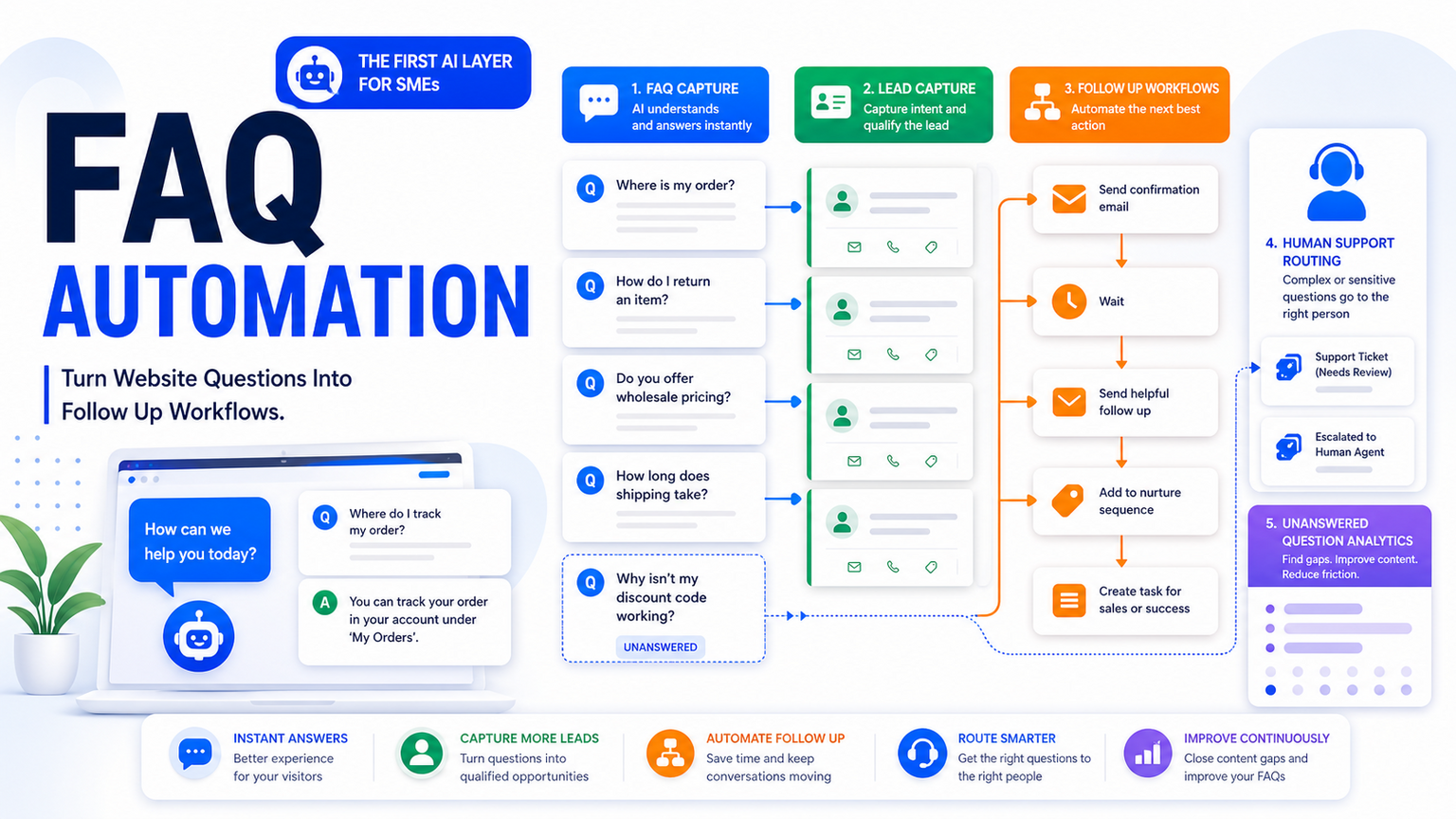
# FAQ Automation Should Turn Website Questions Into Follow Up Workflows Meta description: FAQ automation helps SMEs answer repeated questions, capture leads, route complex issues and turn website demand into follow up w
FAQ Automation Should Turn Website Questions Into Follow Up Workflows
Meta description: FAQ automation helps SMEs answer repeated questions, capture leads, route complex issues and turn website demand into follow up workflows.
FAQ automation is the practical first AI automation layer many SMEs should build before buying another general chatbot. The current signal is simple: customer service AI is being discussed everywhere, but the business risk is not just whether a bot can answer. It is whether the answer is connected to the next workflow.
That is a useful cross-check for the buyer query behind this post: businesses want faster answers, but they also need safer handoff, escalation and measurement.
So this post treats Reddit as a light small-business context signal, not confirmed product news. The stronger driver is today's GOFTUS topic cluster for "faq automation".
Why FAQ automation matters now
Most SME websites already have repeated questions hiding in contact forms, live chat transcripts, sales calls and inbox threads. People ask about pricing ranges, service areas, booking steps, refunds, timelines, documents, integrations and who to speak to next.
A static FAQ page can answer some of that. A website FAQ chatbot can answer more of it. But the real value comes when FAQ automation connects the answer to the next action. If a visitor asks about a service, the system can suggest the right page, capture the lead, qualify urgency, create a CRM note, route the question to support, or log an unanswered query for review.
That is why GOFTUS frames AI FAQ automation as an entry wedge into workflow automation. It is not just a better help page. It is a controlled customer-answer layer that can reveal what buyers want, where support is leaking time and which questions should become follow-up work.
For the GOFTUS FAQ automation service, the natural starting point is /services#faq-automation.
Bharatvaj's view is that SMEs should avoid treating customer support FAQ automation as a magic replacement for people. Customers still prefer clarity, honesty and a route to a human when the question is sensitive. The automation should reduce repetitive work, not hide the business behind a vague bot.
A practical FAQ automation system should know what it is allowed to answer, what it should never answer, when to ask for contact details and when to create a task for a person. If the question involves price exceptions, complaints, refunds, legal risk, medical advice, finance or account access, the workflow should pause and route to a human.
That is also where measurement matters. The best FAQ systems tell the business which questions were answered, which were abandoned, which became leads and which need new content.
What competitors are missing
The market has useful players. UK teams such as Faculty AI, Deeper Insights, Waracle and Brainpool AI can support larger AI programmes. US firms such as LeewayHertz, Markovate, SoluLab and BairesDev build custom systems. European teams such as Addepto, STX Next, Netguru and 10Clouds deliver software and automation projects. SaaS tools such as Zapier, n8n, Relevance AI, Lindy, Gumloop, Bardeen, Make and Stack AI can automate specific tasks.
The gap is ownership of the workflow around the customer question. A chatbot that answers one question is useful. A workflow that answers, captures, routes, updates CRM, alerts the right owner and improves the knowledge base is more valuable.
Tools automate tasks. GOFTUS automates the workflow around the task.
For FAQ automation, that means GOFTUS does not start with a generic bot prompt. We map the repeated questions, business rules, escalation points, CRM fields, support handoff and review rhythm first. The website answer is only one piece of the operating system.
What SMEs should do next
First, collect the top questions from the last thirty to sixty days of website forms, inbox threads, sales calls and support tickets. Do not invent the FAQ from internal assumptions. Use real customer language where possible.
Second, divide questions into safe-answer, lead-capture and human-review categories. Safe-answer questions can cover opening hours, process steps, locations, documents needed and service summaries. Lead-capture questions need contact details and context. Human-review questions should create a task or ticket.
Third, connect the FAQ system to the rest of the business. A website FAQ chatbot should not trap useful demand in a chat transcript. GOFTUS can connect automated customer answers to CRM follow-up, support triage, email alerts, reporting dashboards and internal knowledge updates through /services#faq-automation and wider /services work.
Fourth, review unanswered questions every month. If five people ask the same thing and the system cannot answer safely, the business has found a content gap, sales objection or service confusion.
Finally, keep the CTA soft and useful. The best FAQ automation helps a visitor get the answer they need, then offers the next step when it makes sense: book a call, send details, view a service page, or ask a person.
FAQ automation is not just a customer-service shortcut. It is a practical way for SMEs to turn repeated questions into a measurable workflow. The right system answers safe questions, captures leads, routes complex issues, updates CRM or support tools and improves the knowledge base over time.
The risk is buying a generic chatbot and hoping it behaves. The better path is to design the customer-answer workflow first, then add AI where it saves time and improves clarity.
If your team is seeing repeated website questions, slow reply times or lost leads, start with the FAQ automation service at /services#faq-automation. GOFTUS can help scope the questions, rules, integrations and review process before the automation goes live.
What is FAQ automation for small business?
FAQ automation for small business is a controlled way to answer repeated website and customer questions, capture useful context and route anything complex to the right person. It can use FAQ content, a website FAQ chatbot, CRM notes and support rules. The goal is not to replace human judgment. The goal is to reduce repeated replies and make sure unanswered questions become follow-up work.
How does AI FAQ automation connect to CRM?
AI FAQ automation can collect a visitor's question, match it to a safe answer, ask for contact details when needed and create a CRM note or follow-up task. GOFTUS designs the rules so the answer, lead source, urgency and next action are visible to the team. That turns a simple website answer into a measurable workflow.
When should a question go to a human?
A question should go to a human when it involves complaints, refunds, legal or financial risk, unusual pricing, account access, sensitive data or anything the FAQ system cannot answer confidently. GOFTUS builds these stop rules into FAQ automation so the customer gets a useful next step instead of a risky automated answer.
Reddit is treated here as light SME context, not confirmed news.
This run selected the daily GOFTUS "faq automation" cluster because no 2026-07-19 post on the public API clearly targeted FAQ automation before publishing.