FAQ Automation Should Connect Website Answers To Lead Flow
FAQ automation should connect website answers to lead flow, support routing, and CRM updates so SMEs stop losing repeated customer questions.
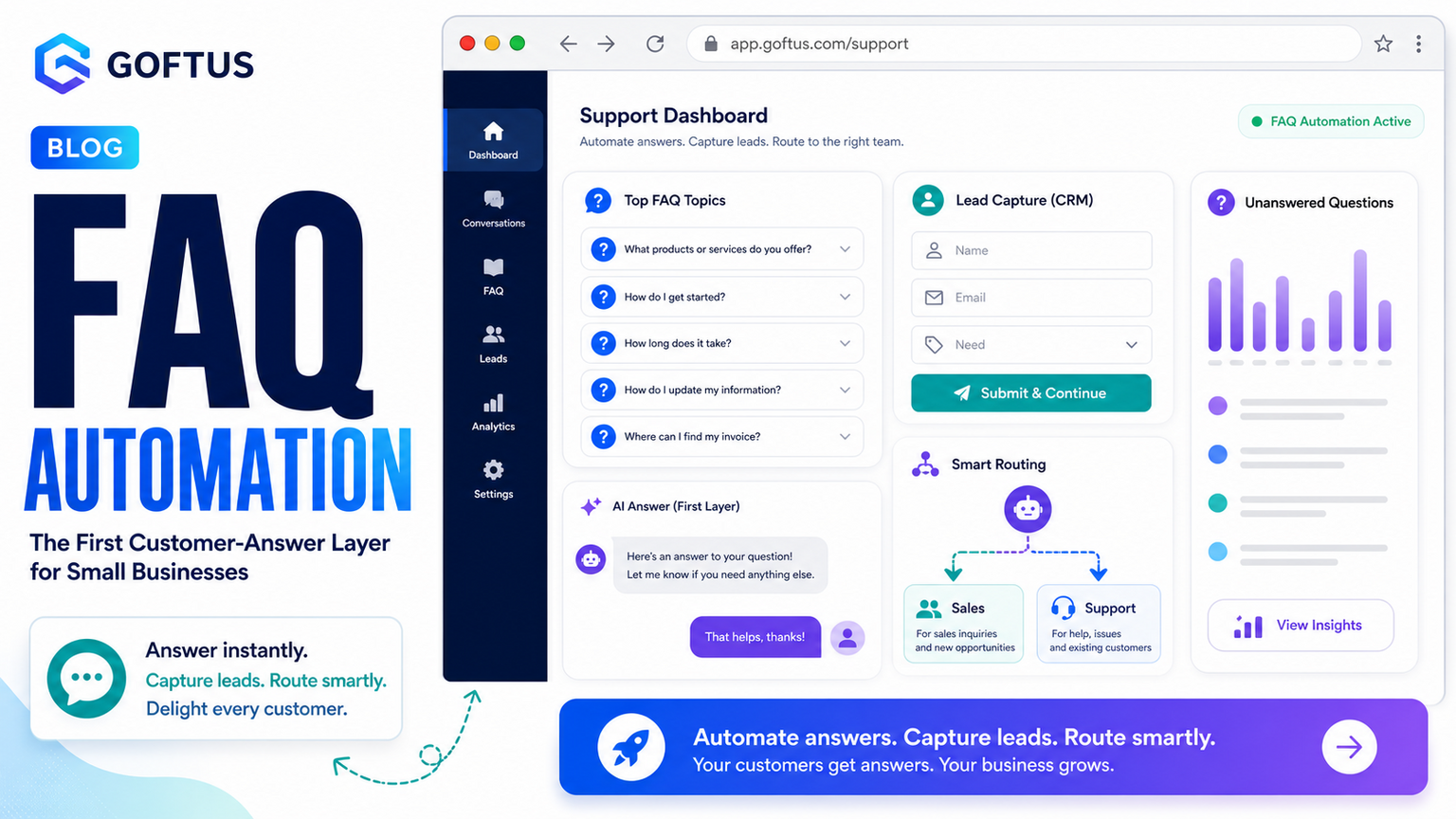
# FAQ Automation Should Connect Website Answers To Lead Flow Meta description: FAQ automation should connect website answers to lead flow, support routing, and CRM updates so SMEs stop losing repeated customer questions
FAQ Automation Should Connect Website Answers To Lead Flow
Meta description: FAQ automation should connect website answers to lead flow, support routing, and CRM updates so SMEs stop losing repeated customer questions.
FAQ automation is not only a cheaper way to answer repeated website questions. For a small business, the better use is to turn common questions into a controlled first customer-answer layer that captures leads, routes exceptions, updates follow-up tools, and shows the team what customers still cannot find.
That matters because many SMEs do not lose enquiries at the final proposal stage. They lose them earlier, when a visitor asks a simple question about pricing, availability, delivery, eligibility, onboarding, booking, returns, integrations, or response time and nobody owns the first answer. A generic chatbot may reply, but it often fails to connect the question to sales, support, CRM, or the next human action.
GOFTUS sees FAQ automation as a practical wedge into wider workflow automation. Start with repeated questions, publish approved answers, capture contact details when the visitor needs help, route complex issues to the right person, and measure unanswered questions every month. The outcome is not more AI on the website. The outcome is fewer cold leads and fewer repeated manual replies.
This run selected the daily FAQ automation cluster because today's published GOFTUS posts did not clearly target FAQ automation, AI FAQ automation, website FAQ chatbot, automated customer answers, or support FAQ automation.
The source signal is a buyer-query and operator-pain mix rather than one single breaking-news announcement. Those headlines show the market direction: vendors are trying to connect marketing, sales, support, and automation instead of leaving website questions as isolated chat events.
The important lesson is that the first answer should create the next step. If a visitor asks, "Do you work with my industry?" the FAQ answer can explain the fit, but the workflow should also offer a diagnostic, capture the enquiry, tag the CRM record, and send the right follow-up. If a customer asks, "Where is my invoice?" the answer should separate a public FAQ response from a private account request and route the issue safely.
This is why FAQ automation is a stronger starting point than another disconnected website FAQ chatbot. A chatbot can be useful, but an SME needs approved answers, ownership, escalation, CRM hygiene, and review. The FAQ layer should know when to answer, when to ask for details, when to stop, and when to hand the conversation to a person.
The same pattern also connects to browser with ai controls. Many businesses still complete support, quoting, booking, or CRM steps inside browser-based tools. Once the FAQ layer is stable, a controlled browser workflow can prepare updates, open the right records, or draft a support action. It should not silently click submit across unknown sites. It needs narrow allowed workflows, login boundaries, audit logs, and human-approved browser actions.
What this means for SMEs
For UK, US, and EU SMEs, the practical move is to map the repeated questions before buying a larger AI stack. Export emails, chat logs, form submissions, sales notes, and support tickets. Group the questions by intent: buying, onboarding, support, billing, delivery, compliance, technical fit, or complaint. Then decide which questions can be answered publicly, which should collect details, and which should always route to a human.
Next, connect each answer to a workflow. A buying question may create a CRM lead and suggest a consultation. A support question may create a ticket and attach the approved answer. A document question may route to document automation. A complex operational question may become an AI agents or workflow automation opportunity. This is where the GOFTUS FAQ automation service at /services#faq-automation is useful: it turns answer content into a measured operational system.
Finally, review unanswered questions monthly. The unanswered list is not a failure. It is a content roadmap, a sales-enablement signal, and a workflow-improvement queue. If ten prospects ask the same thing and the website cannot answer it, the business has found a gap worth fixing.
The market gives SMEs many options. UK firms such as Faculty AI, Deeper Insights, Waracle, and Brainpool AI can help with advanced AI strategy and custom builds. US providers such as LeewayHertz, Markovate, SoluLab, and BairesDev can deliver larger AI or software projects. European teams such as Addepto, STX Next, Netguru, and 10Clouds can support data, product, and engineering work. SaaS tools such as Zapier, n8n, Relevance AI, Lindy, Gumloop, Bardeen, Make, and Stack AI can automate useful steps.
The gap for many SMEs is ownership of the whole customer-answer workflow. Tools automate tasks. GOFTUS automates the workflow around the task. That means the FAQ answer, lead capture, CRM update, support route, human review, reporting loop, and monthly improvement cadence are designed together.
GOFTUS does not position FAQ automation as a magic replacement for staff. It is a practical first layer that helps staff spend less time repeating safe answers and more time handling the questions that need judgement.
What SMEs should do next
Start with one page and one question category. For example, choose pricing fit, service eligibility, booking, onboarding, or support triage. Write approved answers. Add a capture step only when the visitor needs help. Route the detail to the right owner. Track unanswered questions.
If the first layer works, expand into CRM follow-up, support triage, reporting automation, document processing, AI agents, and controlled browser-based workflows.
GOFTUS can help SMEs run a short diagnostic through /contact, then build the first FAQ automation layer through /services#faq-automation before expanding into wider workflow automation through /services and AI agents through /agents.
FAQ automation should not sit on the website as a static help section. It should answer repeated questions, capture intent, route issues, update the right tools, and show the team what customers still need. For SMEs, that makes it a low-risk first step into AI automation because the scope is narrow, the answers can be approved, and the workflow value is easy to see.
Is FAQ automation the same as a website FAQ chatbot?
No. A website FAQ chatbot is one interface. FAQ automation is the wider system around the answer: approved knowledge, lead capture, routing, CRM or support updates, reporting, and review. The chatbot may be part of it, but it should not be the whole strategy.
Why should FAQ automation connect to CRM or support tools?
Because repeated questions often reveal buying intent or service risk. If the answer helps but nobody follows up, the business may still lose the opportunity. Connecting FAQ automation to CRM and support tools makes the first answer useful to the team.
When should an SME add AI agents after FAQ automation?
Add AI agents after the answer layer is clear and measured. Once you know the repeated questions, routes, owners, and exceptions, agents can help draft follow-ups, prepare records, and support browser-based workflows with approval controls.
Reddit access was partly rate limited, so Reddit is labelled as supporting social context rather than full-platform evidence.