FAQ Automation for SMEs: Route Website Questions Before Follow-Up Slips
FAQ automation helps SMEs answer repeated website questions, capture leads, route support issues, and stop follow-up slipping between teams.
# FAQ Automation for SMEs: Route Website Questions Before Follow-Up Slips Meta description: FAQ automation helps SMEs answer repeated website questions, capture leads, route support issues, update CRM, and keep follow-u
FAQ Automation for SMEs: Route Website Questions Before Follow-Up Slips
Meta description: FAQ automation helps SMEs answer repeated website questions, capture leads, route support issues, update CRM, and keep follow-up from slipping.
Quick answer
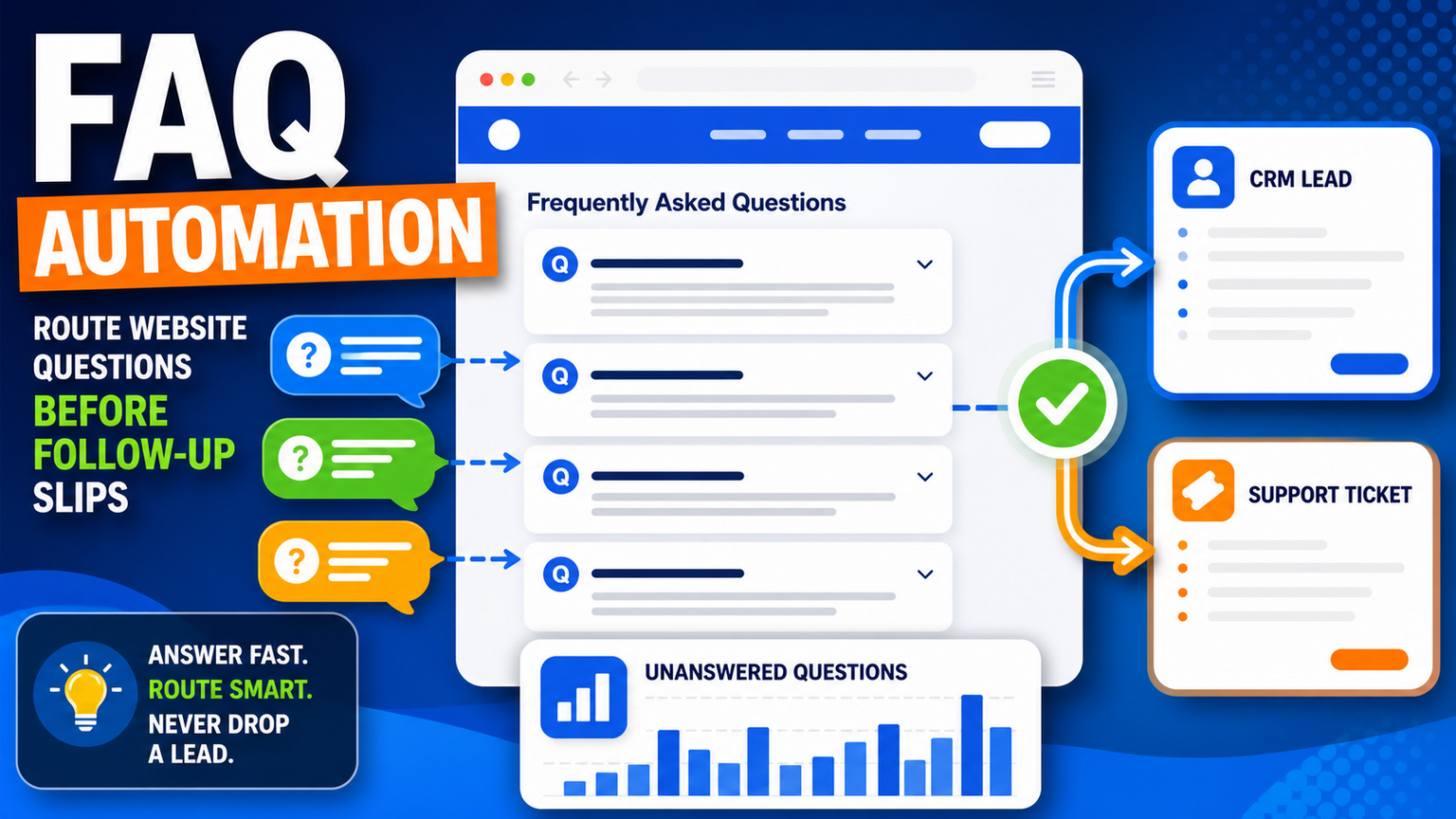
FAQ automation is not just a website widget. For SMEs, it should become the first customer-answer layer: answer repeated questions, capture buying intent, route complex issues to the right person, and show which questions still need a better answer. That is why today's daily GOFTUS topic cluster targets faq automation rather than another vendor headline.
The fresh signal is a mix of operator pain and customer-service automation coverage. operator research flagged a 100-score r/Entrepreneur discussion where a builder said the hard part of AI work is not always the model, but messy real-world workflows across portals, phone calls, documents, and handoffs. Together, the lesson is simple: businesses do not need more isolated answers. They need a controlled question-to-follow-up workflow.
For UK, US, and EU SMEs, GOFTUS recommends starting with FAQ automation service before adding heavier AI agents. The fastest win is usually repeated customer questions on a website, landing page, chat inbox, or contact form.
What this means for SMEs
Most small teams already know their repeated questions. Pricing fit, delivery times, booking steps, warranty rules, onboarding documents, integrations, support status, and refund policies come up again and again. The problem is that the answer lives in too many places: a sales person's memory, an old help article, a WhatsApp thread, a support macro, a spreadsheet, or a forgotten Notion page.
A good FAQ automation workflow does four practical jobs. First, it answers the simple question clearly on the website. Second, it captures the signal behind the question, such as buyer intent, urgency, product fit, or support category. Third, it routes the next step to sales, support, CRM, or an internal owner. Fourth, it logs unanswered or low-confidence questions so the business can improve content and workflow rules.
That is different from installing a generic chatbot and hoping customers enjoy it. A chatbot can create more confusion if it answers from stale pages, invents policy details, or fails to tell sales that a strong lead asked a buying question. FAQ automation should be narrower and more accountable. It should know what it can answer, when it must escalate, what fields to capture, and which system gets updated.
Bharatvaj's view: the best first automation project is often the least glamorous one. If a business answers the same twenty questions every week, that is not a content problem only. It is a workflow leak. Every repeated question can become a trigger for qualification, support triage, document delivery, CRM follow-up, or a scheduled callback.
How to build the first customer-answer layer
Start with the questions customers already ask. Export contact-form messages, support tags, sales-call notes, live-chat transcripts, and inbox threads. Group them into practical categories: buying questions, onboarding questions, support questions, account questions, document questions, and questions that should never be answered automatically.
Then write approved answers in plain language. Each answer should include what the customer can do next, when a human will respond, and what information the business needs. For example, a pricing-fit answer should not just say "contact us". It should ask for company size, location, workflow type, and urgency, then route the lead into CRM with the right follow-up owner.
Next, connect the FAQ layer to workflow tools. A buying question can create or update a CRM lead. A support question can open a ticket with category and priority. A document question can send an approved document or start a document automation workflow. A complex browser-based task, such as checking a portal or submitting a form, should move into an approved AI agents or services workflow with login boundaries, human review, and audit logs.
Finally, measure the misses. The unanswered-question report is the management layer most tools forget. It shows which pages are unclear, which products need better support content, which questions should become new FAQ items, and which handoffs are slowing down revenue or support.
Competitor lens
SaaS tools such as Zapier, n8n, Make, Lindy, Gumloop, Bardeen, Relevance AI, and Stack AI can be useful for moving data and triggering tasks. Larger consultancies and AI firms, including Faculty AI, Deeper Insights, Waracle, Brainpool AI, LeewayHertz, Markovate, SoluLab, BairesDev, Addepto, STX Next, Netguru, and 10Clouds, can also support wider programmes.
The gap is ownership of the whole workflow. Tools automate tasks. GOFTUS automates the workflow around the task. That means mapping the question, approving the answer, routing the next step, updating CRM or support systems, keeping humans in the loop, and improving the workflow after real customer behaviour appears.
For an SME, this distinction matters. A task automation may send a message. A GOFTUS workflow decides whether the message should be sent, what it should include, who owns the follow-up, what gets logged, and what happens when the question does not fit the script.
What SMEs should do next
Choose one high-volume customer journey, not the whole business. Good first targets include quote requests, appointment questions, delivery questions, onboarding questions, repeated support questions, or product-fit questions. Build a small answer library, decide escalation rules, and connect only the systems needed for follow-up.
Use FAQ automation as the wedge into broader workflow automation. Once the question layer is stable, GOFTUS can connect it to CRM automation, support triage, document processing, reporting automation, and safe browser-based actions. The aim is not to remove humans from customer conversations. The aim is to make sure humans only step in where judgement, reassurance, negotiation, or exception handling is actually needed.
If you want a practical starting point, review GOFTUS AI FAQ automation or use the £100 Startup Kit diagnostic through GOFTUS services. The diagnostic can identify the first repeated-question workflow worth automating, the systems it should update, and the controls needed before customer-facing automation goes live.
Summery for SMEs
FAQ automation should answer repeated questions, capture intent, route the next step, and expose the questions your website still fails to answer. Treat Reddit and news signals as prompts to inspect your own workflow, not as proof that one tool will solve support. The safest SME path is a narrow, approved customer-answer layer connected to CRM, support, documents, and human review.
FAQ
What is the first FAQ automation workflow an SME should build? Start with repeated website questions that either block buying decisions or create support noise. Approved answers, lead capture, routing rules, and unanswered-question reports usually create more value than a broad chatbot launch.
Should FAQ automation replace live chat? No. It should handle repeated questions, capture context, and route complex issues to the right person. Live chat and human support remain important for judgement, reassurance, negotiation, and exceptions.
How does GOFTUS connect FAQ automation to CRM and support? GOFTUS maps each question category to the next workflow step, then connects forms, FAQ answers, CRM fields, support tickets, document delivery, and reporting rules through a controlled service workflow.
Where should businesses start? Start at /services#faq-automation with one repeated-question journey, one approved answer library, and one measurable follow-up path.