FAQ Automation for SMEs: Route Buying Questions Before Sales Loses Context
Use FAQ automation to answer repeated website questions, capture buying intent, and route follow-up before sales loses context.
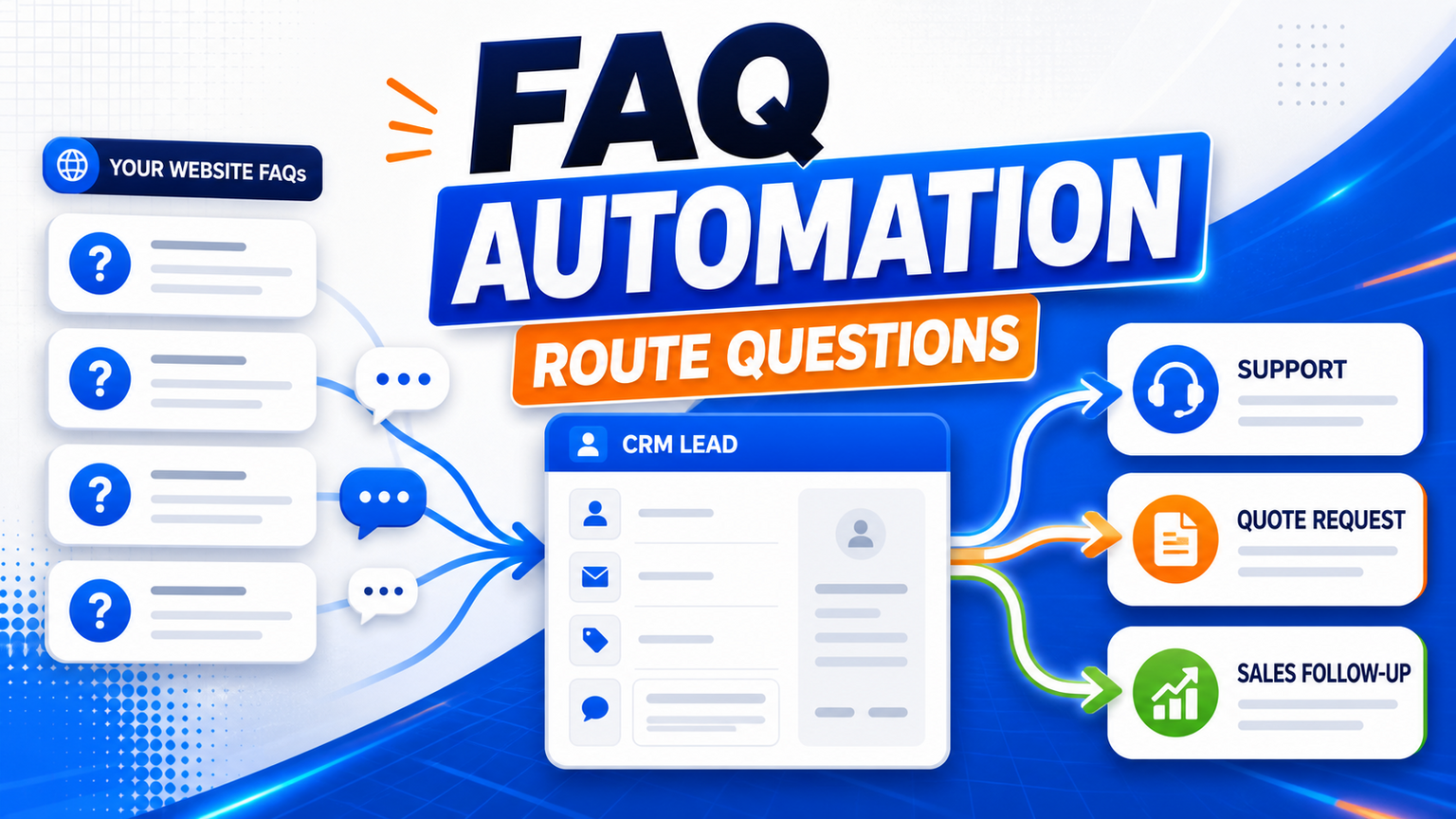
# FAQ Automation for SMEs: Route Buying Questions Before Sales Loses Context Meta description: FAQ automation helps SMEs answer website questions, capture intent, and route buying signals into CRM, sales, and support fo
FAQ Automation for SMEs: Route Buying Questions Before Sales Loses Context
Meta description: FAQ automation helps SMEs answer website questions, capture intent, and route buying signals into CRM, sales, and support follow-up without losing context.
Quick answer
FAQ automation is not just a chatbot that answers the same questions. For a UK, US, or EU SME, it should capture what the visitor asked, decide whether the question is sales, support, pricing, booking, or account related, give a safe answer when the answer is known, and pass the context into the right follow-up workflow. The current signal is practical: small business operators are still asking how to connect web forms, quotes, local service requests, and customer questions to tools such as CRMs and field-service systems. That is why the buyer query is simple: faq automation that routes questions before sales loses context.
A GOFTUS FAQ automation service starts with repeated website questions, then connects those questions to lead capture, support triage, CRM notes, staff review, and reporting. The goal is not to replace staff. The goal is to stop useful questions from disappearing in chat widgets, inboxes, form notifications, and half-read support threads.
What this means for SMEs
Most small businesses already have an FAQ page, a contact form, and an inbox. The problem is that these assets rarely work as one customer-answer system. A buyer asks whether a service covers their area. Someone else asks if an invoice issue can be fixed. A third visitor asks for a quote and includes enough context to qualify the lead. If all three are treated as generic messages, the business loses speed.
FAQ automation gives the business a first customer-answer layer. It can answer simple questions from approved website content, ask one or two qualifying follow-up questions, and route the result to sales, support, or operations. For a local service firm, that might mean sending quote-ready questions to CRM. For ecommerce or B2B services, it might mean tagging returns, integrations, pricing, or onboarding questions. For professional services, it might mean separating urgent client requests from research questions.
The key is workflow design. A website FAQ chatbot on its own can become another inbox. AI FAQ automation becomes useful when each outcome has a next step: answer, capture, assign, escalate, update CRM, or add a gap to the knowledge base.
The useful lesson from the current operator discussions is that SMEs do not need more isolated widgets. They need fewer lost handoffs. When a business owner asks how to modernize a long-running store or connect a website quote form to a job-management tool, the real request is not just technical. It is operational: make sure customer intent moves from the website to the person or system that can act on it.
That is where FAQ automation should begin. Start with the questions staff answer every week. Mark which answers are safe to automate and which need human review. Decide what data must be captured before a handoff is useful. Then connect the answer layer to CRM, support tickets, calendars, or a simple internal queue.
This is also why GOFTUS frames FAQ automation as an entry wedge into wider workflow automation. Once a business can capture and route questions reliably, the same pattern can support sales follow-up, customer support automation, reporting automation, document processing, and AI agents that prepare work for approval.
How to build the workflow
First, collect the top questions from website forms, sales calls, chat, inboxes, and support tickets. Do not start by asking an AI tool to invent an FAQ. Start from real customer language. Group the questions into sales, support, billing, delivery, account, and product categories.
Second, define answer confidence. Some questions can be answered directly from approved website copy, opening hours, service areas, refund rules, or onboarding instructions. Some should be answered with a short explanation plus a human handoff. Some should never be automated because they involve legal, medical, financial, contract, or account-specific decisions.
Third, design routing. A question about pricing might create a CRM lead. A question about a broken order might create a support ticket. A question about an integration might route to operations. Unanswered questions should be logged so the business can improve content.
Fourth, monitor the gaps. FAQ automation should report which answers were used, which questions were escalated, which topics created leads, and which answers need review.
Competitor lens
Tools such as Zapier, n8n, Make, Bardeen, Lindy, Gumloop, Relevance AI, and Stack AI can connect forms, chat, CRMs, and support tools. Consultancies such as Faculty AI, Deeper Insights, Waracle, Brainpool AI, LeewayHertz, Markovate, SoluLab, BairesDev, Addepto, STX Next, Netguru, and 10Clouds can support broader AI projects.
Those options can be useful. The difference is where the responsibility sits. Tools automate tasks. GOFTUS automates the workflow around the task. For FAQ automation, that means answer governance, routing rules, human review, CRM or support integration, reporting, and monthly improvement.
If an SME already uses Zapier, n8n, HubSpot, Jobber, Zendesk, Intercom, Airtable, Google Sheets, or a custom CRM, GOFTUS can often work with the existing stack instead of replacing it.
What SMEs should do next
Pick one high-friction customer journey: quote requests, onboarding questions, delivery updates, booking questions, or support triage. Write down the top 20 repeated questions and the next action each question should trigger. Then decide which questions can be answered automatically, which need approval, and which should only prepare a draft for staff.
If the current website FAQ is static, the first improvement is not a big AI rebuild. It is a routed FAQ workflow: answer known questions, capture missing context, update CRM or support, and show staff the unanswered gaps. GOFTUS can help map this as part of the FAQ automation service, or as a wider automation diagnostic through GOFTUS services.
A practical starting point is the £100 Startup Kit diagnostic. Use it to identify the first customer-answer workflow, the systems it must touch, review gates, and the metric that proves it is helping.
Summery for SMEs
FAQ automation works best when it is treated as a routing workflow, not a novelty chatbot. The SME win is simple: answer repeated questions faster, capture buying intent, send the right context to sales or support, and learn which questions still need better content. Start with one journey, connect it to the system staff already use, and review the gaps every month.
FAQ
Is FAQ automation the same as a website chatbot?
Not quite. A website chatbot is the interface. FAQ automation is the workflow behind it: approved answers, intent capture, routing, CRM or support updates, human review, and reporting. SMEs should judge the system by whether questions move to the right next step, not by whether the chat window looks modern.
What should an SME automate first?
Start with repeated questions that already slow sales or support: service areas, booking steps, quote requirements, delivery status, onboarding instructions, and basic troubleshooting. Avoid automating sensitive decisions until the workflow has review gates and logs.
How does GOFTUS keep FAQ automation practical?
GOFTUS maps the customer question, the answer source, the handoff rule, and the staff review step before building automations. That makes the system easier to monitor and improve than a standalone widget.
Source notes
RSS listings were used as headline-level context.
SEO mapping: source signal equals small business question-routing pain; business problem equals routing questions before sales loses context; evergreen keyword equals faq automation; path equals /services#faq-automation.