FAQ Automation for SMEs: Turn Repeated Website Questions Into Booked Follow-Up
FAQ automation helps SMEs answer repeated website questions, capture intent, route support, and book CRM follow-up without losing human control.
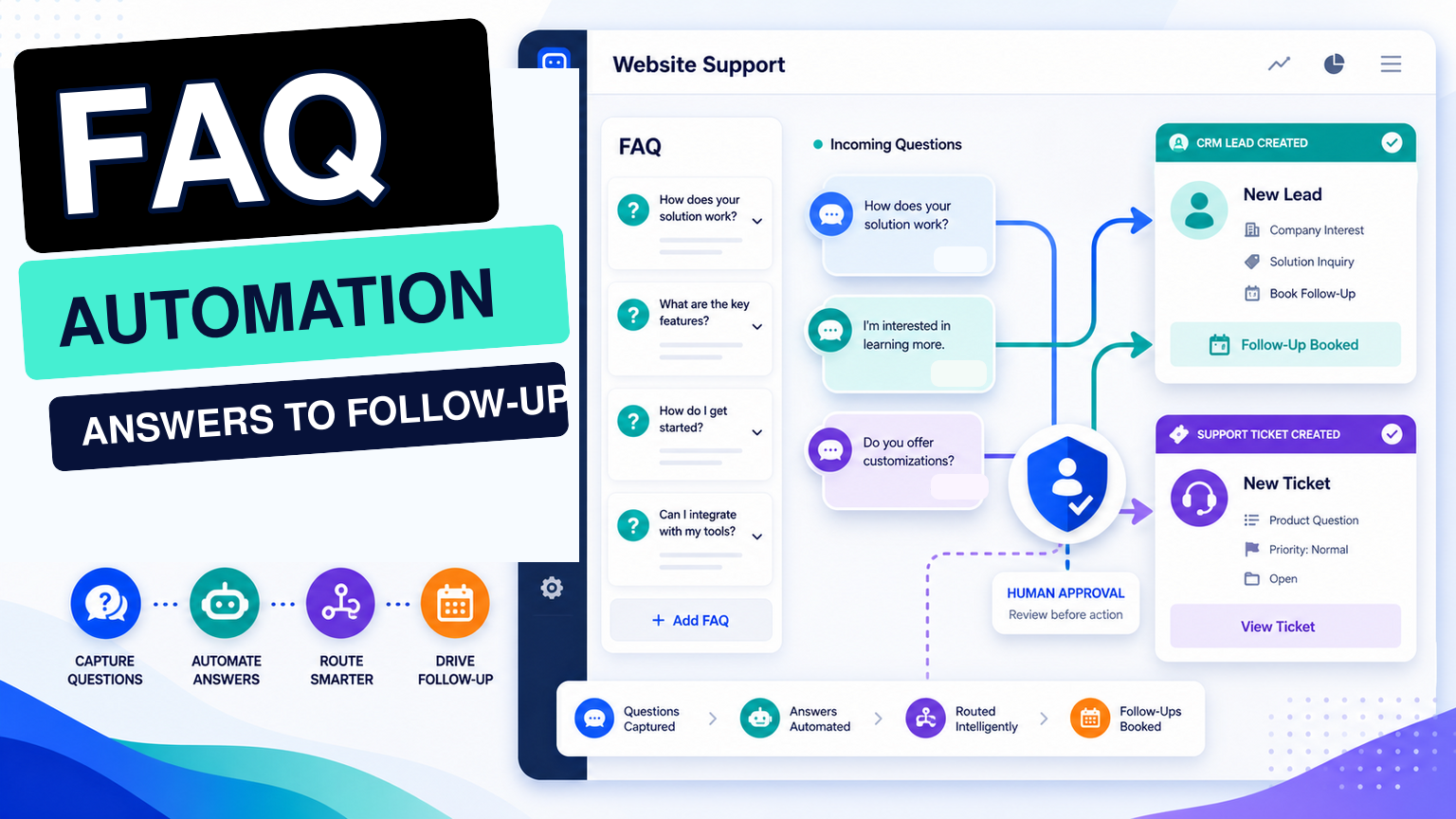
# FAQ Automation for SMEs: Turn Repeated Website Questions Into Booked Follow-Up Meta description: FAQ automation helps SMEs answer repeated website questions, capture intent, route support, and book CRM follow-up witho
FAQ Automation for SMEs: Turn Repeated Website Questions Into Booked Follow-Up
Meta description: FAQ automation helps SMEs answer repeated website questions, capture intent, route support, and book CRM follow-up without losing human control.
FAQ automation is the first practical customer-answer layer many SMEs should build before buying another broad chatbot or AI tool. Treat that as buyer-context sourcing, not a single verified market statistic.
The business problem is simple. Repeated website questions are not just support noise. They are buying intent, onboarding friction, service confusion, and support demand arriving before the team has a clean follow-up process. FAQ automation should answer safe questions, collect the right details, create CRM or support follow-up, and show which questions the website still fails to answer. GOFTUS builds that through the FAQ automation service at /services#faq-automation, then connects the same question layer into wider /services and /agents when the next workflow needs automation.
What this means for SMEs
Most UK, US, and EU SMEs already have the raw material for FAQ automation. It sits in contact forms, sales emails, WhatsApp messages, helpdesk tickets, call notes, proposal comments, and the memory of front-line staff. Customers ask whether a service fits their location, budget, timeline, software stack, delivery need, or support issue. Staff answer these questions repeatedly, but the answers rarely become an owned system.
That creates four operating leaks. First, response speed depends on who is available. Second, the answer changes from person to person. Third, useful buying questions are treated like generic support messages. Fourth, nobody reviews what customers could not find on the website.
A simple website FAQ chatbot can help, but only if the workflow behind it is designed. The answer layer needs approved source material, safe topics, stop rules, routing logic, CRM fields, support ownership, and a weekly review of unanswered questions. Without that structure, the business gets another tool to monitor instead of a customer-answer workflow.
Good FAQ automation starts narrow. Choose one service page, one product line, or one support category. Gather the last fifty real questions. Remove private information. Group each question into answer, qualify, route, or review. Answer questions can use approved wording. Qualify questions ask for one extra detail, such as location, order size, integration, or urgency. Route questions create a CRM task, support ticket, or internal notification. Review questions show where the website needs clearer copy.
Bharatvaj's view is that FAQ automation should not try to replace the human relationship with a customer. It should protect that relationship by making the first answer faster, clearer, and easier to hand off.
The strongest first build is usually boring on purpose. It answers repeated service questions, captures contact details when intent is high, opens a support route for complex issues, and logs the conversation. That might sound less exciting than a fully autonomous AI agent, but it is far more useful for a business that needs reliable outcomes.
The weekly review matters. Look at which questions were answered, which were escalated, which created booked follow-up, which confused customers, and which should become new website copy. If the same unanswered question appears every week, the website or sales material needs improvement. If the same buying question keeps appearing, the CRM follow-up should be automatic. If the same support issue keeps escalating, the support process needs a clearer owner.
This is also where FAQ automation becomes a wedge into wider automation. Once questions are structured, GOFTUS can connect them to CRM updates, support triage, document workflows, reporting automation, and, where appropriate, browser with ai controls for portal tasks that still need human approval.
What SMEs should do next
Start by mapping the customer journey around questions, not around software. Where do questions arrive? Which ones repeat? Which ones show buying intent? Which ones require judgement? Which ones should never be answered automatically?
Then create the approved answer set. Use existing website pages, proposals, onboarding documents, policies, and support notes. Do not let AI invent pricing, terms, delivery promises, refund decisions, regulated advice, or account-specific answers. For sensitive topics, the automation should acknowledge the request, capture context, and route it to a person.
Next, design the handoff. A pricing or availability question can create a CRM task. A support question can open a ticket with the conversation summary. A document request can trigger a document workflow. A booking question can create a draft follow-up for review. If a later workflow needs a browser portal, GOFTUS can add controlled agent steps through /agents and /services, with login boundaries, approval gates, logs, and stop rules.
Finally, measure the gaps. The most useful FAQ automation report is not total conversations. It is repeated questions answered, unanswered questions, booked follow-up created, support routes opened, and website pages that need clearer copy. That is how automated customer answers become a measurable operating system instead of a chatbot experiment.
Tools such as Zapier, n8n, Make, Bardeen, Gumloop, Lindy, Relevance AI, and Stack AI can be useful for connecting triggers, forms, chat steps, CRM updates, and notifications. Larger consultancies and delivery firms such as Faculty AI, Deeper Insights, Waracle, Brainpool AI, LeewayHertz, Markovate, SoluLab, BairesDev, Addepto, STX Next, Netguru, and 10Clouds can also support bigger AI or data programmes.
The gap for SMEs is usually ownership of the workflow around the answer. A tool can send a message. A consultant can build a chatbot. The business still needs approved content, escalation rules, CRM ownership, support handoff, review cadence, and improvement loops. Tools automate tasks. GOFTUS automates the workflow around the task.
That is the difference between a FAQ widget and FAQ automation. The widget answers. The workflow decides what happens next, who owns the exception, what is logged, and how the customer gets a reliable follow-up.
FAQ automation should help SMEs turn repeated website questions into approved answers, booked follow-up, routed support, and clearer website copy. The first build should be narrow, measurable, and safe: answer what is approved, qualify what is unclear, route what needs judgement, and review what customers keep asking.
GOFTUS can map the questions already reaching your website, inbox, CRM, and support tools, then design the approved answers and handoffs through /services#faq-automation. Once that first layer is working, the same operating pattern can expand into /services, /agents, /questions, and other workflow automation without losing human control.
Is FAQ automation the same as a chatbot?
No. A chatbot is the front-end interface. FAQ automation is the workflow behind it: approved answers, question capture, CRM or support routing, human escalation, logs, and weekly improvement.
What should be automated first?
Start with repeated low-risk questions that staff already answer every week, especially service scope, onboarding, availability, common support steps, and buying-intent questions.
When should a human step in?
Use human review for complaints, refunds, account changes, payment promises, legal or regulated advice, private data, and any question outside the approved answer set.
How does GOFTUS help?
GOFTUS designs the question map, approved answer library, routing logic, CRM or support handoff, and unanswered-question review through /services#faq-automation.
The xurl CLI was unavailable in this cron environment, so X was not used as a signal.