FAQ Automation Should Turn Repeated Questions Into Follow Up Workflows
Learn why FAQ automation should answer repeated website questions, capture leads, route exceptions, and improve SME follow-up workflows.
# FAQ Automation Should Turn Repeated Questions Into Follow Up Workflows Meta description: Learn why FAQ automation should answer repeated website questions, capture leads, route exceptions, and improve SME follow-up wo
FAQ Automation Should Turn Repeated Questions Into Follow Up Workflows
Meta description: Learn why FAQ automation should answer repeated website questions, capture leads, route exceptions, and improve SME follow-up workflows.
Quick answer
FAQ automation is no longer just a tidy help page. For SMEs in the UK, US, and Europe, it is becoming a practical first layer for customer support, lead capture, and workflow automation. The useful version answers repeated questions, records what people asked, routes complex issues to the right person, and pushes qualified enquiries into CRM or support tools.
This is why GOFTUS treats FAQ automation service as an entry wedge into wider workflow automation. A website FAQ chatbot can reduce repeated manual replies, but the real value appears when unanswered questions become follow-up tasks, new knowledge-base updates, and better sales or support handoffs.
What this means for SMEs
The daily search opportunity is clear: business owners are looking for phrases such as faq automation, AI FAQ automation, website FAQ chatbot, automated customer answers, customer support FAQ automation, and FAQ automation for small business. At the same time, current buyer articles around small-business AI tools, customer self-service, chatbots, and support automation keep pointing operators toward software lists. Those lists are useful, but they usually leave the hard question unanswered: who owns the workflow after the answer is displayed?
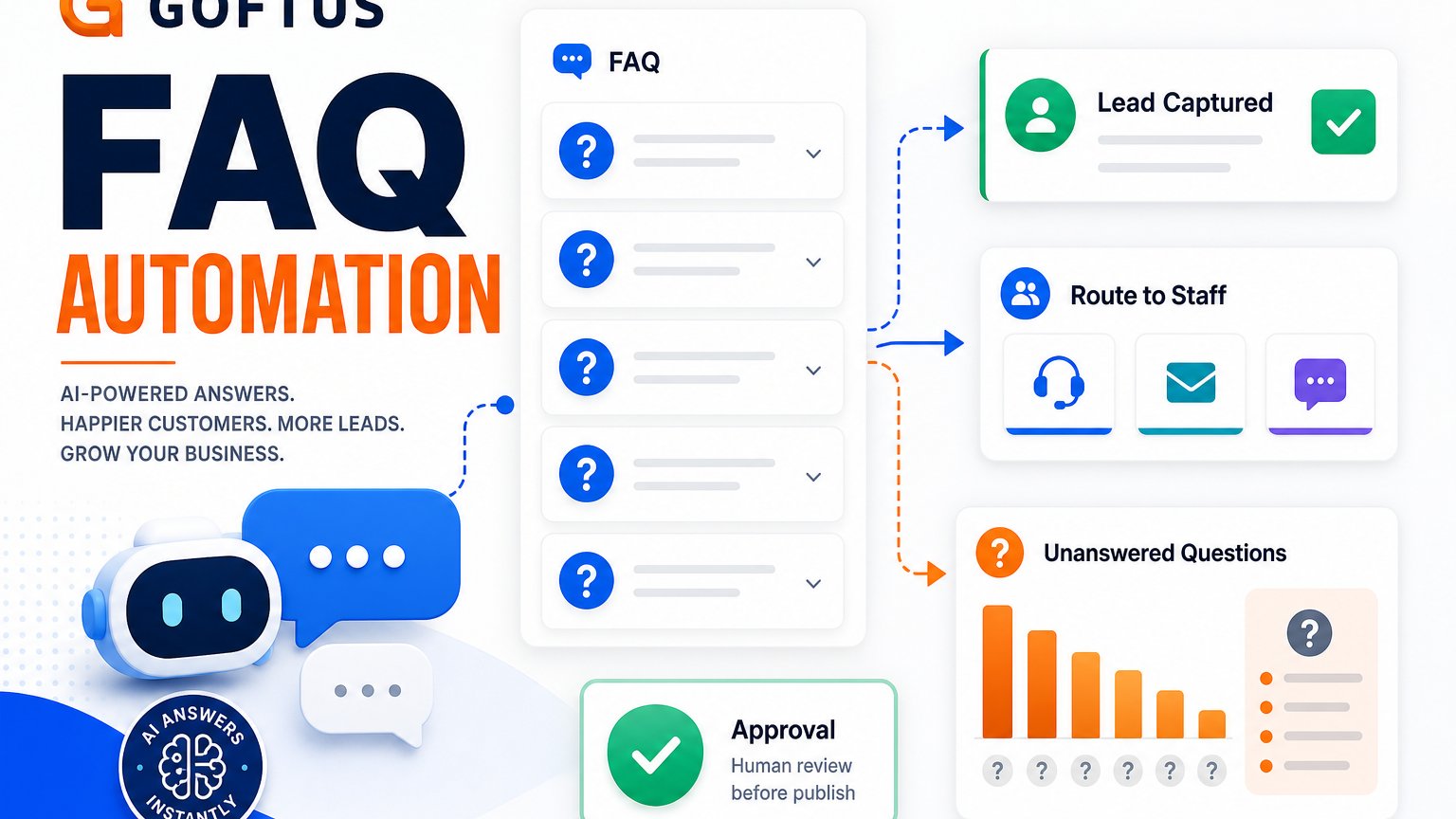
A small business does not need another isolated widget that says hello, guesses an answer, and disappears. It needs a controlled loop. First, approved answers should come from the website, policies, service pages, pricing rules, delivery notes, and human-reviewed documents. Second, every low-confidence or complex query should create a clear next action. Third, the same workflow should update CRM, ticketing, email, Slack, Teams, or a spreadsheet without creating messy records.
That is the difference between a chatbot project and an operating system for customer questions. The chatbot is the visible surface. FAQ automation is the process underneath: collect questions, answer known ones, identify gaps, hand off exceptions, and improve the knowledge base each week.
Thirumurugan's view
Thirumurugan's view is that FAQ automation should be chosen because it is boring in the best way. It starts with the questions a business already receives every day: pricing, availability, booking steps, delivery areas, return rules, onboarding, account access, and service suitability. Those questions are not glamorous, but they consume staff attention and often decide whether a visitor becomes a lead.
The wrong approach is to install a generic AI chat widget and hope it behaves. The better approach is to map the ten or twenty highest-volume customer questions, write approved answers, define when the bot must stop, and connect the resulting events to follow-up tools. If a visitor asks a sales-ready question, the system should capture contact details and trigger a CRM task. If the answer is missing, it should log the gap and tell staff what needs approval. If the issue is sensitive, it should route to a human rather than improvise.
This is especially important for SMEs because the person answering support may also handle sales, admin, operations, and delivery. A good AI FAQ automation workflow protects that person's time without removing their judgement.
Competitor lens
The market gives businesses many useful options. Zapier, n8n, Make, Bardeen, Gumloop, Lindy, Relevance AI, and Stack AI can automate parts of a process. Consultancies such as Faculty AI, Deeper Insights, Waracle, Brainpool AI, LeewayHertz, Markovate, SoluLab, BairesDev, Addepto, STX Next, Netguru, and 10Clouds can also help with wider AI delivery.
The gap is ownership of the workflow around the answer. Tools automate tasks. GOFTUS automates the workflow around the task. For FAQ automation, that means GOFTUS looks beyond the chat bubble: where the answer comes from, what happens when the answer is uncertain, who approves changes, how leads are captured, how CRM records stay clean, and how unanswered questions become operational improvements.
That competitor-aware distinction matters because a tool-only setup can look successful on day one and become risky by week four. Questions change. Products change. Staff discover edge cases. If nobody reviews unanswered questions, the system slowly drifts away from the business.
What SMEs should do next
Start with a narrow FAQ automation audit. Export recent website chat messages, contact-form questions, support emails, sales calls, and staff notes. Group them into simple categories: answer now, capture lead, route to support, escalate to sales, or update the knowledge base. Then decide which answers are safe to automate immediately and which need human approval.
Next, design the minimum workflow. A practical first version can include five elements: approved answer source, website FAQ chatbot, lead-capture step, exception route, and weekly unanswered-question review. That gives the business a controlled way to move from repeated answers to automated customer answers without pretending every issue can be solved by AI.
After that, connect the workflow to wider automation. FAQ automation can feed CRM follow-up, support triage, document automation, reporting dashboards, and eventually AI agents that take limited actions with approval. For businesses with browser-based portals or SaaS dashboards, the next step may include browser with ai controls, but only after the FAQ layer shows which actions are safe and repeatable.
GOFTUS can help design this path through the FAQ automation service, wider AI automation services, and a consultation via /contact. The aim is not to replace staff. The aim is to make customer questions easier to answer, easier to route, and easier to learn from.
FAQ
Is FAQ automation the same as a chatbot?
No. A chatbot is the interface customers see. FAQ automation is the workflow behind it: approved answers, lead capture, routing, CRM updates, staff review, and unanswered-question reporting. A small business should treat the chatbot as one component, not the whole project.
What should an SME automate first?
Start with repeated, low-risk questions where the business already has an approved answer. Examples include opening hours, service areas, booking steps, document requirements, onboarding steps, and basic product suitability. Avoid automating refund disputes, complaints, compliance-sensitive advice, or anything that requires judgement until a human review step exists.
How does this lead to wider workflow automation?
Every customer question is a signal. Once questions are captured and categorised, GOFTUS can connect them to CRM follow-up, support tickets, reporting dashboards, document workflows, and AI agents with approval gates. FAQ automation is often the safest first wedge because it begins with known answers and visible business pain.
Summery for SMEs
If customers keep asking the same questions, do not start by buying a generic AI tool. Start by designing the workflow around those questions. FAQ automation should answer what is safe, capture leads, route what is complex, update the right system, and show staff what customers still cannot find. That is how a website FAQ chatbot becomes practical business automation.
Source notes
GOFTUS framing is based on the service need behind the query faq automation and the internal requirement to connect automated customer answers to follow-up workflows.