FAQ Automation for SMEs: Turn Website Questions Into Qualified Follow-Up
FAQ automation helps SMEs answer repeated website questions, capture lead context, route support issues, and trigger qualified follow-up workflows fast.
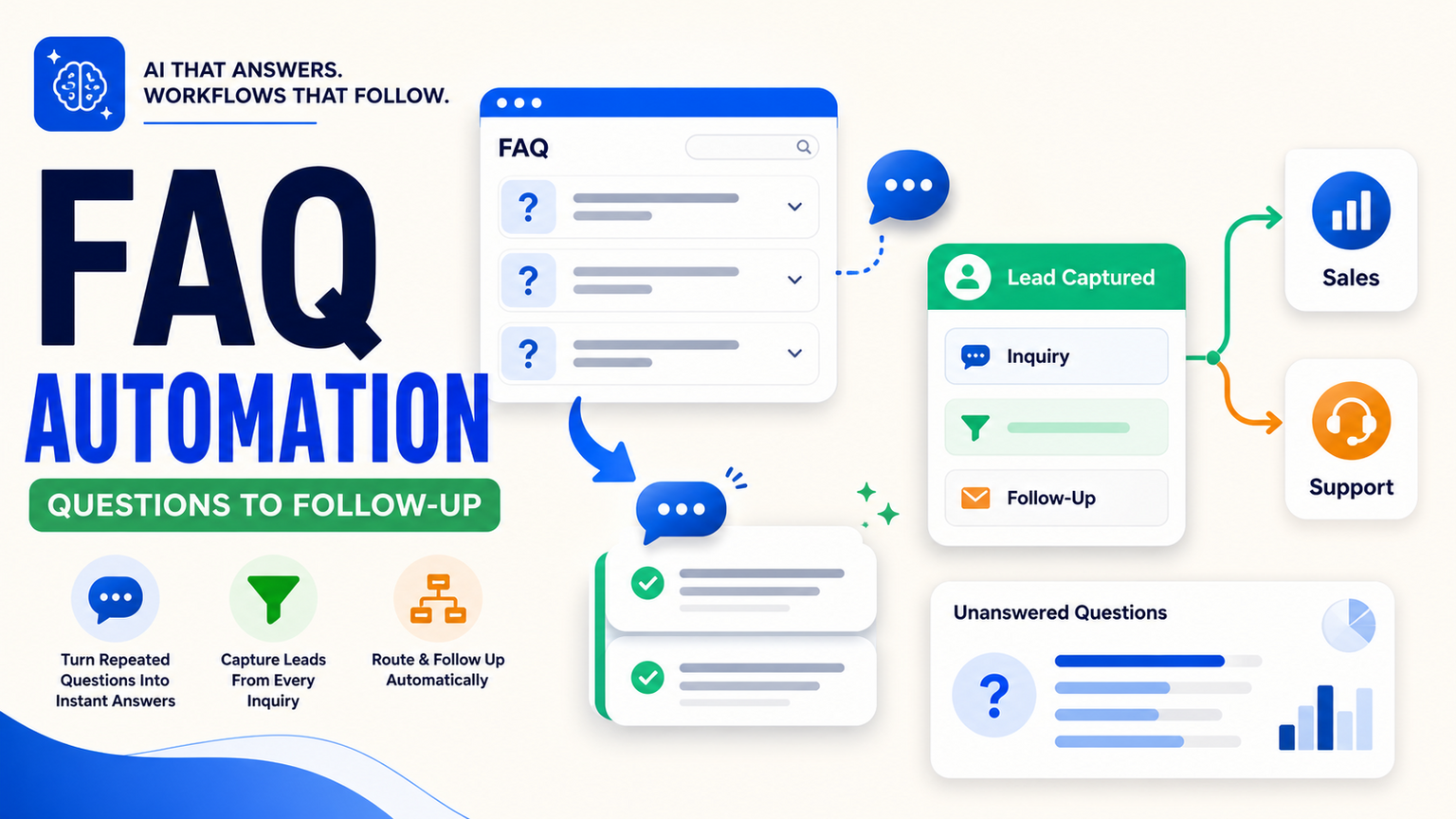
# FAQ Automation for SMEs: Turn Website Questions Into Qualified Follow-Up FAQ automation helps a small business turn repeated website questions into useful customer answers, lead context, and routed follow-up instead o
FAQ Automation for SMEs: Turn Website Questions Into Qualified Follow-Up
FAQ automation helps a small business turn repeated website questions into useful customer answers, lead context, and routed follow-up instead of another inbox queue. The fresh signal for this run is simple: customer service automation keeps appearing in current buyer content and the latest GOFTUS intelligence still ranks faq automation as a 90 plus keyword for blog, FAQ, and product pages. Reddit small-business and operator feeds were noisy during collection, so the social layer is treated as context rather than proof.
For SMEs in the UK, US, and Europe, the buyer problem is not whether a website can show an answer. It is whether the answer captures intent, knows when to hand off, updates the right workflow, and shows the team which questions are still unanswered. That is why this post targets faq automation, with a direct link to the GOFTUS FAQ automation service at /services#faq-automation.
What this means for SMEs
Most small businesses already have a hidden FAQ problem. Customers ask the same pricing, service area, booking, delivery, onboarding, support, and eligibility questions through the website, chat, email, WhatsApp, contact forms, sales calls, and social messages. Staff answer from memory, copy old replies, or leave the question for whoever knows the answer. The customer may still get help, but the business loses a clean view of demand.
A basic FAQ page only solves the publishing part. FAQ automation solves the operating part. It detects repeated questions, serves approved answers, captures contact details when intent is high, routes complex issues to sales or support, and records what the customer wanted. It can also show which questions do not yet have a good answer, so the team improves the website instead of guessing.
That is the practical difference between AI FAQ automation and a static website FAQ chatbot. The goal is not more auto-replies. The goal is fewer missed leads, faster support triage, and better customer knowledge.
What operators should build first
Start by collecting real questions from the last 30 to 90 days. Pull them from email, contact forms, live chat transcripts, sales notes, support tickets, call notes, and website search if available. Sort them into four groups: safe answer, qualify first, hand off, and improve the page.
Safe-answer questions include opening hours, service coverage, booking steps, document requirements, simple onboarding steps, and standard support routes. Qualify-first questions ask about budget, location, urgency, company size, technical stack, or support severity. Hand-off questions involve pricing exceptions, refunds, contracts, complaints, regulated advice, security incidents, personal data, or any promise the business cannot automate safely. Improve-the-page questions show where the website is unclear.
Then create an approved answer bank. Each answer needs an owner, source, last-reviewed date, escalation trigger, and next action. In GOFTUS projects, that next action may be a CRM update, a support ticket, a sales task, a document request, a reporting event, or a human approval step. The system should tell staff exactly why a lead was routed, not just that someone filled out a form.
A good first version can be small. Ten to twenty high-frequency questions are enough if they connect to follow-up. The team can review unanswered questions weekly, add better answers, and remove anything that creates confusion. Over time, the same workflow becomes the entry wedge into wider automation: CRM automation, customer support automation, document automation, reporting automation, and AI agents that act only after approval.
SaaS tools such as Zapier, n8n, Make, Bardeen, Gumloop, Lindy, Relevance AI, and Stack AI can be useful for moving data and triggering automations. Consultancies such as Faculty AI, Deeper Insights, Waracle, Brainpool AI, LeewayHertz, Markovate, SoluLab, BairesDev, Addepto, STX Next, Netguru, and 10Clouds can support larger AI builds.
The gap for SMEs is usually ownership. Tools automate tasks. GOFTUS automates the workflow around the task. FAQ automation is not only a widget. It needs a question source, answer owner, review process, escalation lane, CRM or support handoff, and monthly improvement loop. Without that layer, the business can end up with faster answers and the same messy follow-up.
GOFTUS counter-positions around measurable workflow outcomes. Did repeated questions fall? Did qualified enquiries reach the right person faster? Did support receive better context? Did the site reveal missing content? Did high-risk questions get handed to humans? That is the work that turns FAQ automation from a page feature into an operating system for customer answers.
What SMEs should do next
If your team keeps answering the same questions, do not start by buying the biggest chatbot. Start with a question audit. Pick the ten repeated questions that slow sales or support. Decide which answers are safe, which need qualification, and which need handoff. Connect the workflow to one system of record, such as a CRM, support desk, shared inbox, or simple review dashboard.
Then add measurement. Track unanswered questions, repeated questions, handoffs, lead captures, and answer edits. If AI helps draft answers, keep human review for anything that affects price, policy, trust, or customer commitments. If later an AI agent needs to use a web portal, connect the workflow to browser with AI controls rather than letting it act freely.
GOFTUS can help through the FAQ automation service at /services#faq-automation, or through a wider diagnostic via /contact when the same questions also touch CRM, support, documents, reporting, or agent workflows. The £100 Startup Kit style diagnostic is a practical way to map the first workflow before committing to a larger system.
FAQ automation is the first customer-answer layer for SMEs that do not want repeated website questions to disappear into inboxes. Use it to publish approved answers, capture intent, route complex requests, and learn which parts of the website still confuse buyers. The winning approach is not chatbot first. It is workflow first: answer, qualify, hand off, log, review, and improve.
Is FAQ automation different from a normal chatbot?
Yes. A normal chatbot often focuses on conversation. FAQ automation focuses on the operating workflow around repeated questions. It uses approved answers, captures useful context, routes complex issues, and records what still needs improvement. For SMEs, that means fewer repeated replies and better follow-up instead of another isolated chat tool.
What should an SME automate first?
Start with high-volume, low-risk questions that already have approved answers. Good examples include service coverage, booking steps, required documents, onboarding steps, delivery information, and support routing. Avoid automating refunds, contracts, regulated advice, pricing exceptions, or complaints until human review and escalation rules are clear.
How does FAQ automation connect to wider GOFTUS workflows?
FAQ automation can become the front door for CRM, support, reporting, document, and AI-agent workflows. A customer question can trigger a lead record, support ticket, document request, or human review task. That is why GOFTUS treats /services#faq-automation as an entry wedge into practical workflow automation rather than a standalone widget.
Reddit is treated as operator context only.
Internal link target: /services#faq-automation.