FAQ Automation for SMEs: Keep Customer Questions Moving From Website to Follow-Up
FAQ automation helps SMEs answer website questions, capture leads, route support issues, and keep sales follow-up moving safely with human review.
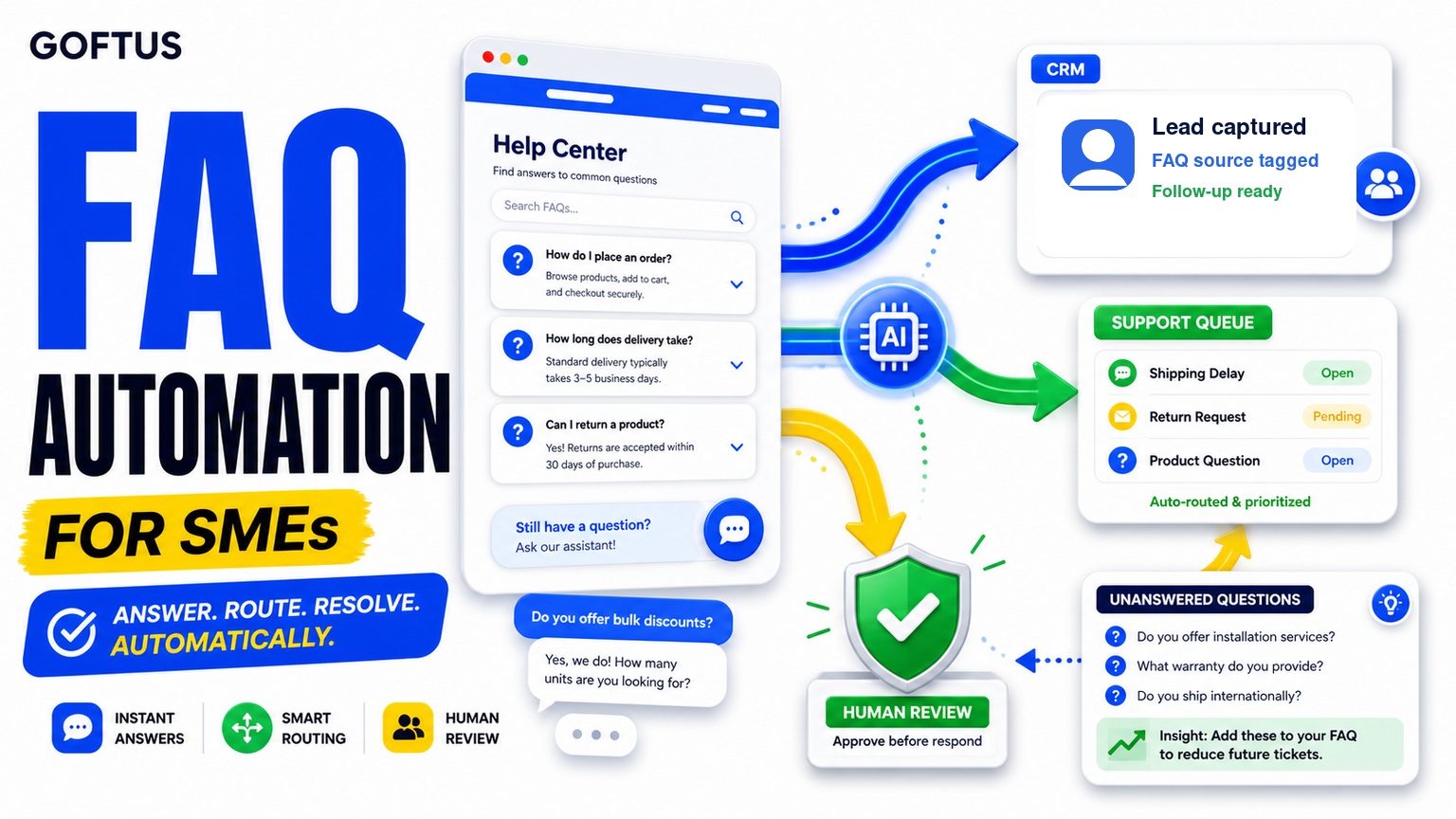
# FAQ Automation for SMEs: Keep Customer Questions Moving From Website to Follow-Up # Quick answer FAQ automation helps a small business answer repeated website questions, capture useful customer details, route harder
FAQ Automation for SMEs: Keep Customer Questions Moving From Website to Follow-Up
Quick answer
FAQ automation helps a small business answer repeated website questions, capture useful customer details, route harder issues, and keep follow-up visible. The fresh signal for this run is buyer-query source monitoring rather than a single vendor announcement. Google News also indexed r/smallbusiness discussions about real-world AI automation and customer support replacement concerns.
For UK, US, and EU SMEs, the problem is practical. Website questions arrive in chat, forms, email, social DMs, and support inboxes. Staff answer the same question repeatedly, then forget to log the lead, create the ticket, update the CRM, or improve the website. FAQ automation should fix the handoff, not just add another chatbot.
GOFTUS treats an FAQ automation service as the first customer-answer layer. It starts with approved answers, then adds lead capture, support routing, human review, and a monthly unanswered-question loop. If questions are already leaking across channels, start with /services#faq-automation before buying another disconnected widget.
What this means for SMEs
Most small teams do not need a giant AI programme to get value from automation. They need one reliable place where repeated customer questions become clear next actions. A visitor asks whether a service fits their use case. A customer asks which documents are needed. A buyer asks about delivery area, integration steps, appointment availability, refund policy, or what happens after a quote request. Each answer may look simple, but the follow-up decides whether the business wins the work or loses context.
FAQ automation gives that flow a repeatable structure. First, collect the questions that staff already answer every week. Second, write approved answer boundaries: what can be answered instantly, what needs a human, and what should never be promised by AI. Third, capture the fields that matter, such as service interest, urgency, location, account status, source page, and contact preference. Fourth, route the result into CRM, support, calendar, document collection, or a staff review queue. Fifth, review unanswered questions so the website and knowledge base improve over time.
That structure makes the automation safer. A website FAQ chatbot can be useful, but only if the business knows what happens after the reply. The answer is fewer lost leads, fewer repeated replies, cleaner support routing, and better visibility into what customers could not find.
Why customer-question routing matters
Customer questions often reveal intent before a formal lead exists. A pricing question may need sales qualification. A technical fit question may need a short diagnostic. A support question may need ticket creation. A document question may need a checklist. A portal action may later need browser with ai controls, where an AI agent prepares work inside a browser but a person approves submits, downloads, or record changes.
This is why GOFTUS frames AI FAQ automation as a wedge into wider workflow automation. The first layer answers safe questions from approved content. The second layer routes exceptions. The third layer connects to CRM, support, reporting, document automation, or AI agents. The workflow can stay human-approved where risk is higher, while simple repeated answers move quickly.
A good implementation should also measure gaps. If ten visitors ask the same question and the approved answer does not exist, that is not a chatbot failure. It is useful customer intelligence. The business can add a website section, train staff, update onboarding, or change a sales script. FAQ automation turns repeated confusion into an improvement backlog.
Competitor lens
Tools automate tasks. GOFTUS automates the workflow around the task.
Zapier, Make, n8n, Bardeen, Lindy, Relevance AI, Gumloop, and Stack AI can move data and connect apps. They are useful when the process is already designed. Agencies and consultancies such as Faculty AI, Deeper Insights, Waracle, Brainpool AI, LeewayHertz, Markovate, SoluLab, BairesDev, Addepto, STX Next, Netguru, and 10Clouds can also help with bigger AI programmes.
The SME gap is usually not the connector. It is ownership. Who approves the answer text? Who defines when the chatbot must stop? Who checks whether a lead record is complete? Who updates the support category? Who reviews unanswered questions? Who decides which questions become automation and which stay human-led?
GOFTUS counter-positioning is simple: start with the business workflow before choosing the tool. The FAQ answer, lead capture, support route, review gate, audit log, and improvement cycle should be designed together. A SaaS tool may respond to the customer. A GOFTUS workflow should make sure the right team owns the next action.
What SMEs should do next
Start with one high-traffic website page or one inbox where repeated questions slow the team down. List the top 20 questions, then mark each as instant answer, qualify and route, support ticket, document request, human review, or do not automate. This creates a safer brief than asking for a generic AI chatbot.
Next, define the handoff. If the answer suggests buying intent, send it to CRM with the right source and service tag. If it is a support issue, create a ticket with context. If it is sensitive, prepare a draft and ask a person to approve it. If the customer asks something the business cannot answer yet, log it for content improvement.
GOFTUS can help build that first layer through the FAQ automation service at /services#faq-automation. For a lighter start, the same thinking fits a diagnostic: identify the repeated customer question, map the follow-up, decide what should be automated first, and keep humans in the loop where judgment matters.
Summary for SMEs
FAQ automation is a customer-question routing workflow that answers safe questions, captures leads, escalates exceptions, and improves the knowledge base. The practical move is to automate the repeated answer and the follow-up around it.
FAQ
Is FAQ automation useful if we already have a contact form?
Yes. A contact form collects a message, but FAQ automation can answer safe questions, classify intent, capture the right fields, and send the next step to CRM or support. The value is the workflow after the question, not only the form submission.
Should FAQ automation replace human support?
No. It should remove repeated low-risk answers and make human support easier. Sensitive, unusual, or high-value questions should route to staff with context, suggested next steps, and a visible log.
How does FAQ automation connect to wider AI agents?
FAQ automation can prepare structured context for AI agents, but agents should act only inside approved boundaries. Browser tasks, CRM changes, document updates, and support actions need approval gates, logs, and stop rules.