FAQ Automation Should Capture Customer Answers Before the Next Chatbot
FAQ automation helps SMEs answer repeat questions, capture leads, route complex issues, and build a safer path into AI support workflows.
# FAQ Automation Should Capture Customer Answers Before the Next Chatbot Meta description: FAQ automation helps SMEs answer repeat questions, capture leads, route complex issues, and build a safer path into AI support w
FAQ Automation Should Capture Customer Answers Before the Next Chatbot
Meta description: FAQ automation helps SMEs answer repeat questions, capture leads, route complex issues, and build a safer path into AI support workflows.
FAQ automation is the practical first layer most small businesses should build before buying another broad chatbot. The signal this week is simple: buyers keep searching for customer service automation, AI chatbots, and faster support, while operators on Reddit still worry about missed questions, weak handoffs, and tools that create more work than they remove.
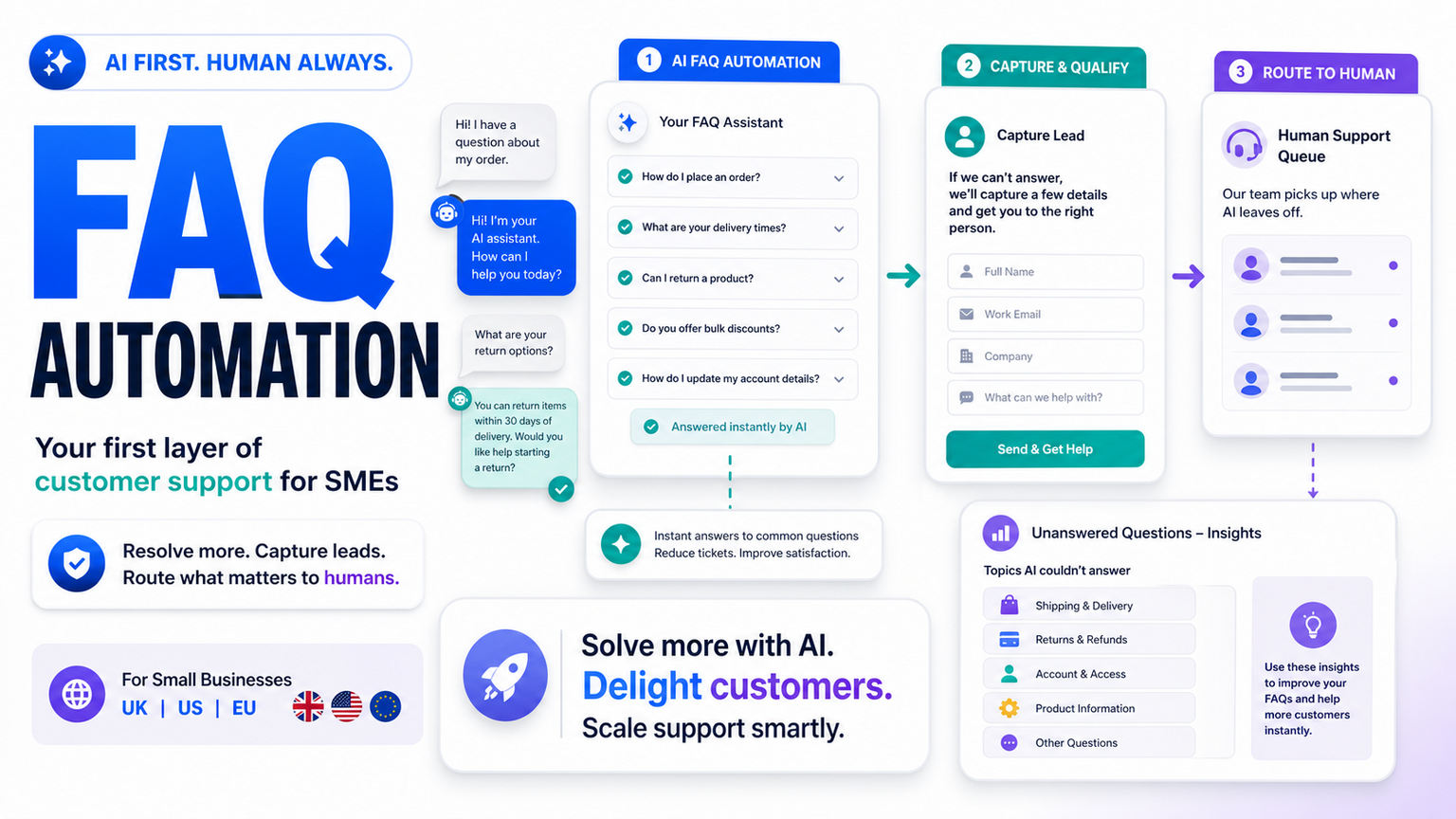
For GOFTUS, that points to a useful wedge. Start with the questions customers already ask on your website, WhatsApp, inbox, contact forms, and sales calls. Turn those questions into approved answers. Capture the details when the answer is not enough. Route the complex cases to the right person. Then use the unanswered-question log to improve the business every month.
That is what an FAQ automation service should do. It is not just a widget. It is the first controlled support workflow that can later connect to CRM follow-up, AI agents, document automation, reporting automation, and browser-based actions.
The daily FAQ automation cluster was selected because no GOFTUS post published today had targeted the FAQ automation cluster yet. The consistent theme is not that every company needs a giant AI platform. It is that support teams need faster answers with safe handoff.
One accessible Reddit search feed showed fresh small-business and AI-operator discussion around AI use in dropshipping and agent visits to B2B websites. That is adjacent context, not a confirmed news event. Hajikreena's view is that the practical SME lesson is still clear: unanswered website questions are an operational leak before they are an AI opportunity.
What this means for SMEs
For UK, US, and EU SMEs, FAQ automation should begin with boring questions that cost time every week. Delivery windows, returns, appointment rules, onboarding steps, pricing boundaries, eligibility checks, service areas, document requirements, and refund policies are all good candidates. A customer does not care whether the answer came from a chatbot, a knowledge base, or a support agent. They care whether it is clear, current, and connected to the next step.
The risk is that many businesses skip this layer and buy a generic website chatbot first. That often creates three problems. The bot answers with outdated wording. The team cannot see which questions it failed to answer. The CRM or support inbox does not receive enough context for follow-up. In that setup, automation becomes a new channel to babysit.
A better path is narrower. Build a controlled FAQ workflow. Approve the answers. Add lead capture only where it is useful. Route sensitive cases to a person. Log unknown questions. Review the log monthly. Once that works, the same structure can support AI agents, reporting automation, and browser with ai controls for safe back-office follow-up.
The GOFTUS workflow pattern
GOFTUS treats FAQ automation as an operating system for customer answers, not as a disconnected plug-in. The first step is question capture. Pull repeated questions from forms, chat transcripts, inboxes, sales notes, call summaries, and website search terms. The second step is answer design. Short answers should be approved by the business owner or service lead, not invented live without boundaries.
The third step is routing. If the customer asks something the FAQ cannot answer, the workflow should collect useful context, such as name, email, order type, location, urgency, and consent to be contacted. Then it should send the issue to the right destination: CRM, support board, email queue, ticketing tool, Slack, Teams, or a human reviewer.
The fourth step is improvement. Unanswered questions are valuable. They reveal missing website copy, confusing pricing, unclear policies, and service gaps. A monthly review can turn those questions into better FAQ cards, better service pages, better sales scripts, and better automation rules.
This is why the internal link target matters: AI FAQ automation is the entry wedge into wider GOFTUS workflow automation, not a dead-end help widget.
Faculty AI, Deeper Insights, Waracle, Brainpool AI, LeewayHertz, Markovate, SoluLab, BairesDev, Addepto, STX Next, Netguru, and 10Clouds can all be useful partners for larger AI or software programmes. SaaS tools such as Zapier, n8n, Relevance AI, Lindy, Gumloop, Bardeen, Make, and Stack AI can also connect tasks quickly.
The gap for SMEs is ownership of the workflow around the tool. Tools automate tasks. GOFTUS automates the workflow around the task.
That means GOFTUS focuses on the question source, answer approval, CRM handoff, support routing, exception handling, analytics, and continuous improvement. A widget can display an answer. A workflow decides what happens when the answer is missing, risky, incomplete, or commercially important.
What SMEs should do next
Start with a simple audit. List the twenty questions your team answers most often. Mark which answers are safe to automate, which need a human, and which need customer details before the team can respond. Then map the handoff destination for each type of question.
Next, connect the FAQ layer to one operational system. For a service business, that may be CRM follow-up. For ecommerce, it may be order support. For an agency, it may be qualification and booking. For a regulated or high-trust business, it may be document intake and human review.
Finally, add a monthly review rhythm. Which questions did customers ask that the automation could not answer? Which answers created sales opportunities? Which support issues should become website copy? Which handoffs were too slow? This is how FAQ automation becomes measurable instead of cosmetic.
If your business wants a practical first step, GOFTUS can run a Startup Kit style diagnostic, identify the repeated customer-answer workflows, and build the first layer around automated customer answers, CRM follow-up, support triage, and safe escalation.
FAQ automation is not a small website extra. It is the safest first customer-support automation layer for many SMEs. It answers repeated questions, captures leads, routes complex issues, and creates a log of what customers still do not understand. Build that layer before adding a bigger chatbot or autonomous agent.
Is FAQ automation the same as a chatbot?
No. A chatbot is the interface customers see. FAQ automation is the workflow behind it: approved answers, lead capture, routing, CRM updates, support handoff, and review of unanswered questions.
Why should a small business start with FAQ automation?
Because repeated questions are easy to identify, low risk to answer with approved wording, and directly connected to customer experience. It gives the business a controlled automation win before bigger AI projects.
Where should FAQ automation link inside GOFTUS?
For this cluster, the main internal target is FAQ automation for small business. Related workflows can also point to /services, /agents, /questions, and /contact when the topic expands into wider automation.
Reddit search was partly rate limited, so the Reddit signal is labelled as adjacent operator context rather than direct proof of a confirmed news event.