FAQ Automation for SMEs: Capture Website Questions Before Support Gets Busy
FAQ automation helps SMEs answer repeated website questions, capture leads, route issues, and keep follow-up moving before support gets busy.
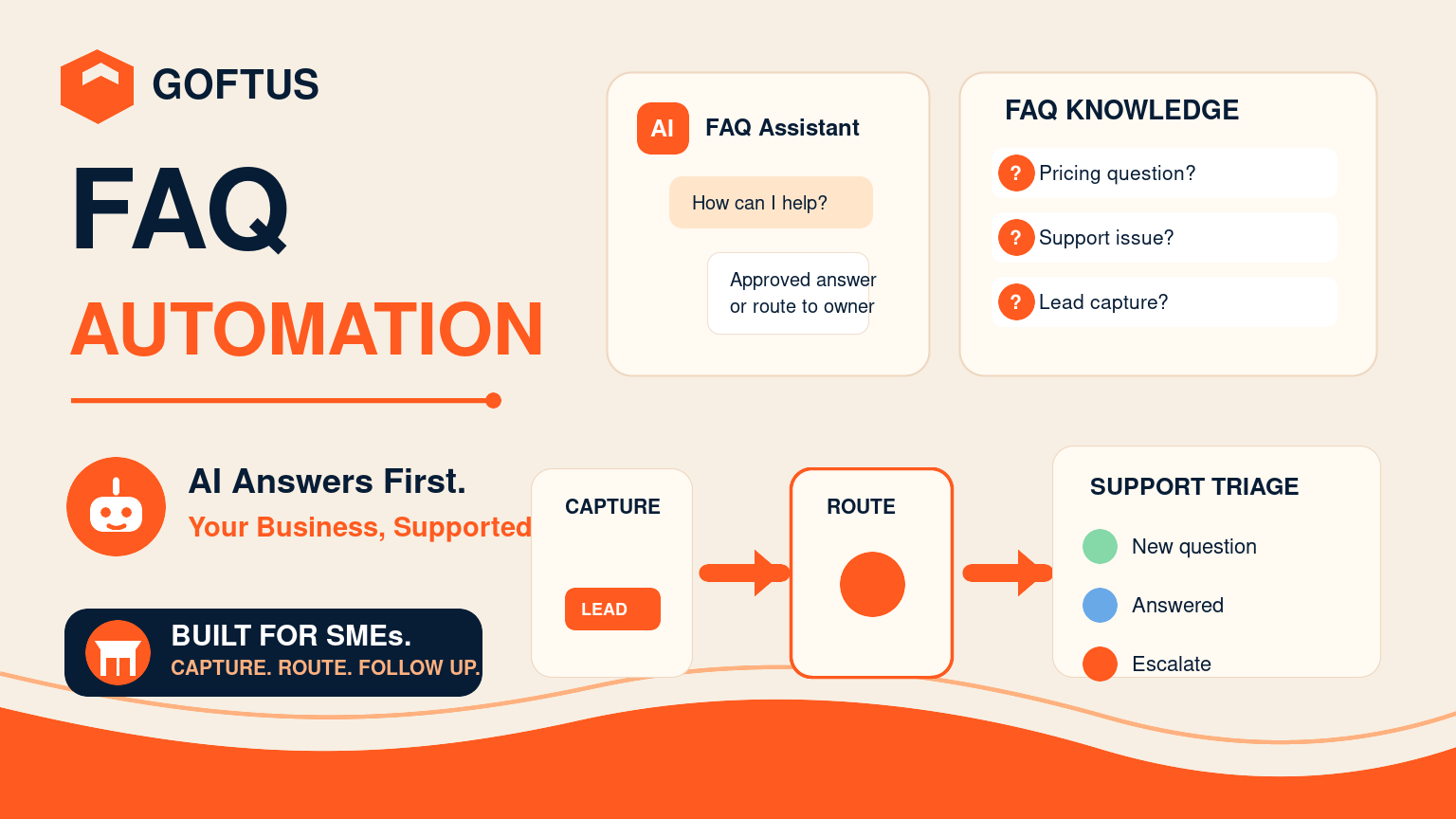
# Quick answer FAQ automation helps SMEs turn repeated website questions into an owned customer-answer workflow before support gets busy. A website FAQ chatbot or AI FAQ automation layer should not just show a static an
Quick answer
FAQ automation helps SMEs turn repeated website questions into an owned customer-answer workflow before support gets busy. A website FAQ chatbot or AI FAQ automation layer should not just show a static answer. It should capture the question, identify whether the visitor is a lead or a support case, route complex issues to the right person, update the CRM or helpdesk, and show which questions remain unanswered. For small teams in the UK, US, and Europe, the first useful automation is often not a full AI agent. It is a practical customer-answer layer connected to follow-up. GOFTUS builds this through the FAQ automation service at /services#faq-automation so the business can answer faster without losing the human handoff.
What this means for SMEs
This run prioritised the daily FAQ automation cluster because no post published after 00:00 UTC today clearly targeted FAQ automation, AI FAQ automation, website FAQ chatbot, automated customer answers, or customer support FAQ automation. The source signal is buyer intent around customer service automation and AI chatbots rather than a single breaking-news claim.
Those results are used here as headline-level source context, not as scraped article evidence. The useful takeaway is simple: buyers are actively comparing tools, but SMEs still need the workflow around the answer.
A normal FAQ page answers what someone already knows to ask. FAQ automation goes further. It watches repeated website questions, groups them by intent, answers low-risk questions immediately, asks for contact details when the question signals buying intent, and sends unclear or sensitive questions to a human owner. The difference matters when a small support team is also handling sales follow-up, onboarding, billing questions, and delivery updates.
Without an owned workflow, a chatbot can create more noise. It may answer common questions, but the sales team may never see the buying signal. It may collect a message, but no one knows whether it became a CRM task. It may produce a helpful draft, but staff cannot see which source page or policy the answer came from. That is where automated customer answers need structure.
Bharatvaj's view
Bharatvaj's view is that FAQ automation should be treated as the first customer-answer layer, not a cheap replacement for support staff. The goal is to reduce repeated questions while improving the handoff for questions that matter.
A practical GOFTUS setup starts by collecting the questions already hidden across website forms, inboxes, chats, WhatsApp messages, sales calls, support tickets, and staff notes. The next step is to separate those questions into safe answer categories, lead categories, support categories, and escalation categories. Only then should the business decide which answers can be automated.
For example, a pricing question may need a sales follow-up, not just a generic answer. A delivery or account question may need identity checks before anything is shared. A product-fit question may need a short qualifying form and a CRM task. A complaint may need a support owner and a written log. FAQ automation works when each path is clear.
This is why the GOFTUS service at /services#faq-automation connects FAQ content with CRM automation, support triage, reporting automation, and human review. The FAQ answer is only the visible part. The workflow behind it decides whether the question becomes a lead, a ticket, a knowledge-base update, or a management insight.
Summary for SMEs
For SMEs, FAQ automation is valuable because it creates a repeatable customer-answer system. The business can answer simple questions quickly, capture leads while interest is high, route complex questions to the right person, and learn which website content is missing.
A sensible first version should include approved answers, contact capture, escalation rules, CRM or helpdesk handoff, unanswered-question reporting, and a monthly review. That review is important. It shows which answers need updating, which questions are becoming sales objections, and where staff still spend time repeating themselves.
GOFTUS keeps the setup practical. We do not start by forcing a business into a large platform migration. We map the current question flow, add the smallest useful automation, connect the follow-up path, and then improve it using real customer questions.
Competitor lens
Tools such as Zapier, n8n, Make, Lindy, Gumloop, Bardeen, Relevance AI, and Stack AI can be useful for connecting forms, chatbots, CRMs, and support tools. Consulting firms such as Faculty AI, Deeper Insights, Waracle, Brainpool AI, LeewayHertz, Markovate, SoluLab, BairesDev, Addepto, STX Next, Netguru, and 10Clouds can also help with broader AI or software delivery.
The gap for many SMEs is not whether a tool can answer a question. The gap is whether the whole workflow is owned. Who approves the answer? Where does the lead go? What happens when the answer is incomplete? Which questions are reviewed each month? Which actions require a human?
Tools automate tasks. GOFTUS automates the workflow around the task. For FAQ automation, that means answers, routing, CRM or support handoff, logs, review, and improvement working together.
What SMEs should do next
Start with the questions your team already answers repeatedly. Pick twenty to thirty questions from your inbox, website form, live chat, sales calls, and support tickets. Mark each one as safe answer, needs lead capture, needs support owner, needs policy check, or should not be automated yet.
Then decide the first workflow. A strong first version is often: answer common public questions, capture contact details for buying questions, create a CRM task for sales intent, create a support task for existing-customer issues, and show a weekly unanswered-question report.
If you want a small diagnostic before building, GOFTUS can review the question flow, suggest the first FAQ automation path, and connect it to the wider workflow through /services#faq-automation or /contact.
FAQ
Is FAQ automation the same as adding a chatbot?
No. A chatbot is only one interface. FAQ automation includes approved answers, customer question capture, lead routing, CRM or helpdesk handoff, escalation rules, logs, and monthly improvement.
What should not be automated first?
Do not start with account-specific, legal, billing, health, security, or sensitive customer questions unless the workflow has identity checks, human review, and clear escalation rules.
How does this help sales?
Repeated website questions often reveal buying intent. FAQ automation can capture the question, collect contact details, qualify the need, and create a follow-up task before the prospect goes cold.
Source notes
Reddit and social intelligence were treated as context only. Notable headline-level cross-checks included Salesforce on customer service automation software, IBM on AI customer service chatbots, and Bitdefender on customer-service AI mistakes. Direct article bodies were not scraped for unsupported claims.