FAQ Automation Should Capture Questions Before They Become Missed Leads
FAQ automation helps SMEs answer repeated website questions, capture leads, route issues and measure gaps before customer demand is missed online.
# FAQ Automation Should Capture Questions Before They Become Missed Leads # Quick answer Small-business operators are still showing a familiar problem in public forums: the website, inbox and direct messages create mor
FAQ Automation Should Capture Questions Before They Become Missed Leads
Quick answer
Small-business operators are still showing a familiar problem in public forums: the website, inbox and direct messages create more repeated questions than a small team can comfortably answer. A fresh r/smallbusiness RSS thread about a quote generator for service businesses framed the pain clearly: customers ask the same pricing and service-fit questions, compare options quickly and expect a useful answer before a staff member has time to type everything manually.
Those listings point to the same operational issue rather than one dramatic new product launch: SMEs want quicker answers, but they also need safe routing, follow-up and control. This is why today's GOFTUS buyer question cluster focuses on FAQ automation service instead of another broad AI tool roundup.
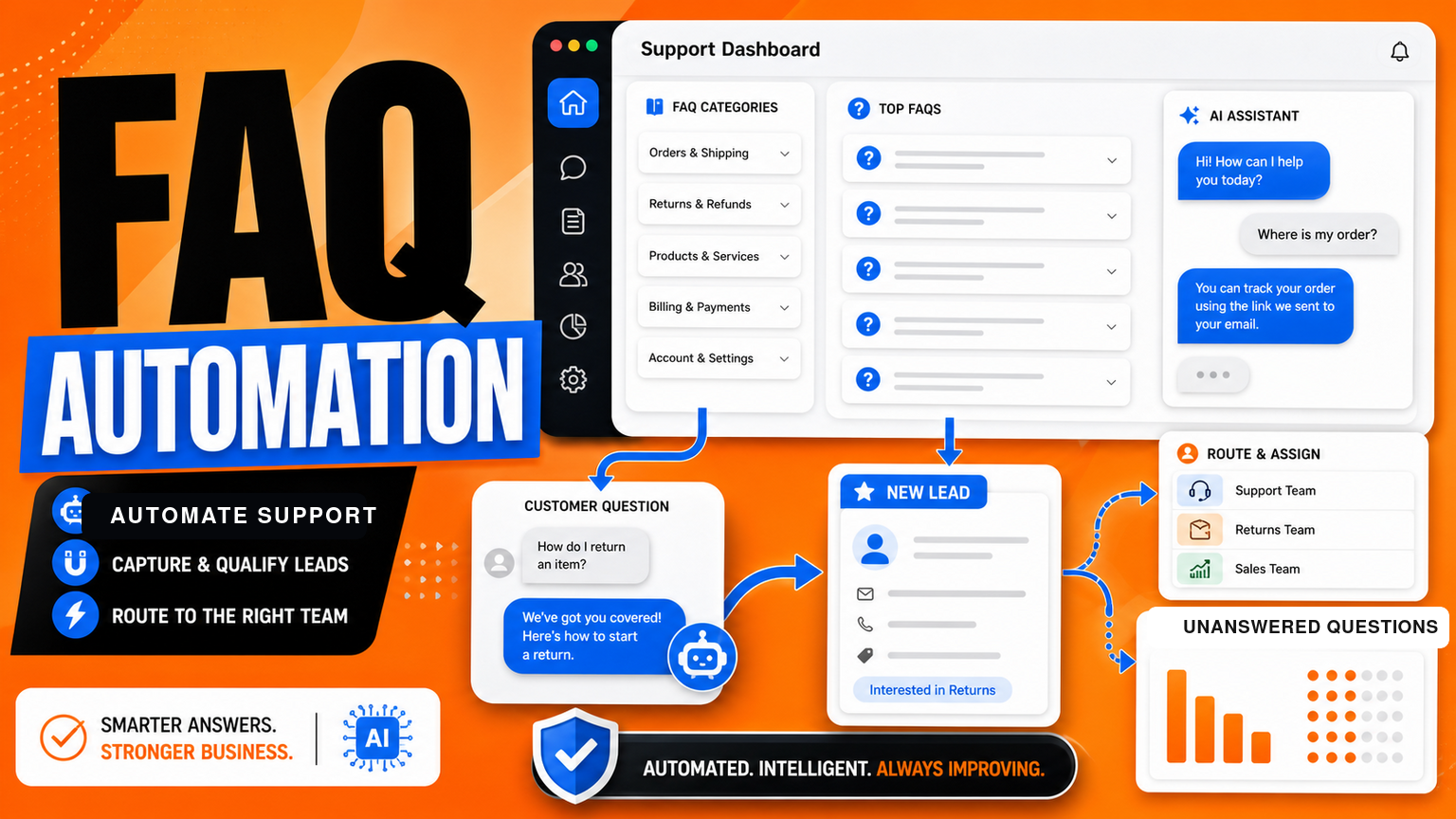
Bharatvaj's view is simple. FAQ automation is not just a chatbot widget. It is the first customer-answer workflow. Done properly, it answers approved questions, captures leads, routes complex issues, updates CRM or support tools, and records unanswered questions so the business can improve the website every month.
What this means for SMEs
For UK, US and EU SMEs, the hidden cost is rarely one single missed message. It is the pattern behind the message. A prospect asks whether the service covers their location. Another asks for price guidance. A customer asks what happens after purchase. A supplier asks where to send documents. The team answers manually, then answers the same thing again the next day.
That repetition is a signal. If ten people ask a similar question, the business does not only need faster typing. It needs a controlled answer, a next step and a record of what happened. AI FAQ automation can become the first layer of that system.
The entry workflow can be narrow. Start with the top twenty questions from the website, email, WhatsApp, live chat and sales calls. Approve plain-English answers. Add safe escalation rules for anything involving pricing exceptions, complaints, legal terms, medical advice, regulated finance, refunds or account access. Then connect the flow to CRM, a support inbox or an internal task board.
This is where GOFTUS differs from a generic bot install. We treat the FAQ as a workflow object. A repeated question can become a lead, a support ticket, a sales note, a knowledge-base update or a human review item. The useful result is not just a faster answer. It is less leakage between customer intent and the next business action.
Why the source signal matters now
The Reddit signal is not a verified market statistic, and it should not be treated as one. It is useful because it reflects the operator pain beneath many small-business automation projects: owners can build or buy a tool, but they still need to know where customer questions go after the first reply.
Customer-service automation is now mainstream enough that business owners are comparing platforms, risks and use cases. That makes the next decision more practical: should an SME buy another SaaS dashboard, or should it build a reliable answering workflow around its existing website and tools?
FAQ automation is often the right first wedge because it is visible, measurable and low-risk when scoped well. A business can track the questions answered, the questions escalated, the leads captured and the pages that still confuse visitors. That evidence can then guide wider automation in CRM follow-up, document processing, internal knowledge assistants and AI agents.
Summery for SMEs
If your team keeps answering the same questions, do not start by asking for a fully autonomous support agent. Start by designing the answer layer. List common questions. Agree the answers. Decide what the system may say, what it must not say and when a human should take over.
Then add workflow. If a visitor asks about availability, capture the lead and route it to sales. If a customer asks about an order, collect enough context and create a support task. If a visitor asks a question the FAQ cannot answer, save it as an improvement item rather than letting it disappear.
GOFTUS can build this through AI FAQ automation and connect it to wider workflow automation services, AI agents and reporting. The goal is not to replace the team. The goal is to remove repeated low-value answering while making important customer moments easier to see.
Competitor lens
Faculty AI, Deeper Insights, Waracle and Brainpool AI in the UK can support serious AI projects. LeewayHertz, Markovate, SoluLab and BairesDev in the US often help with custom builds. Addepto, STX Next, Netguru and 10Clouds across Europe can deliver broader software and data work. SaaS tools such as Zapier, n8n, Relevance AI, Lindy, Gumloop, Bardeen, Make and Stack AI can automate useful steps.
The gap for many SMEs is ownership of the workflow around the tool. Tools automate tasks. GOFTUS automates the workflow around the task. For FAQ automation, that means approved answers, lead capture, escalation rules, CRM or support handoff, unanswered-question review and monthly improvement. The tool is only one part of the operating system.
FAQ
Is FAQ automation the same as a chatbot?
No. A chatbot is one interface. FAQ automation is the wider workflow that decides which answers are approved, what data should be captured, when to escalate, and where each customer question should be logged.
Can a small business start without rebuilding the website?
Yes. A first version can sit on the existing website, use approved question sets and connect to simple CRM, inbox or support-tool handoffs.
What should be measured first?
Measure repeated questions, answered questions, escalations, captured leads and unanswered questions. Those signals show where the website, sales process or support flow needs improvement.
Where should SMEs start with GOFTUS?
Start with the FAQ automation service if repeated customer questions are the bottleneck, or use /contact for a wider workflow diagnostic.
What SMEs should do next
Pull the last month of customer questions from your website forms, inbox, CRM, live chat and call notes. Group them into themes. Mark the questions that can be answered safely with approved copy. Mark the ones that need a human, a document, a quote or a system lookup.
That map becomes the first automation brief. GOFTUS can turn it into a practical FAQ automation layer, connect it to CRM or support systems, and add reporting so the business sees what customers still cannot find. If repeated questions are slowing your team down, book a practical consultation through /contact and start with the smallest workflow that removes the most manual answering.
Source notes
Direct article claims were not treated as scraped body text.