FAQ Automation Should Capture Buying Questions Before They Hit the Inbox
FAQ automation helps SMEs answer repeated website questions, capture leads, route support issues, and improve follow-up before buyers go cold.
# FAQ Automation Should Capture Buying Questions Before They Hit the Inbox Meta description: FAQ automation helps SMEs answer repeated website questions, capture leads, route support issues, and improve follow-up before
FAQ Automation Should Capture Buying Questions Before They Hit the Inbox
Meta description: FAQ automation helps SMEs answer repeated website questions, capture leads, route support issues, and improve follow-up before buyers go cold.
FAQ automation is not just a better help page. For a small or mid-sized business, it can become the first customer-answer layer: the place where repeated buyer questions are answered, missed intent is captured, complex issues are routed, and the team can see what customers still do not understand.
The daily signal for this post comes from buyer-search and operator noise around customer service automation. A Reddit search RSS result from r/smallbusiness also surfaced a recent operator discussion where local-service businesses were described as needing phone-answering, lead-chasing, website, and automation support rather than another isolated tool.
That combination matters for UK, US, and EU SMEs. The market is full of chatbots, ticketing widgets, AI assistants, and workflow tools. But the operational gap is earlier than most teams admit: customers ask the same buying questions on the website, staff reply manually across email or WhatsApp, leads arrive without enough context, and the same unanswered questions keep reappearing.
FAQ automation fixes the first layer before a business buys another chatbot. GOFTUS treats FAQ automation service as a practical wedge into wider workflow automation: answer common questions, capture lead details, route exceptions, update CRM or support tools, and review the questions that still need better content.
What this means for SMEs
For operators, the point is not to replace customer support with a generic bot. The point is to remove the avoidable delay between a customer asking a basic question and the business taking the right next action.
A good FAQ automation workflow starts with real questions from the business. Pricing boundaries, delivery areas, onboarding steps, refund terms, service availability, documents required, appointment rules, product fit, and handoff rules are better starting points than a blank AI prompt. Once those answers are written, the system should be able to show them on the website, capture a name and email when the answer indicates buying intent, and send anything sensitive or unusual to a human.
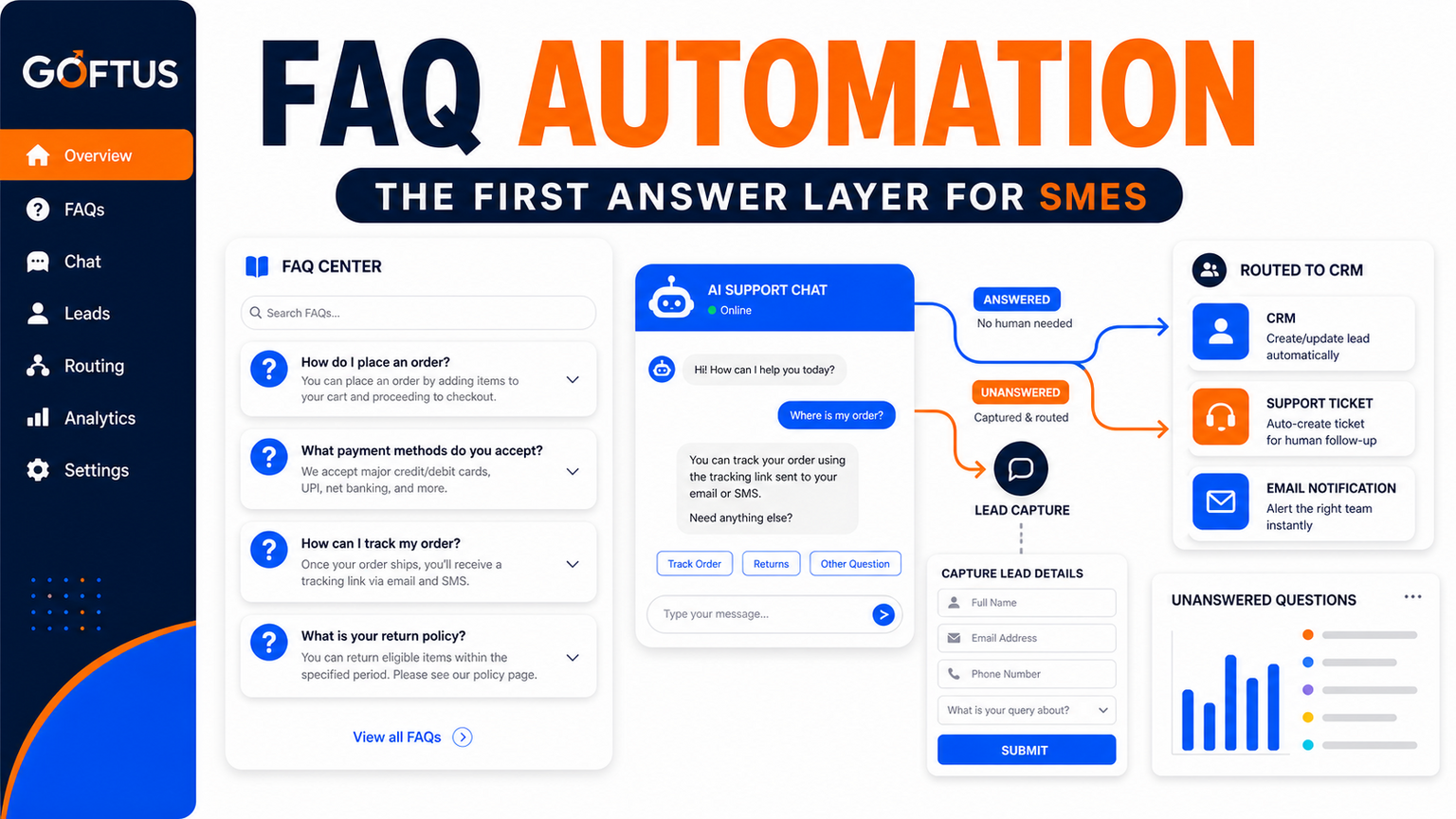
That is why FAQ automation is different from a static FAQ page. A static page waits. An automated customer-answer layer listens, answers, asks a follow-up, and routes the next step. If the visitor asks about a quote, the lead can enter CRM. If the question is about an existing order, the issue can become a support ticket. If the question has no approved answer, it can go into an unanswered-question queue for review.
For regulated or professional services, it can keep risky answers behind review rules instead of letting a chatbot improvise.
Bharatvaj's view is that FAQ automation is one of the safest first AI projects for an SME because it begins with known questions rather than open-ended autonomy.
The mistake is treating the website chatbot as the project. The real project is the workflow around the question. Who owns the answer? Which questions can be answered automatically? Which questions need a form, a ticket, a sales follow-up, or human review? Which unanswered questions should change the website copy next month?
That is where GOFTUS positions the work. The AI can draft, classify, and route. The business still needs approved answers, escalation boundaries, CRM fields, handoff rules, and reporting.
For SMEs in the UK, US, and EU, the practical sequence is simple. Start with the ten to twenty questions staff answer every week. Turn those into approved answers. Add capture points for quote, demo, booking, document, delivery, and support intent. Connect those capture points to the existing CRM, inbox, ticketing tool, spreadsheet, or automation stack. Review the unanswered-question report monthly. That is a workflow system, not a content page.
There are many useful providers in this market. UK firms such as Faculty AI, Deeper Insights, Waracle, and Brainpool AI can support larger AI programmes. US providers such as LeewayHertz, Markovate, SoluLab, and BairesDev, European teams such as Addepto, STX Next, Netguru, and 10Clouds, and SaaS tools such as Zapier, n8n, Relevance AI, Lindy, Gumloop, Bardeen, Make, and Stack AI can all help connect tasks.
GOFTUS does not need to dismiss any of them. The gap is that tools and projects often stop at the visible automation. A chatbot answers. A form submits. A Zap runs. But the customer still needs the business to know what happened, who owns the next step, and which questions are causing friction.
Tools automate tasks. GOFTUS automates the workflow around the task.
For FAQ automation, that means the answer library, capture form, CRM update, support triage, human approval point, unanswered-question log, reporting view, and improvement loop are designed together. A tool can be part of the stack. The outcome is the operating system around customer questions.
What SMEs should do next
First, export the questions customers asked in the last thirty days. Pull from inboxes, website forms, live chat, sales calls, WhatsApp, support tickets, and staff notes. Start with what customers actually ask.
Second, group the questions by intent. Common groups include pricing, availability, delivery, refunds, service fit, implementation, booking, documents, account issues, and complaints. Each group should have an approved answer owner and an escalation rule.
Third, decide where automation should hand off. A buying question may create a CRM lead. A support question may create a ticket. A document question may send a checklist. A risky question may ask for contact details and send the case to a human.
Fourth, add measurement. The most useful report is often not the number of automated answers. It is the list of unanswered or low-confidence questions. That list tells the business what to improve on the website, in sales scripts, in support templates, and in onboarding.
If you want a practical starting point, GOFTUS can map this as part of an AI FAQ automation or wider workflow automation diagnostic. The goal is not to make customers talk to a bot. The goal is to stop good questions from disappearing before a staff member can act.
FAQ automation should be treated as the first customer-answer workflow, not a decorative chatbot. The right system answers repeated questions, captures buying intent, routes exceptions, updates the right tools, and shows the team what still needs a better answer.
For SMEs, this is a low-risk entry point into AI automation because it starts from known customer language. Once the first layer works, the same logic can expand into CRM follow-up, support triage, document collection, reporting, and safer AI agents.
Is FAQ automation the same as a website chatbot?
No. A website chatbot is one possible interface. FAQ automation is the wider workflow that stores approved answers, captures visitor intent, routes difficult questions, updates CRM or support tools, and reports unanswered questions. The chatbot is only useful if the workflow around it is clear.
Where should a small business start with FAQ automation?
Start with the questions staff answer every week. Turn them into approved answers, add a simple capture form for high-intent questions, and connect the results to the tool the team already uses. GOFTUS can help through its FAQ automation service.
Can FAQ automation support sales and support at the same time?
Yes, if the routes are designed carefully. Sales questions can create leads or booking tasks, while support questions can create tickets or send checklist links. The key is to separate answer types, escalation rules, and owners before automation goes live.
The article frames the buyer-query and operator-signal pattern through GOFTUS workflow design.