FAQ Automation for SMEs: Answer Customer Questions Before Support Gets Busy
FAQ automation helps SMEs answer repeated customer questions, capture leads, route support issues, and keep follow-up visible before context is lost.
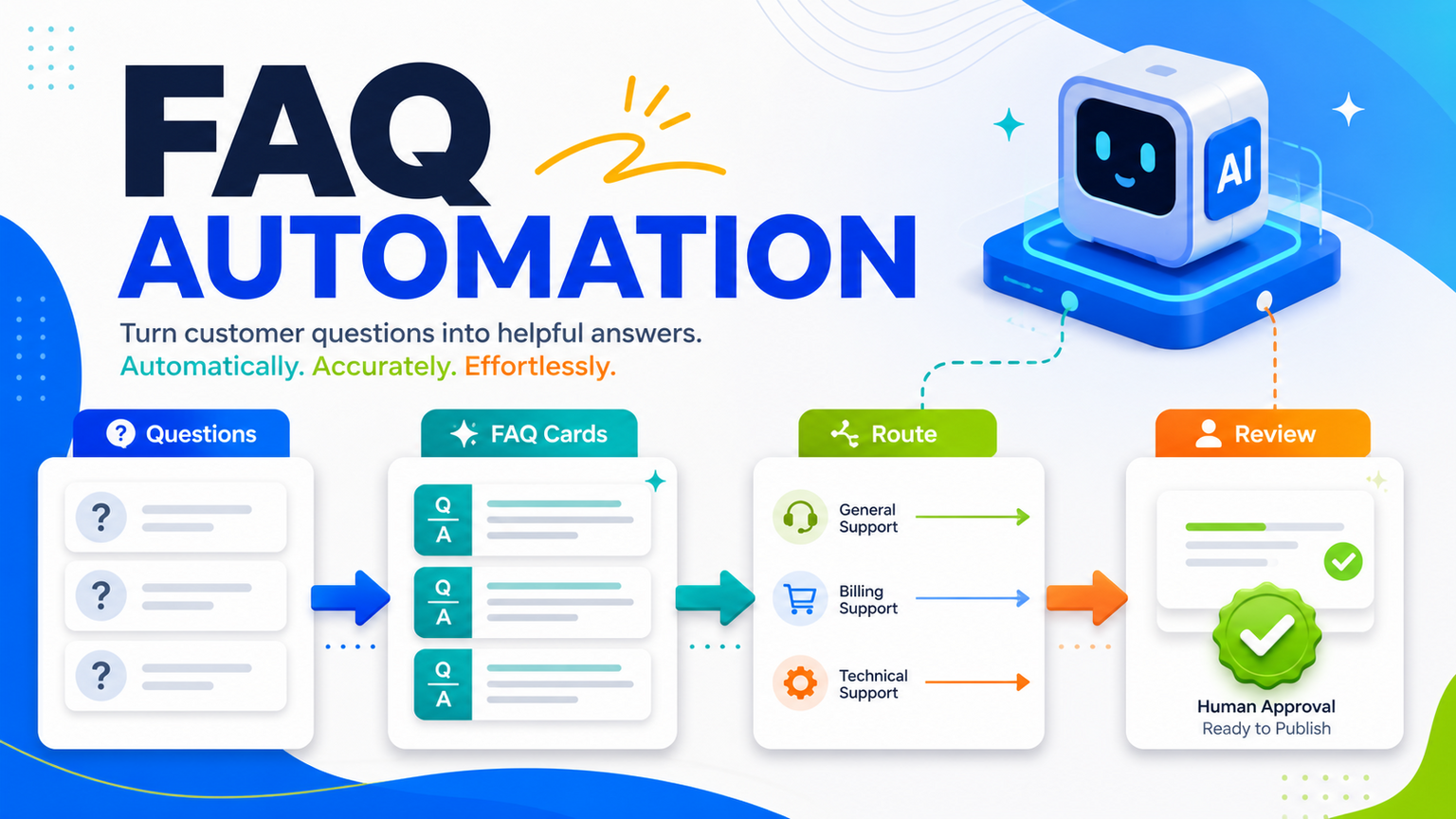
# FAQ Automation for SMEs: Answer Customer Questions Before Support Gets Busy **Meta description:** FAQ automation helps SMEs answer repeated customer questions, capture leads, route support issues, and keep follow-up v
FAQ Automation for SMEs: Answer Customer Questions Before Support Gets Busy
Meta description: FAQ automation helps SMEs answer repeated customer questions, capture leads, route support issues, and keep follow-up visible before context is lost.
Quick answer
FAQ automation is the safest first layer for SMEs that want AI in customer support without handing every conversation to a bot. The buyer problem is clearer than the news headline: customers ask repeated questions before staff are ready, and too many useful leads disappear before anyone follows up.
GOFTUS solves that with AI FAQ automation that captures website questions, answers the repeatable ones, routes complex issues, updates follow-up workflows, and shows what customers still cannot find.
What this means for SMEs
Most small businesses do not need a giant customer-service platform on day one. They need a dependable first answer layer that works before support gets busy, before a salesperson checks the inbox, and before a founder loses the thread across forms, chat, WhatsApp, and email.
FAQ automation is useful because it starts with known questions. Pricing ranges, service fit, opening hours, delivery areas, booking steps, onboarding requirements, refund policy, document requests, and next-step questions can be turned into reviewed answers. The system can then capture the question, show the answer, ask for missing context, and route anything uncertain to a person.
That makes it different from a generic chatbot. A chatbot tries to converse. FAQ automation tries to keep the customer journey from going cold. The difference matters for UK, US, and EU SMEs because the team often has limited time, mixed tools, and no dedicated support operations role.
Thirumurugan's view
The strongest reason to start with FAQ automation is control. A business owner can review the answer library, decide which topics are safe to answer automatically, and choose which questions must go to a human. That is easier to govern than a broad AI assistant that improvises across every customer request.
A good FAQ automation workflow should not hide unanswered questions. It should collect them. If five prospects ask about setup time, pricing, integrations, or support handoff, that is a sales signal. If customers keep asking where a document is, that is an operations signal. If the same question creates tickets every week, that is a support-triage signal.
This is where GOFTUS positions FAQ automation as the wedge into wider workflow automation. The answer layer can connect to CRM follow-up, support routing, internal notes, reporting, document requests, and later AI agents. The first win is not replacing staff. The first win is making sure the business sees what customers are asking and responds consistently.
How to build the first customer-answer layer
Start with the last thirty days of questions from contact forms, inboxes, sales calls, live chat, support tickets, and staff notes. Group them into ten to twenty answer themes. Do not start with a blank knowledge base. Start with the questions customers already ask.
Next, mark each answer as automatic, reviewed, or human-only. Automatic answers should be factual, stable, and low risk. Reviewed answers can be drafted by AI but approved before sending. Human-only questions include complaints, custom pricing, legal terms, sensitive customer data, unusual refunds, and anything that could damage trust if answered badly.
Then design the routing. A website FAQ chatbot can answer simple questions, but the real workflow should also capture name, email, company, urgency, service interest, and the page where the question was asked. Qualified leads can move to CRM. Support issues can become tickets. Unclear questions can be added to a review queue.
Finally, measure what the FAQ layer changes. Useful measures include repeated questions answered, leads captured, complex issues routed, unanswered topics added, and staff review time. These are practical workflow outcomes, not vanity bot metrics.
Competitor lens
SaaS tools such as Zapier, n8n, Make, Bardeen, Gumloop, Lindy, Relevance AI, and Stack AI can automate pieces of the journey. Agencies and consultancies such as Faculty AI, Deeper Insights, Waracle, Brainpool AI, LeewayHertz, Markovate, SoluLab, BairesDev, Addepto, STX Next, Netguru, and 10Clouds can help with broader AI delivery.
The gap for many SMEs is not whether a tool can answer a question. The gap is who owns the workflow after that answer. Does the lead enter CRM? Does the support issue get routed? Does the team see unanswered questions? Does anyone review risky answers? Does the system improve each month?
Tools automate tasks. GOFTUS automates the workflow around the task. For FAQ automation, that means answer design, routing logic, CRM and support handoff, human review, reporting, and the next step into GOFTUS services when the business is ready to automate more than FAQs.
What SMEs should do next
Pick one narrow customer journey. A service business might choose booking questions. An ecommerce operator might choose delivery and returns. A B2B agency might choose qualification and consultation questions. A regulated business might choose document requests and escalation rules.
Write approved answers for the questions that repeat. Add a clear handoff when the answer is not enough. Connect the flow to CRM or support so the question does not disappear. Review the unanswered-question report weekly for the first month. Then decide whether the next automation should be CRM follow-up, support triage, document automation, reporting, or controlled AI agents.
For SMEs that want a practical start, GOFTUS can map the question flow, build the FAQ answer layer, connect the follow-up workflow, and use the £100 Startup Kit diagnostic as a focused way to decide what should be automated first. The best first project is not the flashiest chatbot. It is the customer-answer workflow that stops repeated questions from slowing the business down.
Summery for SMEs
FAQ automation should answer common questions, capture useful context, and route anything complex before support gets busy. Use it as a controlled first layer, not a replacement for judgement. GOFTUS links the FAQ layer to CRM, support, reporting, and later agent workflows so each answer creates a visible next step.
FAQ
Is FAQ automation the same as a website chatbot?
No. A website chatbot is the interface customers see. FAQ automation is the workflow behind it: approved answers, lead capture, routing, review queues, CRM updates, and reporting on unanswered questions.
What questions should SMEs automate first?
Start with repeated, stable, low-risk questions about services, fit, process, booking, delivery, documents, and support routes. Keep pricing exceptions, complaints, legal questions, and sensitive account issues in human review.
Where does browser with ai controls fit?
After the FAQ layer is stable, controlled browser agents can help staff work across portals and web-based tools. GOFTUS links those workflows to /agents so browser actions use approvals, logs, login boundaries, and stop rules.