Enterprise AI ROI Gap Shows SMEs Need Workflow Controls
Enterprise AI is finding insights but not easy savings. SMEs need workflow controls, approvals, and measurement before adding more AI tools.
# Enterprise AI ROI Gap Shows SMEs Need Workflow Controls Meta description: Enterprise AI is finding insights but not easy savings. SMEs need workflow controls, approvals, and measurement before adding more AI tools. A
Enterprise AI ROI Gap Shows SMEs Need Workflow Controls
Meta description: Enterprise AI is finding insights but not easy savings. SMEs need workflow controls, approvals, and measurement before adding more AI tools.
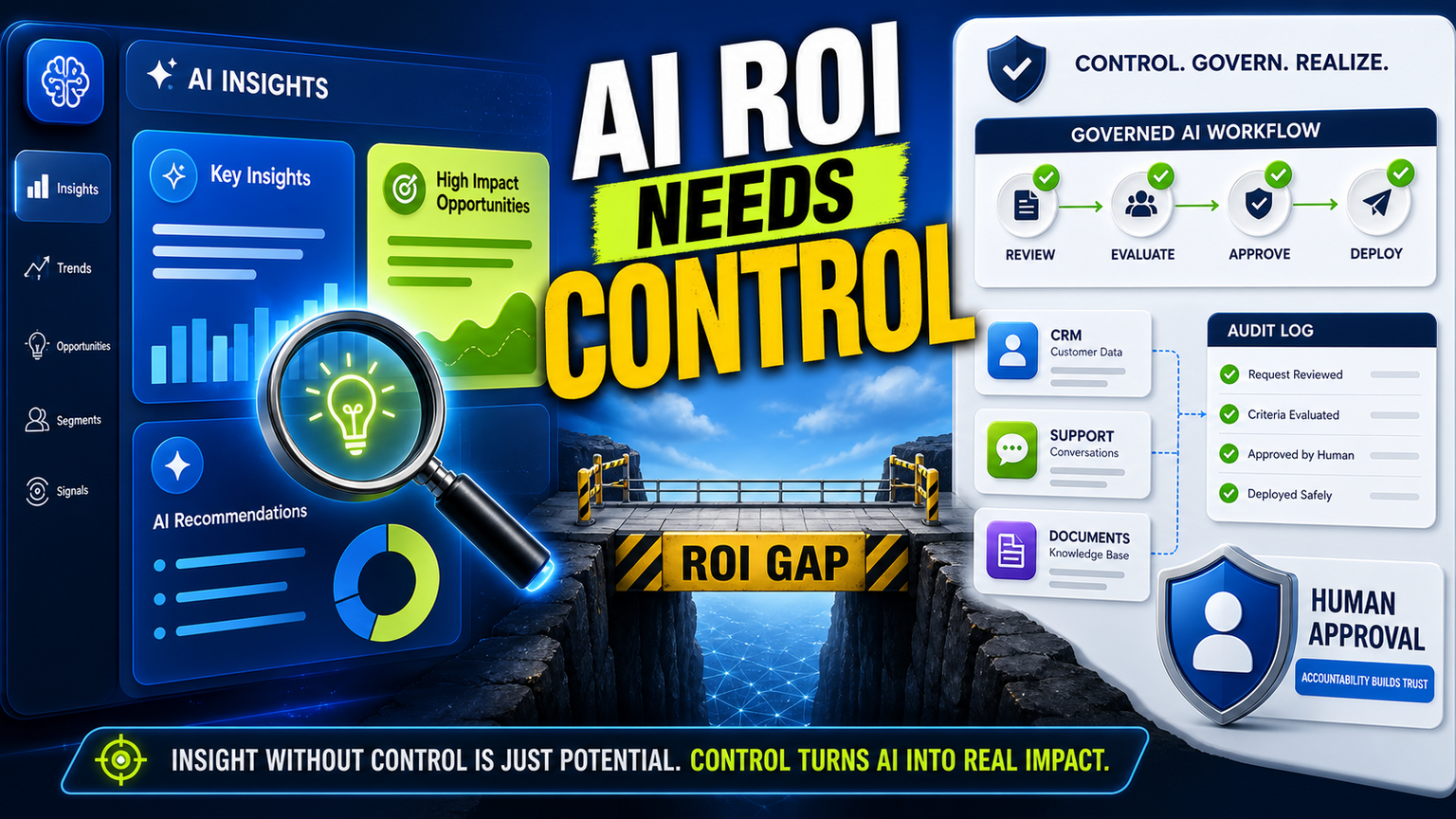
A fresh MarketScale report says enterprise AI is generating useful business insights, but not the cost savings many teams expected. The useful lesson for UK, US and EU SMEs is not to avoid AI. It is to stop treating AI as a magic layer on top of messy work. If an AI assistant finds insights but the team still copies data between tools, waits for approvals in chat, and cannot see which handoffs failed, the saving will be hard to prove.
GOFTUS reads this as a workflow-control problem. Start with one measurable process, such as lead follow-up, support triage, document processing, reporting, or browser-based admin. Then define the trigger, allowed data, approval points, owner, audit trail, fallback path, and monthly improvement review. That is where AI automation becomes an operating system rather than another dashboard.
MarketScale published a 27 July 2026 article titled "Enterprise AI is generating business insights but not saving money, and the governance gap is widening." The article says enterprise platforms are adding AI quickly, but returns are landing in unexpected places. It also points to trust deficits and governance gaps as operational risks.
That matters because the same pattern often reaches SMEs a few months later. Larger firms buy copilots and platform AI first. Smaller firms then copy the tool purchase, but without the process design, data boundaries, or operational measurement that would turn the tool into a reliable business workflow.
Reddit's small business hot feed on 27 July showed operators discussing cash payments, bookkeeping growth, staffing, and disputes over payments. Those are not AI announcements. They are the everyday messy processes where owners actually need savings. If AI cannot reduce missed follow-ups, unclear responsibility, duplicated admin, or manual reconciliation, it will feel clever but expensive.
The mistake is asking, "Which AI tool should we buy?" before asking, "Which workflow should be easier to run next month?" A chatbot can summarize a customer email. A model can draft a report. A browser agent can fill a form. None of those wins automatically changes the business unless the surrounding workflow is designed.
For an SME, the first AI project should usually have a simple before-and-after test. How long does it take to answer repeated customer questions today? How many leads are not followed up? Which documents sit in inboxes waiting for extraction? Which browser portals require staff to copy the same details again and again? Which reports need manual checking before a manager trusts them?
GOFTUS turns those questions into automation maps. The map says what AI is allowed to read, what it may draft, what it may update, and where a human must approve. It also says what happens when confidence is low, a login is required, a customer is angry, a document is incomplete, or a browser task reaches a submit button. This is especially important for agentic workflows and for browser with ai controls, where the risk is not the first draft but the action that follows.
What this means for SMEs
SMEs should treat the enterprise AI ROI gap as a warning against tool-first buying. If the objective is cost saving, the workflow has to include measurement from day one. That can be as basic as a weekly count of unanswered questions, average lead response time, documents processed, exceptions routed, reports corrected, or browser tasks completed with approval.
The second lesson is governance without bureaucracy. Smaller firms do not need a giant AI committee. They need clear rules that fit their scale: approved data sources, approved actions, named owners, audit logs, customer escalation rules, and a review cadence. In GOFTUS projects, those rules are part of the automation build, not a PDF sitting outside the system.
The third lesson is to connect AI to the tools where work finishes. If an AI answer never updates the CRM, support desk, spreadsheet, document folder, project board, or reporting pack, the saving leaks away. A practical AI automation project should include the connector, the approval, the exception queue, and the handoff.
What SMEs should do next
1. Pick one expensive workflow, not one exciting model.
2. Write the current steps from trigger to outcome.
3. Mark the steps AI can draft, classify, extract, route, or check.
4. Mark the steps that need approval before anything is sent, submitted, deleted, purchased, or updated.
5. Add a simple audit trail so staff can see who approved what and why.
6. Define a fallback for uncertain answers, missing data, blocked logins, and unhappy customers.
7. Review the numbers monthly and improve the automation rather than replacing it with another tool.
For many SMEs, the easiest starting point is customer-answer automation, CRM follow-up, document processing, or browser-based operations with explicit controls. GOFTUS can help scope that through practical workflow automation at /services, agentic workflow design at /agents, and question-led diagnostics at /questions.
Faculty AI, Deeper Insights, Waracle, Brainpool AI, LeewayHertz, Markovate, SoluLab, BairesDev, Addepto, STX Next, Netguru, and 10Clouds can all be useful partners for strategy, engineering, or specialist delivery. SaaS tools such as Zapier, n8n, Relevance AI, Lindy, Gumloop, Bardeen, Make, and Stack AI can also automate important tasks.
The gap is ownership of the workflow around the task. Tools automate tasks. GOFTUS automates the workflow around the task. That means the trigger, data source, permission boundary, approval gate, exception handling, CRM or support update, reporting trail, and improvement loop are designed together.
This is the difference between "we added AI" and "the weekly process now runs with fewer missed steps." SMEs do not need more AI theatre. They need small systems that make work easier to run, safer to delegate, and simpler to measure.
Enterprise AI is proving that insights alone are not enough. If AI does not connect to approvals, systems, and measurable outcomes, the saving is hard to see. SMEs should start with one workflow, define the controls, connect the handoffs, and measure the result before buying another platform.
Is this a reason to delay AI automation?
No. It is a reason to choose a smaller, better-scoped workflow first. A focused GOFTUS project can connect AI to the actual process, add human review, and measure whether work improves.
Where should a small business start?
Start where repeated work already hurts: support questions, lead follow-up, document extraction, reporting checks, or controlled browser tasks. Explore /services or /agents when the workflow needs safe action, not just answers.
How does GOFTUS reduce the governance gap?
GOFTUS builds the operating rules into the automation: allowed data, approval points, exception routes, logs, owner review, and improvement cadence.
Primary source: MarketScale, "Enterprise AI is generating business insights but not saving money, and the governance gap is widening," published 27 July 2026.