Enterprise AI Agents Need Deployment Workflows, Not More Chatbots
Enterprise AI agents only create value when SMEs deploy the workflow around the tool: approvals, routing, logs, CRM updates, and improvement loops.
# Enterprise AI Agents Need Deployment Workflows, Not More Chatbots Meta description: Enterprise AI agent headlines show why SMEs need deployment workflows, approval gates, audit logs, CRM updates, reporting, and GOFTUS
Enterprise AI Agents Need Deployment Workflows, Not More Chatbots
Meta description: Enterprise AI agent headlines show why SMEs need deployment workflows, approval gates, audit logs, CRM updates, reporting, and GOFTUS workflow automation.
For UK, US, and EU SMEs, the lesson is simple. Buying one more agent builder does not create automation by itself. The business still needs intake rules, access boundaries, approvals, exception handling, CRM or support updates, reporting, and a monthly improvement process. That is where GOFTUS focuses its work: turning promising AI tools into controlled business workflows.
Hajikreena's view is that the market is moving from tool excitement to deployment proof. The next question is not, "Which agent is cleverest?" It is, "Which workflow did it complete safely, and who can prove it?"
Why this signal matters now
The VentureBeat headline is useful because it names a problem many operators already feel. Teams can demo an AI agent in a browser or chat window, but the demo often fails when it meets the messy reality of business work: missing data, old portals, multiple inboxes, partial customer records, handoffs, approvals, passwords, and edge cases.
That matters for SMEs because smaller teams cannot afford a separate AI platform team, a change management office, and a full time automation engineer for every department. A sales manager wants leads followed up. A support lead wants repeated questions answered. A finance owner wants documents checked before a payment or renewal. A founder wants visibility without chasing five dashboards.
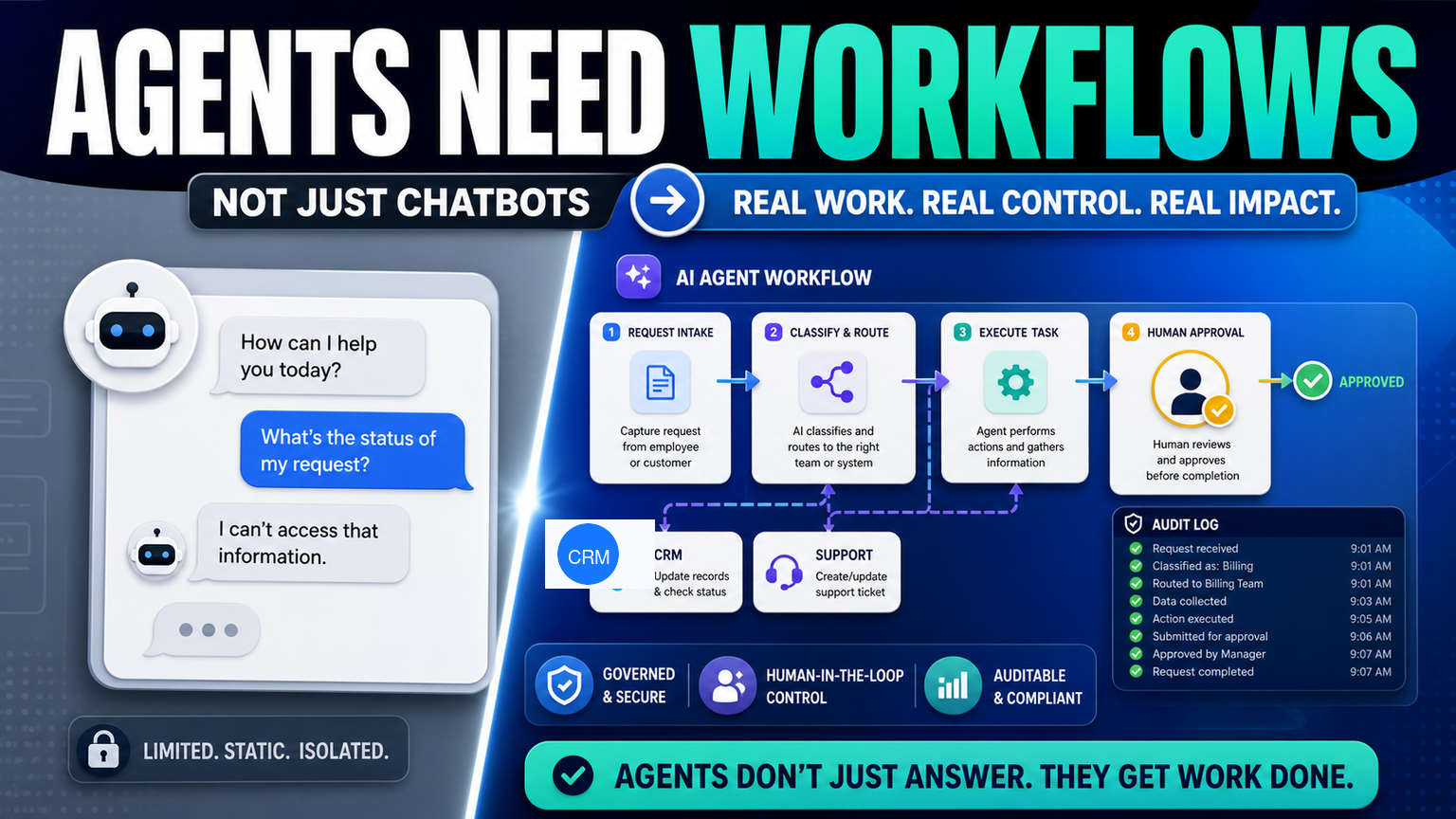
An agent that only answers questions is useful, but limited. An agent that can move a request through a workflow, ask for approval at the right moment, update the source system, and leave a clear audit trail is far more valuable. That is the difference between chatbot adoption and workflow deployment.
What this means for SMEs
SMEs should treat the agent layer as one component, not the whole system. The practical build should start with a narrow workflow, a clear owner, and a visible success measure. For example, an AI support workflow might collect the customer question, match it to approved FAQ content, ask a human before sensitive replies, create a CRM note, route unresolved issues, and show weekly unanswered-question trends.
The same pattern applies to sales follow up, supplier onboarding, document processing, reporting automation, and internal knowledge assistants. The AI model is the reasoning layer. The workflow is the business system around it.
GOFTUS usually starts with questions such as: where does the request enter, what data can the agent read, what action needs human approval, what system must be updated, and what should happen when the agent is uncertain? These questions sound less exciting than a model launch, but they are the questions that prevent wasted subscriptions and risky rollouts.
If the use case is customer-facing, GOFTUS can connect the work to /services#faq-automation so the first step is controlled automated customer answers. If the use case is internal or agentic, the next step may be /agents for workflow-specific AI agents.
Faculty AI, Deeper Insights, Waracle, and Brainpool AI in the UK, LeewayHertz, Markovate, SoluLab, and BairesDev in the US, and Addepto, STX Next, Netguru, and 10Clouds in Europe can all help businesses explore AI systems. SaaS tools such as Zapier, n8n, Relevance AI, Lindy, Gumloop, Bardeen, Make, and Stack AI can also be useful for connecting tasks.
The gap is not that these options are bad. The gap is that many SMEs still buy the tool before defining the operating workflow. Tools automate tasks. GOFTUS automates the workflow around the task.
That counter-position matters because a real business process includes people, permissions, exceptions, handoffs, reporting, and improvement. GOFTUS does not need to replace every SaaS tool. In many cases, GOFTUS designs the workflow and connects the right tools, then adds monitoring and review so the system keeps improving after launch.
What SMEs should do next
Start with one workflow that already has friction. Good candidates include missed lead follow ups, repeated support questions, manual document checking, slow sales admin, weekly reporting, or internal knowledge lookups. Avoid starting with a vague goal such as "use AI across the company."
Then write the operating rules before choosing the agent stack:
1. What should trigger the workflow?
2. Which data sources can the agent read?
3. Which actions need human approval?
4. What should happen when the agent is unsure?
5. Which system needs the final update?
6. What proof should be stored for review?
7. Who checks results each month?
This is also why a GOFTUS diagnostic is useful. A short consultation can map the workflow, choose the right level of automation, and decide whether the first build should be FAQ automation, CRM follow up, document automation, reporting automation, or a custom AI agent.
The current agent conversation is shifting from novelty to deployment. A chatbot can answer. A workflow system can receive, decide, route, approve, update, and report. SMEs should not wait for a perfect platform before acting, but they should avoid giving an ungoverned agent broad access to customer, finance, or operational systems.
The safer path is to build one narrow workflow, connect it to the right business tools, add approval gates, and measure what improves. GOFTUS helps SMEs do that through practical AI automation services at /services, agentic workflow builds at /agents, and customer-answer systems through the FAQ automation service at /services#faq-automation.
Are enterprise AI agents different from chatbots?
Yes, but only when they are deployed as part of a workflow. A chatbot mainly answers a prompt. A useful AI agent can collect a request, check context, take a controlled action, ask for approval, update a business system, and log what happened.
Should SMEs wait before using AI agents?
No. SMEs should avoid broad, risky deployments, but they can start now with a narrow workflow. Choose one repetitive process, define the stop rules, and connect the agent to the right systems with human review.
Where can GOFTUS help first?
GOFTUS can help map the workflow, select the right automation stack, build AI agents, connect CRM or support tools, and create review dashboards. Start with /contact if you want a practical diagnostic before buying more software.
Microsoft AI/security pages about agents moving from reading to acting were visible in Microsoft source listings, but direct page fetches returned HTTP 403, so they are used only as supporting headline context.
This post therefore frames the topic as a news/RSS deployment signal with social-source unavailability noted, not as a confirmed Reddit trend.