Document Automation for SMEs: Approval Gates Before AI Handles Business Files
Document automation helps SMEs extract, review, approve, and route business files before AI agents update CRM, support, finance, or shared records safely.
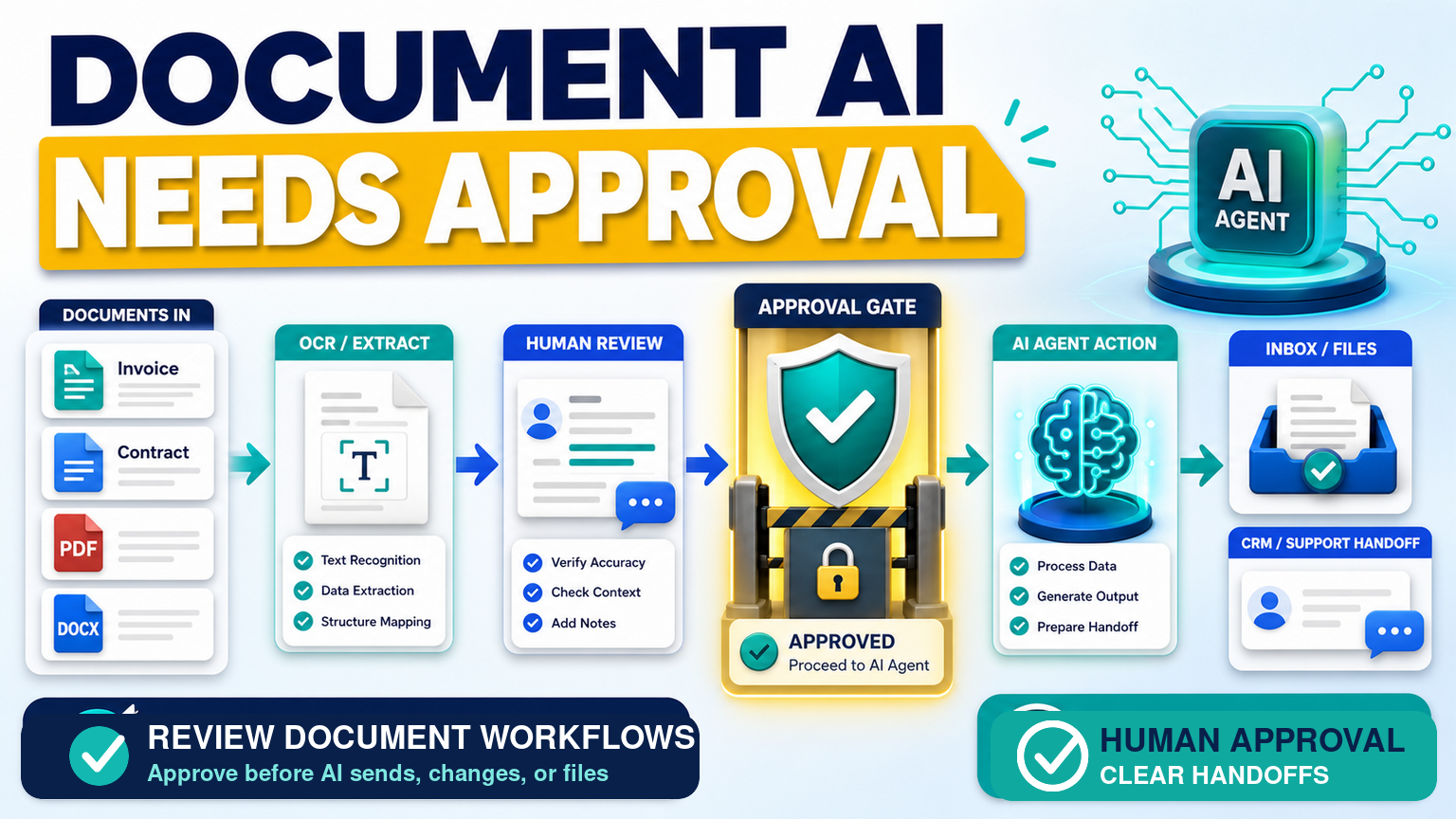
# Document Automation for SMEs: Approval Gates Before AI Handles Business Files # Quick answer Document automation is no longer only about scanning PDFs or moving files into folders. The fresh signal for this post is a
Document Automation for SMEs: Approval Gates Before AI Handles Business Files
Quick answer
Document automation is no longer only about scanning PDFs or moving files into folders. The fresh signal for this post is a 100-score operator research item from r/Anthropic about an account being banned after file conversion. The useful business lesson is still clear: when AI tools touch business files, staff need approval gates, logs, and escalation paths before the output becomes a CRM update, support reply, invoice note, or customer document.
Those sources show the same market direction: document handling is becoming part of agentic AI and business process automation, not a separate back-office utility.
For a UK, US, or EU SME, document automation should start with a narrow workflow. Capture the file, extract the useful fields, show the source, ask a person to review exceptions, then route the approved output into the right system. GOFTUS builds this type of controlled automation through /services, with supporting AI agents where the workflow needs controlled reasoning or handoff.
What this means for SMEs
Most businesses already have document workflows hiding in plain sight. A sales team receives PDFs and manually copies details into CRM. Support staff read screenshots, contracts, forms, or email attachments before deciding what to do next. Finance teams check invoices against purchase orders. Operations teams convert files, rename folders, and chase missing information. These jobs look small, but they create delay, duplicated effort, and risk when they depend on memory.
AI can help, but only if the workflow is designed around the document, not around the tool demo. A useful document automation system should know which documents are allowed, what fields matter, what confidence level is acceptable, who approves changes, and where the final data goes. It should also keep the original file linked to the extracted answer, so a person can check the source when a customer, supplier, auditor, or manager asks why a decision was made.
That is the difference between simple automation and operational control. A basic OCR tool may read text. A workflow automation platform may move files. An AI agent may summarize or classify the content. GOFTUS connects these steps into a business process: intake, extraction, review, approval, routing, CRM or support handoff, and improvement from exceptions.
Hajikreena's view is that SMEs should not wait until they have a perfect document estate. Start with one repeatable file type. Examples include quote requests, onboarding forms, support attachments, supplier invoices, compliance checklists, inspection notes, call summaries, or customer documents that sales has to interpret before follow-up. The first goal is not total automation. The first goal is a safer path from document received to business action completed.
Competitor lens
Tools automate tasks. GOFTUS automates the workflow around the task.
Zapier, Make, n8n, Bardeen, Gumloop, Lindy, Relevance AI, and Stack AI can be valuable when the job is clear and the business already knows the rules. Consultants such as Faculty AI, Deeper Insights, Waracle, Brainpool AI, LeewayHertz, Markovate, SoluLab, BairesDev, Addepto, STX Next, Netguru, and 10Clouds can help with broader AI builds. The gap for many SMEs is not access to another connector or model. The gap is ownership of the workflow.
A document automation project needs decisions before it needs more software. Which files are in scope? Which fields become business records? What happens when the AI is unsure? Who approves a changed customer record? When does a document trigger a support ticket, a sales follow-up, a refund review, or a manager escalation? Which actions must never be taken without a human?
GOFTUS counter-positioning is practical: design the workflow, integrate the systems, monitor the exceptions, and improve the process after launch. That matters when an AI agent touches documents and then drives work across CRM, support, finance, shared drives, or browser-based tools.
What SMEs should do next
First, pick one document workflow with visible business value. Do not start with every file in the company. Choose a flow where delays are easy to see, such as inbound enquiries with attachments, supplier invoices, support evidence, contract intake, or customer onboarding documents.
Second, define the action boundary. Reading and summarizing a file is lower risk than changing a CRM field, sending a customer reply, approving a payment, deleting a file, or submitting a portal form. Put AI in observe and prepare mode first. Let it extract fields, draft next steps, and flag missing information. Keep submit, send, approve, pay, delete, and customer-facing actions behind human review.
Third, build exception handling into the workflow. If the file is unreadable, the customer name is unclear, the invoice total does not match, or the document type is outside scope, the system should route the issue to a person rather than guessing. Good automation reduces judgement work by removing repetition, not by hiding uncertainty.
Fourth, keep an audit trail. The team should be able to see the original document, extracted fields, AI summary, reviewer decision, final system update, and any follow-up task. This is especially useful for regulated sectors, finance-sensitive work, B2B sales, and customer support where a small mistake can travel quickly.
Fifth, connect the workflow to outcomes. Measure fewer missed follow-ups, faster document triage, cleaner CRM records, reduced support rework, and fewer manual copy-paste steps. The GOFTUS /services path is built around these measurable workflows rather than generic AI transformation.
Summary for SMEs
Document automation should not mean letting AI quietly change business records after reading a file. It should mean a controlled path from document intake to extraction, review, approval, and handoff. The current AI market signal, from Reddit operator anxiety to document automation news, points in the same direction: files are becoming fuel for AI agents and workflow systems. SMEs that add approval gates now can move faster without losing control.
FAQ
Is document automation only for large enterprises? No. SMEs can start with one repeatable file type, one approval rule, and one handoff into CRM, support, finance, or a shared task list.
Can AI read invoices, contracts, or support attachments safely? Yes, when it is limited to extraction and preparation first. Human approval should come before customer-facing messages, record changes, payments, deletions, or portal submissions.
Where should GOFTUS fit? GOFTUS designs the workflow around the document: intake, extraction, review, approval, system handoff, monitoring, and improvement through /services.