CRM Automation for SMEs: Follow Up After Customers Say Yes
CRM automation helps SMEs turn new customers into owned follow-up workflows with reminders, approvals, support handoffs, and clear next actions.
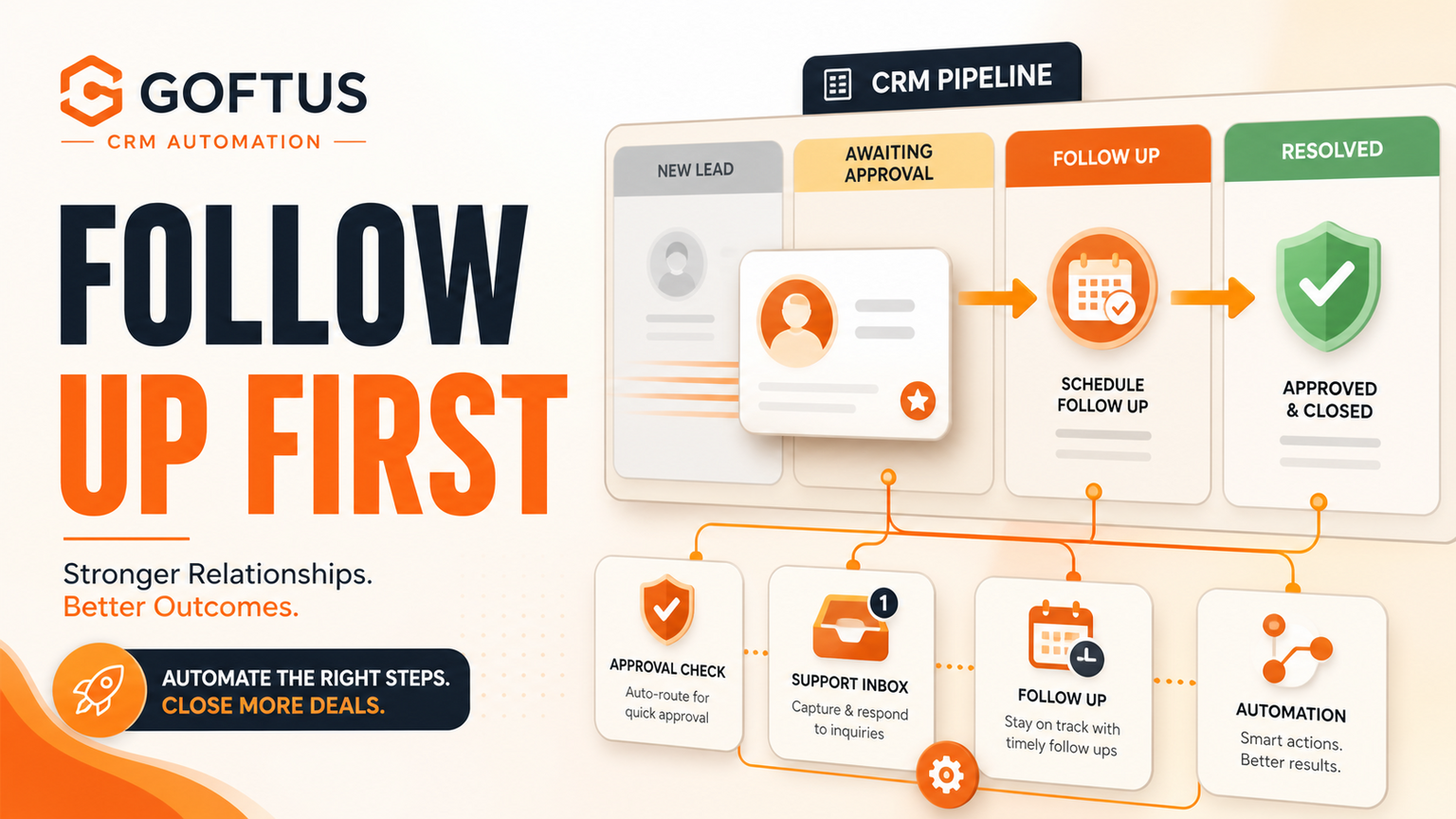
CRM automation should start immediately after a customer says yes. It is a familiar operator problem: an entrepreneur on r/Entrepreneur wrote that more customers can create a new problem after the sale. The business lesson is still useful for UK, US, and EU SMEs. Growth breaks when follow-up sits in inboxes, notes, and memory instead of an owned workflow. CRM automation gives that moment a controlled path. A new customer should trigger a clear sequence: confirm the next step, assign the owner, route documents or support questions, update the CRM, schedule the follow-up, and show what is stuck. GOFTUS helps SMEs build those practical workflows through /services, so automation supports the real handoff rather than just sending another message.
What this means for SMEs
Many businesses buy marketing tools before they fix the post-sale workflow. That creates a painful gap. The lead is won, but onboarding is slow. The support inbox receives questions that sales never sees. A founder promises a follow-up call but no one owns the calendar task. A finance detail waits for approval. A customer success note never reaches the CRM.
This is where CRM automation matters. It is not only a database update. It is a set of operating rules around the customer journey. The workflow should know which events need a human, which updates can run automatically, and which actions must pause until someone approves them.
Listings included AI lead-flow and small-business CRM coverage from sources such as Business Wire, Slack, TechRadar, Salesforce, and The Futurum Group. Those listings are a headline-level cross-check that CRM and follow-up automation remain active business topics. They do not prove any single vendor is the answer.
For SMEs, the useful question is simple: what happens in the first 24 hours after a customer says yes? If the answer depends on one person remembering every detail, growth will expose the weakness.
How to design the follow-up workflow
Start with a narrow customer moment. Good examples are quote accepted, demo booked, invoice paid, support question raised, renewal date approaching, or proposal sent with no reply. Map the current path before choosing tools.
A practical CRM automation workflow normally needs five lanes.
First, capture the trigger. That may come from a form, email, chat, Stripe event, booking calendar, website FAQ, or sales note.
Second, enrich the record. The CRM should know the customer type, service interest, region, deal stage, owner, promised next step, and any support risk.
Third, route the work. The task may go to sales, support, finance, delivery, or a founder. The workflow should assign one owner instead of broadcasting noise.
Fourth, add approval gates. Discounts, contract changes, refunds, data exports, account access, and public customer messages should not be fully autonomous on day one. They need review before action.
Fifth, measure the gaps. Track unanswered questions, missed follow-ups, aging tasks, handoff delays, and repeated support themes. That turns CRM automation into an improvement loop instead of a one-off zap.
Hajikreena's view is that small businesses should not copy enterprise CRM complexity. They should own the few moments where money, trust, or delivery can slip.
A good first GOFTUS build might connect a website enquiry to CRM, create a follow-up task, draft a personalised reply, route a support question, and notify the right owner. A second phase might add document collection, FAQ automation, reporting, or AI agents that prepare updates for approval. If browser actions are involved, such as updating a web portal or submitting a form, GOFTUS can connect the workflow to /agents with browser controls, logs, and stop rules.
That path is less glamorous than launching a fully autonomous agent. It is also safer. It lets the business see where automation helps, where humans must stay in control, and where the customer experience actually improves.
Tools like Zapier, n8n, Make, Bardeen, Gumloop, Lindy, Relevance AI, and Stack AI can be useful building blocks. Consultants such as Faculty AI, Deeper Insights, Waracle, Brainpool AI, LeewayHertz, Markovate, SoluLab, BairesDev, Addepto, STX Next, Netguru, and 10Clouds can also support larger AI programmes.
The gap is often ownership. Tools automate tasks. GOFTUS automates the workflow around the task. That means deciding who approves the action, what gets logged, how exceptions are routed, which customer record is the source of truth, and how the workflow improves each month.
For SMEs, this matters because the CRM is not the whole business. Follow-up touches support, finance, delivery, documents, website questions, sales messages, and leadership reporting. A disconnected automation can make one step faster while making the whole customer journey harder to manage.
What SMEs should do next
Pick one post-sale moment that regularly causes delays. Write the exact trigger, owner, customer promise, CRM fields, approval point, and fallback path. Then decide which parts can run automatically and which parts need a human review.
GOFTUS can help turn that map into a working CRM automation through /services. The build can start small: one intake source, one CRM update, one follow-up task, one approval gate, and one weekly report. From there, the workflow can expand into FAQ automation, support triage, AI agents, document processing, or reporting automation.
If you are not sure where to start, use the GOFTUS consultation or Startup Kit style diagnostic to find the handoff that costs the most time. The best first automation is usually not the flashiest. It is the one that protects revenue after the customer has already shown intent.
More customers can create more operational risk when follow-up depends on memory. CRM automation helps SMEs turn new customer intent into an owned workflow with routing, reminders, approvals, and clear logs. The win is not replacing staff. The win is making sure every customer promise has a path, an owner, and a next action.
Is Reddit the source of truth for this topic? No. The business recommendation comes from mapping that concern to practical CRM and follow-up workflow design.
Should SMEs automate every customer follow-up? No. Start with repeated, low-risk steps. Keep approvals for refunds, contracts, access changes, public responses, and anything that affects money or trust.
Where should GOFTUS link this workflow? CRM automation usually starts with /services, then may connect to /agents when browser actions or AI agent handoffs are required.
Sometimes the real problem starts after they say yes." This was used as operator sentiment only.
These were used as headline-level context where direct article retrieval was not required for the recommendation.