CRM Automation for SMEs: Cut Admin Cost Without Losing Customer Follow Up
CRM automation helps SMEs reduce admin cost while protecting follow up, approval workflows, customer context, and clear workflow visibility.
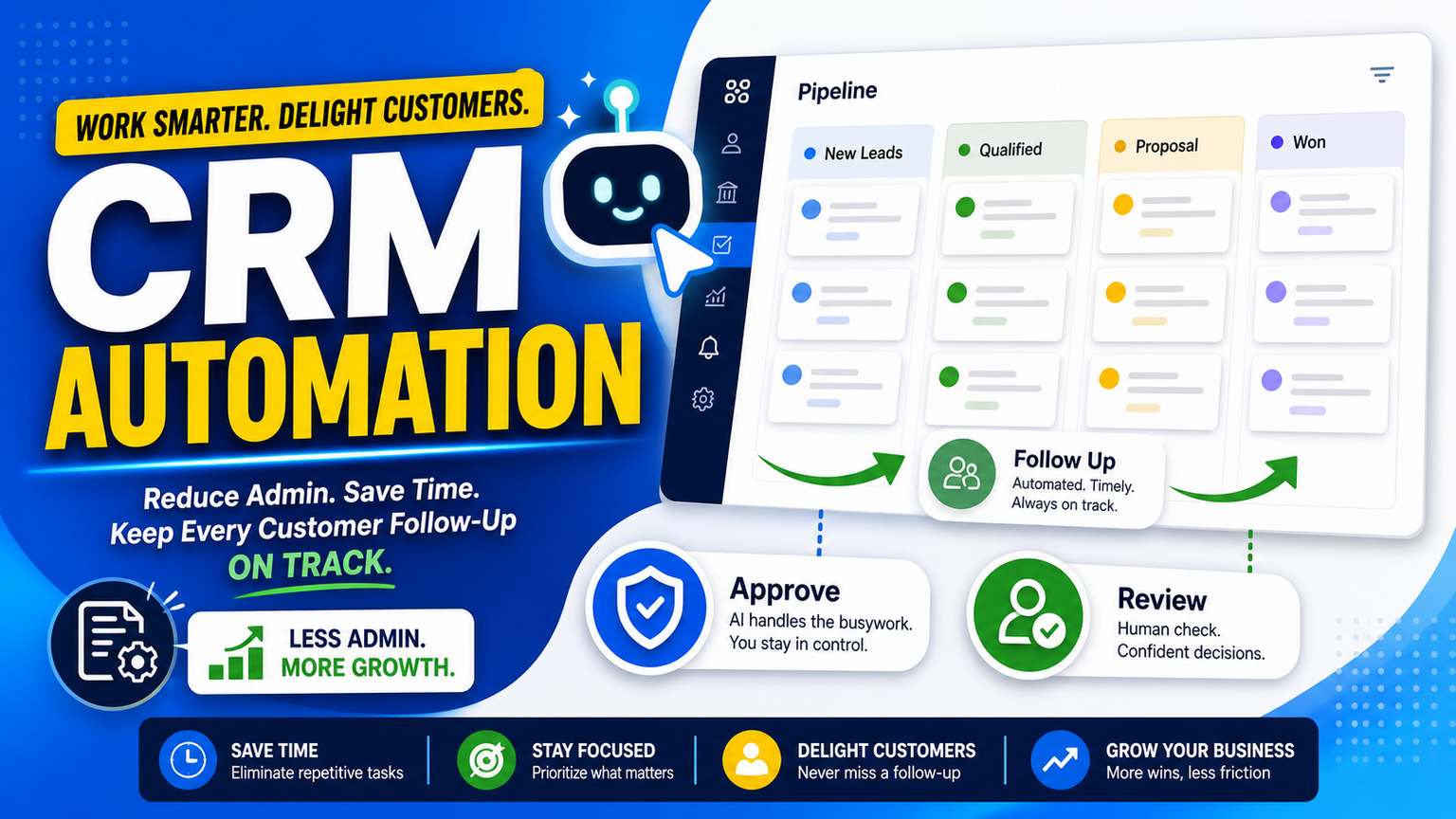
# CRM Automation for SMEs: Cut Admin Cost Without Losing Customer Follow Up Meta description: CRM automation helps SMEs reduce admin cost while protecting follow up, approval workflows, customer context, and clear workf
CRM Automation for SMEs: Cut Admin Cost Without Losing Customer Follow Up
Meta description: CRM automation helps SMEs reduce admin cost while protecting follow up, approval workflows, customer context, and clear workflow visibility.
Quick answer
That source is about a global enterprise, not an SME playbook. But it is a useful warning for UK, US, and European operators: AI cost saving becomes risky when leaders automate tasks before they redesign the customer workflow around them.
For SMEs, the searchable problem is not whether a large payments company can reduce headcount. The problem is how to use CRM automation to remove admin, protect follow up, and keep a human decision point where money, reputation, or customer trust is involved. GOFTUS approaches this through workflow mapping, CRM triggers, approval steps, exception logs, and practical service design at /services. The aim is not fewer people by default. The aim is fewer dropped leads, fewer copy-paste updates, and clearer ownership of every customer action.
What this means for SMEs
Many smaller businesses already have a CRM, support inbox, spreadsheet, booking tool, or quote pipeline. The waste is usually hidden between those systems. A lead arrives from a form, someone copies it into a spreadsheet, another person sends a manual follow up, a manager checks the deal status later, and nobody can easily see which question, quote, or complaint has gone quiet.
That is where CRM automation earns its place. It should capture the event, enrich the record, assign the owner, suggest the next step, and remind the team before the customer loses interest. If an AI assistant drafts an email, updates a deal stage, or prepares a support response, the workflow should still define who approves it, when it can send automatically, and what gets logged.
The Visa story is useful because it shows how quickly AI efficiency is becoming a board-level operating theme. SMEs do not need to copy enterprise restructuring. They need a smaller, safer version: identify repetitive admin, prove the workflow gain, and only then expand automation into finance, sales, service, or operations.
How to build CRM automation without losing customer context
Start with one measurable workflow. Good candidates include missed enquiry follow up, quote reminders, onboarding tasks, renewal prompts, support escalation, invoice chasing, or abandoned consultation requests. Each workflow should have a source event, a desired outcome, an owner, a deadline, and a rule for exceptions.
Then map the data. Which fields must be present before a task can move forward? Which fields can AI draft or classify? Which fields are too sensitive for automatic action? For example, an AI can summarise a support ticket and suggest a CRM note. It should not promise a refund or send a pricing commitment unless a human approval rule allows it.
Next, add controls. A simple approval workflow can be enough: draft, review, approve, send, log, measure. More advanced flows can include confidence thresholds, browser with ai controls for web portals that lack APIs, and stop rules when the customer record is incomplete.
Finally, measure the right things. Start with response time, overdue tasks, repeated data entry, unanswered leads, quote turnaround, rework, and customer handoff quality. If those improve, the cost case becomes more credible and less disruptive.
Summery for SMEs
CRM automation should not be treated as a quick headcount lever. It is a workflow design decision. The strongest SME use cases reduce admin while making customer ownership clearer. That means every automation needs a trigger, a visible owner, an approval rule, an exception path, and a record of what happened.
GOFTUS uses this approach because tools alone rarely solve the messy middle of customer operations. A Zapier, Make, n8n, or CRM-native automation can move data from one place to another. The business still needs to decide what the next best action is, who checks it, when AI is allowed to help, and how the team learns from the result.
If your team is thinking about AI efficiency, start with a diagnostic question: where are customers waiting because staff are copying, checking, or retyping information? That is often the first profitable automation lane.
Competitor lens
The market is crowded for good reasons. Faculty AI, Deeper Insights, Waracle, and Brainpool AI in the UK can support larger AI programmes. LeewayHertz, Markovate, SoluLab, and BairesDev in the US can build custom systems. Addepto, STX Next, Netguru, and 10Clouds in Europe can support data and software delivery. SaaS tools such as Zapier, n8n, Relevance AI, Lindy, Gumloop, Bardeen, Make, and Stack AI can automate individual steps quickly.
Those options can be useful. The gap appears when a business assumes task automation equals workflow automation. Tools automate tasks. GOFTUS automates the workflow around the task. That means CRM design, approvals, exception handling, logs, service handoff, reporting, and monthly improvement sit together instead of being scattered across disconnected automations.
For SMEs, that difference matters. A cheaper task is not a better outcome if a warm lead is routed to the wrong person or a support promise is sent without review.
What SMEs should do next
Pick one customer workflow where admin cost and customer delay are visible. Write down the current steps, systems, handoffs, and failure points. Mark which actions are safe to automate, which actions need human approval, and which actions should stop when information is missing.
Then build a small CRM automation around that map. Connect the form, inbox, CRM, task list, and follow-up message. Add review rules before sensitive communication. Log the action so managers can see what changed. Review the workflow after a month before adding more AI.
GOFTUS can help with this through workflow automation, CRM follow up, AI agents, and practical diagnostics at /services. If you want a smaller first step, use a consultation or the £100 Startup Kit diagnostic to identify the admin lane where automation is most likely to pay back without creating new operational risk.
FAQ
Should SMEs copy enterprise AI cost cutting?
No. Large company restructuring is not a blueprint for smaller firms. SMEs should use the signal to examine admin waste, customer delays, and repeated handoffs. The safer goal is workflow proof: automate one narrow CRM or support path, measure whether customers receive faster and clearer follow up, and keep humans in control of sensitive decisions.
Where does CRM automation usually start?
It usually starts where enquiries, quotes, support tickets, or renewal reminders fall between systems. A practical first workflow captures the event, creates or updates the CRM record, assigns an owner, drafts the next step, asks for approval when needed, and logs the outcome for review.
How does GOFTUS position this work?
GOFTUS treats CRM automation as workflow design, not just software setup. The service connects triggers, owners, approval rules, AI assistance, logs, and improvement cycles so SMEs reduce admin without losing control of customer relationships.
Source notes
It uses the signal to discuss controlled CRM automation, workflow ownership, and practical AI ROI for UK, US, and European businesses.