Claude for Small Business Shows SMEs Need Workflow Controls
Anthropic's Claude for Small Business push shows SMEs need workflow controls, approvals, and measurable AI handoffs before scaling assistants.
# Claude for Small Business Shows SMEs Need Workflow Controls Meta description: Anthropic's Claude for Small Business push shows SMEs need workflow controls, approvals, and measurable AI handoffs before scaling assistan
Claude for Small Business Shows SMEs Need Workflow Controls
Meta description: Anthropic's Claude for Small Business push shows SMEs need workflow controls, approvals, and measurable AI handoffs before scaling assistants.
Anthropic's Claude for Small Business signal shows frontier AI vendors are no longer speaking only to enterprise teams. They are speaking to owners, operators, agencies, advisors, and small teams that want better answers, faster admin, and less manual coordination. That is good news for UK, US and EU SMEs, but it creates a risk: teams may buy an assistant before they design the workflow that makes it safe and measurable.
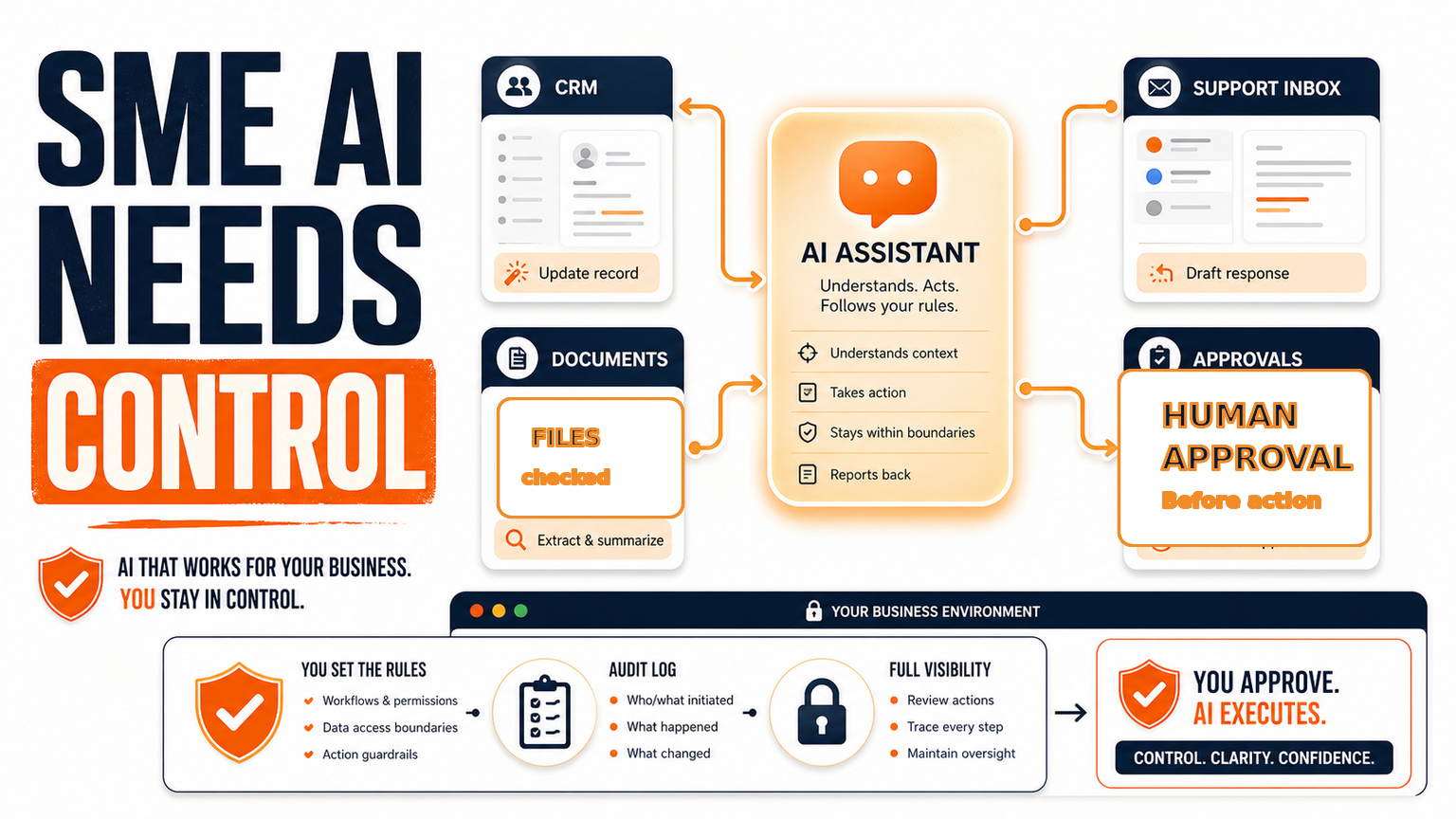
The practical lesson is simple. A small business should ask, "Which repeated workflow should this assistant help us run, who approves the output, and where does the result get recorded?" GOFTUS sees the real value in connecting AI assistants to CRM follow-up, support triage, documents, reporting, and controlled browser actions. The assistant can draft and reason, but the business still needs triggers, permissions, logs, stop rules, and a named owner.
The official Anthropic page was reachable during this run, so the source was checked directly.
This matters because SME AI adoption is moving from curiosity to operations. Small teams are already using assistants to draft emails, summarize documents, prepare proposals, research prospects, explain spreadsheets, and write code. The next step is controlled work: update the CRM, route a support issue, prepare a report, collect missing details, or hand a browser task to a human for approval before submit.
Claude for Small Business is a reminder that the market is moving toward packaged AI for everyday teams. That does not remove the need for implementation. It increases it. A capable model can produce better drafts, but the business still has to decide what the assistant is allowed to read, where outputs go, and when a human must review.
For example, a sales team may want an assistant to summarize enquiries and draft follow-up emails. The workflow should define which inboxes are included, which CRM fields can be updated, which offers need manager approval, and what happens when the lead is high value or unclear. A support team may want AI to answer repeated questions. The workflow should connect to FAQ automation, route complex issues, capture unanswered questions, and update the source knowledge base.
This is where GOFTUS positions the work differently from a tool-only rollout. The assistant is one component. The operating value comes from the surrounding system: intake, context, approvals, logs, exception handling, CRM or support updates, and monthly improvement. Without that system, even a very good assistant can become another tab that staff use inconsistently.
What this means for SMEs
SMEs should start with one workflow that already causes visible friction: missed lead follow-up, repeated customer questions, proposal preparation, supplier inbox sorting, document extraction, reporting packs, quote checks, or browser portal updates. A narrow workflow can be measured and improved.
The first design question is the trigger: form submission, email, uploaded document, support ticket, CRM stage change, spreadsheet row, or scheduled report. The second is data access. Which systems can the assistant read, and which ones are off limits? The third is action level. Can it only draft, update records, or prepare a browser task that waits for human approval? For browser with ai controls, this distinction is especially important because the assistant may be operating inside portals where a click has business consequences.
The fourth question is review. SMEs do not need enterprise bureaucracy, but they do need simple approval rules and evidence. Every useful AI workflow should leave a log showing what was read, what was suggested, who approved it, and what failed.
GOFTUS helps SMEs turn those answers into practical systems: AI automation, AI agents, customer-answer workflows through FAQ automation service, reporting automation, document processing, and controlled browser workflows. The goal is to make work easier to run.
Faculty AI, Deeper Insights, Waracle, Brainpool AI, LeewayHertz, Markovate, SoluLab, BairesDev, Addepto, STX Next, Netguru, and 10Clouds can all be useful depending on scale, budget, and delivery model. SaaS tools such as Zapier, n8n, Relevance AI, Lindy, Gumloop, Bardeen, Make, and Stack AI can also automate useful steps quickly.
The gap appears when a business assumes the tool is the workflow. Tools automate tasks. GOFTUS automates the workflow around the task. That means deciding what happens before the AI runs, how it gets context, who reviews sensitive actions, how exceptions are routed, how records are updated, and how the owner measures improvement.
For SMEs, this distinction matters more than model benchmarks. The winner is not the team with the most AI tabs open. The winner is the team that can show fewer missed replies, faster document handling, cleaner CRM data, and safer assistant-to-action handoffs.
What SMEs should do next
Pick one operational pain point and write it as a workflow sentence: "When this happens, AI should help with this step, but a human must approve this action, and the result must be recorded here." If that sentence is hard to write, the business is ready for a diagnostic before it scales AI.
A practical first project could connect a website form to CRM enrichment and follow-up. Another could connect repeated support questions to automated customer answers and a knowledge-base improvement loop. Another could use an AI agent to prepare browser-based admin tasks while keeping login boundaries, allowed domains, and submit buttons under human control.
GOFTUS can map the process, identify risk points, build the automation, and set the improvement loop through a consultation or Startup Kit style diagnostic. The assistant may be Claude, ChatGPT, Gemini, a local model, or a mix. The business result depends on the workflow design around it.
Claude for Small Business is a strong signal that frontier AI is becoming normal for smaller teams. The opportunity is not just better chat. It is better controlled work. SMEs should connect assistants to clear workflows, approved data, CRM and support handoffs, browser boundaries, audit logs, and owner review. GOFTUS helps turn AI assistants into measurable workflow systems rather than another unmanaged tool.
Should SMEs use Claude or another AI assistant?
They can, but the first decision should be the workflow. Choose the assistant after defining the task, data access, approval rules, and handoff.
Where should a small business start with AI automation?
Start with repeated admin, support questions, lead follow-up, documents, reporting, or browser tasks where the current process is slow and measurable.
Why does GOFTUS focus on workflow controls?
Because AI value appears when outputs become safe actions, records, routes, and reviews. A standalone assistant helps, but a controlled workflow changes operations.