Claude Science Workbench: The SME Workflow Automation Lesson
Anthropic’s Claude Science shows why SMEs need AI workflows that connect tools, approvals, audit trails, and improvement loops.
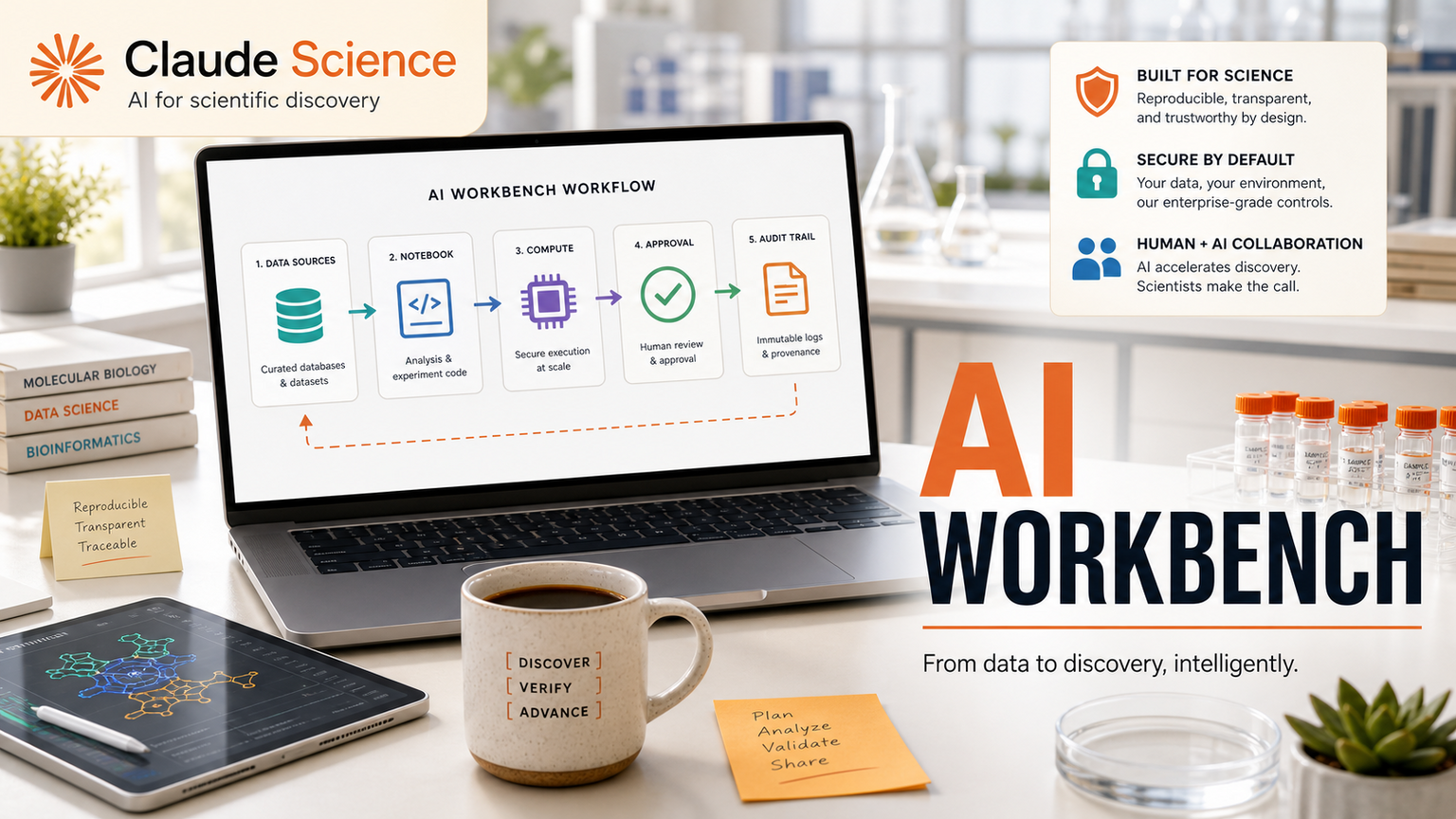
# Quick answer Anthropic has introduced Claude Science, an AI workbench for scientists that connects research tools, databases, compute resources, and auditable artifacts inside one environment. Hajikreena's view is tha
Quick answer
Anthropic has introduced Claude Science, an AI workbench for scientists that connects research tools, databases, compute resources, and auditable artifacts inside one environment. Hajikreena's view is that the business lesson goes beyond laboratories: useful AI agents are moving from chat boxes into governed workflow spaces where tools, context, approvals, and review happen together.
This is a strong SME signal because many businesses face the same operating pattern as researchers. Work is scattered across apps, files, databases, spreadsheets, CRMs, helpdesks, inboxes, and specialist tools. The next automation advantage is not simply asking an AI model a better question. It is designing the workspace around the AI so it can safely read, reason, act, ask for approval, produce evidence, and improve the process.
What this means for SMEs
Claude Science is aimed at scientific teams, but the workflow pattern is familiar to every operations leader. Anthropic says the product integrates commonly used research tools and packages, produces auditable artifacts, and provides flexible access to computing resources. The announcement describes researchers moving between PubMed, Jupyter, R, terminals, databases, file formats, manuscripts, and compute jobs, then pulling that work into one environment.
SMEs have their own version of that fragmentation. A sales workflow may touch a website form, inbox, CRM, enrichment tool, calendar, proposal template, Slack channel, and follow-up sequence. A support workflow may touch a helpdesk, knowledge base, order system, refund policy, delivery tracker, and escalation queue. A finance workflow may touch invoices, bank feeds, approvals, spreadsheets, emails, and reporting packs.
The practical lesson is clear: AI needs an operating wrapper.
For SMEs, that wrapper should include:
A defined workflow owner.
Clear read and write permissions for each connected system.
Human approval gates for customer, financial, legal, HR, or high-value actions.
A record of what the AI used, changed, suggested, or escalated.
Exception handling when confidence is low or data is missing.
Monthly review of accuracy, cost, time saved, and customer impact.
Claude Science also highlights another important design choice: keep sensitive work close to existing infrastructure where possible, and only send the context needed for the task. For UK, US, and European SMEs, this matters because customer data, health data, contracts, employee records, and regulated documents cannot be treated like disposable prompt material.
The takeaway is not that every SME needs a science workbench. The takeaway is that every serious AI workflow needs the same design logic: tools connected in one process, evidence captured, approvals built in, and improvement measured.
Competitor lens
Global SaaS competitors such as Zapier, n8n, Relevance AI, Lindy, Gumloop, Bardeen, Make, and Stack AI make it easier to assemble automations and agents. US competitors such as LeewayHertz, Markovate, SoluLab, and BairesDev publish broad AI agent and vertical automation guides. UK and European competitors such as Faculty AI, Deeper Insights, Waracle, Brainpool AI, Addepto, STX Next, Netguru, and 10Clouds often frame this kind of shift around enterprise AI, production readiness, AI safety, RAG, audits, and sector transformation.
Those tools and consulting angles are useful. The missing layer for many SMEs is the lived workflow around the task.
Tools automate tasks. GOFTUS automates the workflow around the task.
A tool can trigger a CRM update. GOFTUS designs the intake rule, checks missing fields, routes exceptions, asks a human before risky actions, logs the decision, reports whether conversion improved, and adjusts the automation next month. A consultant can explain the AI opportunity. GOFTUS builds the working operating system around the opportunity so sales, support, operations, and reporting teams can use it without creating a new mess.
For Europe and the UK, the relevance is especially practical: SMEs need workflow automation that respects data protection, auditability, human accountability, and vendor dependency, not only model capability.
Summery for SMEs
| Question | Practical answer |
|---|---|
| What happened? | Anthropic announced Claude Science, an AI workbench for scientists that connects tools, databases, compute, and auditable artifacts. |
| Why should SMEs care? | The same workflow problem exists in sales, support, finance, admin, and operations: work is split across too many tools. |
| What is the business lesson? | AI agents need permissions, context, review, evidence, and exception handling, not just a prompt box. |
| What should SMEs automate first? | Start with bounded workflows such as CRM follow-up, support triage, document intake, reporting packs, or internal knowledge search. |
| What is the GOFTUS angle? | Build the workflow wrapper around the AI so automation improves speed, quality, accountability, and measurable outcomes. |
FAQ
Is Claude Science only relevant to scientific teams?
Claude Science is built for scientists, but the operating pattern is relevant to SMEs. It shows how AI becomes more useful when it is connected to tools, data, compute, review, and auditable outputs inside a governed workflow.
Should SMEs build one AI workspace for every department?
Not at first. SMEs should begin with one high-friction workflow where the inputs, decisions, approvals, and outcomes are clear. Once the workflow proves value, the same pattern can be reused across sales, support, finance, operations, or reporting.
How can GOFTUS help with workflow automation?
GOFTUS helps SMEs design and implement practical AI automation around real business processes. That can include CRM follow-up automation, support triage, reporting automation, document processing, internal knowledge assistants, and agentic workflows with review gates and monitoring.
Practical GOFTUS CTA
If your team is testing AI tools but still moving work manually between inboxes, CRMs, spreadsheets, helpdesks, and documents, GOFTUS can map one workflow and turn it into a measured automation system. Start with one process, define the review points, connect the tools, and improve it monthly.
Sources and source notes
Anthropic official announcement: "Claude Science, an AI workbench for scientists, is now available", published June 30, 2026. That is a social sentiment signal, not a verified enterprise procurement data source.
X signal: xurl was not installed in this cron environment, so X was not used.