Claude Outage Shows SMEs Need AI Fallback Workflows
Claude outage reports show why SMEs need AI fallback workflows, backup routes, approval gates, and human ownership before AI runs operations.
# Claude Outage Shows SMEs Need AI Fallback Workflows Meta description: Claude outage reports show why SMEs need AI fallback workflows, backup routes, approval gates, and human ownership before AI runs operations. ## Q
Claude Outage Shows SMEs Need AI Fallback Workflows
Meta description: Claude outage reports show why SMEs need AI fallback workflows, backup routes, approval gates, and human ownership before AI runs operations.
Quick answer
A fresh Google News signal about a worldwide Claude outage and a 529 overloaded message is a useful reminder for SMEs: AI assistants are becoming operational systems, not just writing tools. If a business now depends on one model to answer customers, draft support replies, check documents, enrich leads, update CRM records, or guide staff through daily work, it needs a fallback workflow before the next outage.
The same sourcing pass found live r/Anthropic RSS discussion where users were debating Claude reliability, switching models, and how subagents behave. Direct full article retrieval was not used as the only evidence in this unattended run, so the post treats the item as a headline-level outage signal plus social operator context.
For UK, US, and EU SMEs, the business issue is not whether Claude, ChatGPT, Gemini, or another assistant is good. The issue is whether the company has a plan when the preferred AI route is unavailable, slow, rate limited, or producing lower quality results. A fallback is not buying another subscription. It is a designed workflow with backup routes, human approvals, logs, and service boundaries.
What this means for SMEs
Many teams quietly move AI from experiment to dependency. A manager asks an assistant to summarise customer calls. A salesperson uses it to write follow-ups. A support lead uses it to draft ticket replies. An operations person uses it to clean spreadsheet data or prepare portal updates. At first, this feels lightweight. Then staff start waiting for the AI before they can finish the task.
That dependency is manageable when the workflow is designed. It becomes risky when the only process is open the favourite AI tool and hope it works. Outages, overload messages, usage caps, latency spikes, login issues, model changes, and vendor policy shifts can all interrupt a live operation. The immediate damage is usually not dramatic. It is slower replies, missed handoffs, rushed manual work, inconsistent answers, and staff losing trust in automation.
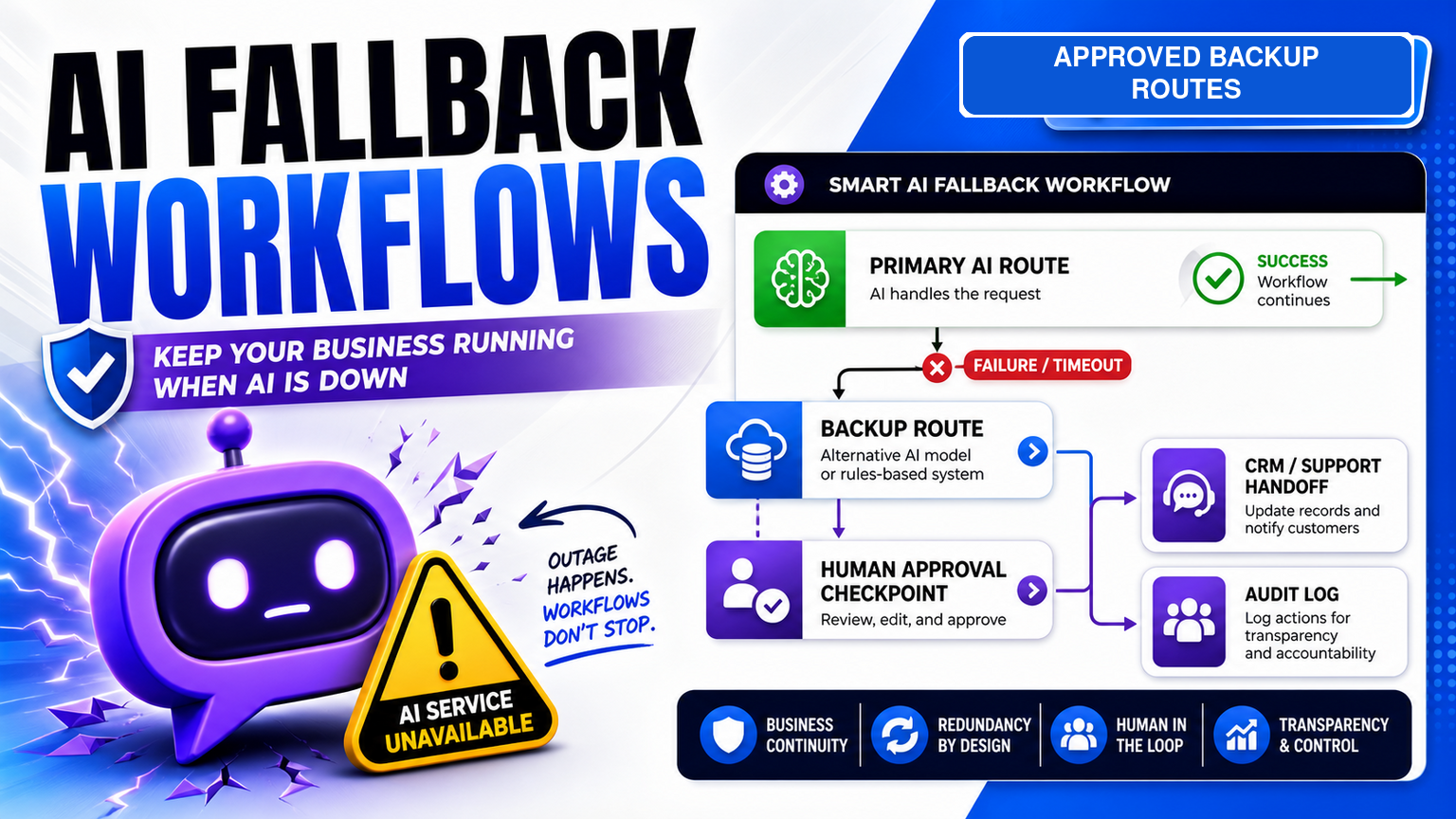
GOFTUS recommends treating AI availability like any other operational dependency. Define the primary route, the backup route, and the human route. If Claude is unavailable, can the workflow switch to another approved model? If no model is available, can the task fall back to a template, saved knowledge base, or human review queue? If a customer answer cannot be generated safely, does it route to support instead of freezing in a draft box?
This is especially important for customer-facing automation. A website FAQ assistant, support triage flow, lead capture workflow, or browser agent should never rely on one model call with no exception path. Approved FAQ content, draft-only mode, and human review can keep work moving when the preferred model is unavailable.
Thirumurugan's view
Thirumurugan's view is that AI reliability should be designed at the workflow layer, not debated only at the model layer. Every vendor will have busy periods, incidents, policy changes, and product shifts. That does not make AI unusable. It means SMEs should stop treating a model subscription as the whole system.
A practical fallback plan starts with a map of the real task. What is the trigger? What information does the AI read? What answer or action does it produce? Who checks it? Where does the result go next? What happens when the model times out or returns a weak answer? Once those questions are clear, the business can add a second model, a template route, a human approval queue, or a pause rule without redesigning everything under pressure.
The best fallback workflows are deliberately boring. They keep a customer informed, preserve the work already collected, create a ticket or CRM note, and notify the right person. They do not pretend the AI is always available. They make sure the business can continue while the AI route recovers.
Competitor lens
SaaS tools and AI builders are useful. Zapier, n8n, Relevance AI, Lindy, Gumloop, Bardeen, Make, and Stack AI can connect models to CRMs, inboxes, spreadsheets, browser actions, forms, and support desks. Consultancies such as Faculty AI, Deeper Insights, Waracle, Brainpool AI, LeewayHertz, Markovate, SoluLab, BairesDev, Addepto, STX Next, Netguru, and 10Clouds can also help businesses plan wider AI programmes.
The gap for many SMEs is not access to tools. It is ownership of the workflow around the tool. Tools automate tasks. GOFTUS automates the workflow around the task.
That means the fallback is designed before the incident. A GOFTUS-style build defines allowed models, backup models, non-AI templates, approval gates, logs, customer messaging, CRM or support handoff, and a named owner. If the primary AI route fails, the workflow can downgrade gracefully instead of stopping completely. That is the difference between a clever demo and an operational system.
What SMEs should do next
First, list the workflows where staff already depend on AI. Include support replies, sales follow-ups, report summaries, document checks, FAQ answers, CRM updates, browser-based admin, and internal knowledge search. If a task would slow down tomorrow without the AI, it needs a fallback route.
Second, classify each workflow by risk. A blog outline can wait. A customer complaint, quote follow-up, payment-related question, legal wording, access request, or browser submission needs stronger human control. The higher the customer or compliance impact, the more important approval and logging become.
Third, create three routes: primary AI, backup AI or rules-based template, and human review. The backup does not need to be as polished as the primary route. It needs to keep work moving safely. For example, a support triage flow can still create a ticket, attach the conversation, suggest a template response, and alert a human.
Fourth, connect fallbacks to the wider system. GOFTUS can help design AI automation at /services, AI agents at /agents, FAQ automation at /services#faq-automation, and a diagnostic conversation at /contact. The goal is resilient workflows that keep answering, routing, approving, and improving when a preferred AI service is down.
Summery for SMEs
The Claude outage signal is a reminder that AI is now part of daily operations for many businesses. When one assistant slows down or becomes unavailable, the real test is whether customer answers, support triage, CRM updates, document checks, and browser workflows continue safely.
SMEs should design fallback workflows now: primary AI route, backup route, human approval, logs, and clear stop rules. That makes AI automation more trustworthy because the business is not depending on one model, one login, or one perfect day of uptime.
FAQ
Does an AI outage mean SMEs should avoid AI automation? No. It means SMEs should use narrow workflows, backup routes, and human approval rather than depending on one model for live operations.
What is a simple AI fallback workflow? A simple fallback captures the request, saves context, switches to an approved backup model or template, and routes uncertain work to a person.
Where should GOFTUS start? Start with the workflow that already causes delays, such as support triage, FAQ answers, CRM follow-up, document checking, or browser-based admin.
Source notes
Reddit access was partial, with several other subreddit feeds rate limited during the run.
This article frames the item as headline-level outage sourcing plus social operator context, not as a full independent incident report.