Claude Opus 5 Shows SMEs Need Agent Workflow Control, Not Just Cheaper Intelligence
Anthropic's Claude Opus 5 signal shows why SMEs need approval gates, logs, workflow ownership and vendor-credit continuity checks before agents act.
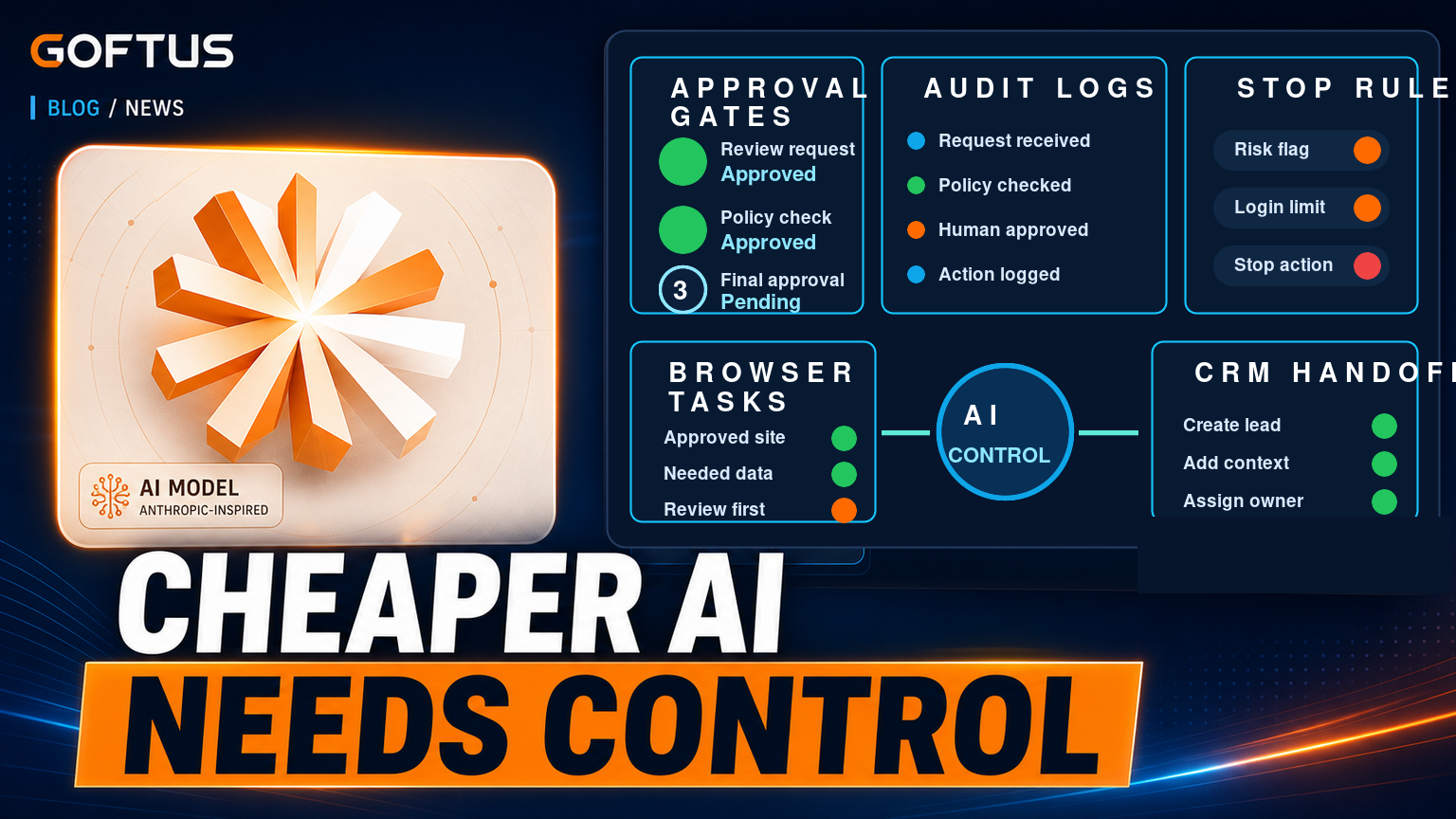
# Claude Opus 5 Shows SMEs Need Agent Workflow Control, Not Just Cheaper Intelligence Meta description: Anthropic's Claude Opus 5 signal shows SMEs why cheaper agent intelligence needs approval gates, vendor billing con
Claude Opus 5 Shows SMEs Need Agent Workflow Control, Not Just Cheaper Intelligence
Meta description: Anthropic's Claude Opus 5 signal shows SMEs why cheaper agent intelligence needs approval gates, vendor billing continuity checks and workflow ownership.
Anthropic has introduced Claude Opus 5 as a more cost-efficient model for long-running agents, coding, computer use and professional work. The signal matters for SMEs because the next wave of AI will not simply answer questions. It will plan tasks, use business software, draft code, read documents, update records and hand work from one system to another.
That sounds useful, but it changes the risk profile. A cheaper and stronger model does not decide which workflow should be automated, who approves exceptions, where logs live, or when an action should stop. That is the operating layer GOFTUS builds.
Thirumurugan's view is simple: model upgrades reduce the cost of intelligence, but they increase the need for workflow control. For a UK, US or EU SME, the real question is whether the business has a safe route from AI suggestion to approved action, and whether the vendor account, billing and credit controls can keep that workflow running when usage spikes.
What this means for SMEs
Anthropic's announcement describes Opus 5 as a step change for the Opus tier, with emphasis on long-running agents, coding, professional work, business task completion and computer use. It also points to stronger alignment and safer behavior compared with earlier Anthropic models. Those claims are useful context, but SMEs should treat them as a starting point rather than a finished automation plan.
The opportunity is clear. A stronger everyday model can help a small team triage requests, summarise documents, draft reports, prepare CRM updates, create support replies and guide staff through browser-based tasks.
The risk is just as practical. If the model can do more at a lower effective cost, teams may connect it directly to live tools too early. That can create messy handoffs, duplicate CRM records, unclear responsibility and compliance gaps.
A sensible SME rollout starts with one narrow workflow. Use AI to classify inbound enquiries, draft a response, suggest a CRM next step and route complex cases to a human. Add approvals, logs and stop rules. GOFTUS can then extend the same pattern into /services, /agents, document automation, reporting automation or browser with ai controls when the first workflow is stable.
Billing continuity is part of workflow control
There is also a separate operating risk that sits outside model quality. Public Anthropic-owned GitHub tracker reports describe usage-credit purchase failures, billing-ledger or entitlement mismatches, auto-recharge loops and support-routing problems. A privacy-sanitized public evidence hub from a high-usage Claude customer also documents a narrower claim: manual prepaid Claude usage-credit purchases failing or losing the advertised checkout state while automatic usage-credit top-ups from the saved billing setup continue charging.
GOFTUS treats this as pattern context, not proof that every manual checkout is broken. The public GitHub issues are accessible tracker reports, but many are still self-reported and not confirmed by a public Anthropic incident notice. Even so, the operational lesson is valid for SMEs and AI-heavy teams: do not design a critical workflow that depends on one credit path, one support route or one unmonitored billing ledger.
If a business relies on Claude Code, prepaid credits, auto-reload or spend controls, it should add vendor-credit checks to the workflow. Track balance changes, keep manual top-up evidence, set alert thresholds before work stops, maintain a fallback provider or work queue, and document who escalates billing exceptions. Billing continuity is not separate from automation governance. It is one of the controls that keeps the workflow available.
Why cheaper intelligence still needs a workflow owner
A model upgrade often creates a buying reflex: subscribe, connect tools, and expect productivity. That is backwards. The workflow owner should be named before automation is built. This person decides allowed tasks, approvals, error reporting and monthly improvement.
For Claude Opus 5 style agent use, that owner might define rules such as: the AI can draft a support answer but cannot send it without review; it can prepare a browser form but cannot submit high-risk changes; it can update a CRM note but cannot change deal stage without a sales owner.
This is where GOFTUS differs from a generic tool setup. We map inputs, handoffs, review points, systems of record, exception paths and reporting. Then we add the AI component where it creates a measurable outcome. The goal is not to show that the model can act. The goal is to make the action safe, visible and useful.
The market around this news will split into several responses. UK consultancies such as Faculty AI, Deeper Insights, Waracle and Brainpool AI may focus on strategy, model evaluation or enterprise delivery. US firms such as LeewayHertz, Markovate, SoluLab and BairesDev may frame the news around custom agent builds. European teams such as Addepto, STX Next, Netguru and 10Clouds may position it around software delivery and integration.
SaaS tools will move quickly too. Zapier, n8n, Relevance AI, Lindy, Gumloop, Bardeen, Make and Stack AI can all help teams assemble useful automations. These tools are valuable, especially when a business already knows its process.
The gap is ownership. Tools automate tasks. GOFTUS automates the workflow around the task. That means approvals, login boundaries, browser action rules, audit logs, CRM handoffs, support triage, document review and monthly improvement. We do not need to attack the tool market to make the point. The best tools still need a controlled workflow around them if an SME expects consistent business outcomes.
What SMEs should do next
First, list the business processes where a better AI model could remove friction without creating customer risk. Good starting points include support triage, sales follow-up, reporting, document intake, FAQ handling and research summaries.
Second, separate suggestions from actions. AI can suggest a reply, a task, a CRM update or a browser step. Action should require permission when money, customer commitments, personal data, legal language, account changes or vendor-credit purchases are involved.
Third, add evidence. Every serious AI workflow should leave a trail: what source was used, what the AI suggested, who approved it, what changed, what billing or usage-credit event affected the work, and what happened when the workflow failed.
Fourth, start small. A GOFTUS diagnostic can turn one messy process into a controlled pilot, then expand it into connected automation. If the work involves browser-based tasks, pair /agents with /services so the AI has narrow permissions, human approval and stop rules.
Claude Opus 5 is another signal that high-capability AI is becoming more affordable and more agent-ready. For SMEs, that should not trigger a rush to connect every tool. It should trigger a workflow review.
If AI can code, use computers, reason over documents and complete business tasks more efficiently, the winning business will not be the one with the most prompts. It will be the one with the clearest controls. GOFTUS helps SMEs build that layer: approved actions, logged decisions, connected systems, vendor-credit checks and measurable outcomes.
Use the model upgrade as a reason to ask better questions. Where should AI assist? Where must a human decide? Where should the workflow stop? What happens if credits, rate limits or support access fail? And what evidence will prove the automation helped the business?
Is Claude Opus 5 a reason for SMEs to start using AI agents?
Yes, but only if the agent is attached to a narrow workflow with approvals and logs. A stronger model can make agents more useful, but it does not automatically make them safe inside CRM, support, document or browser tasks. GOFTUS recommends starting with one controlled use case through /agents or /services, then expanding after the team can measure quality and exceptions.
Should businesses connect cheaper AI models directly to live tools?
Not at first. Direct access can create hidden errors if no one has defined permissions, review points and stop rules. A safer approach is to let AI prepare the action, show the reasoning, and ask a human to approve important changes. That protects customers while still saving time.
Where does browser with ai controls fit into this trend?
Computer-use and agentic workflows make browser control more relevant. If AI can fill forms, collect information or move between web systems, the business needs boundaries. GOFTUS treats browser with ai controls as a managed workflow: approved websites, limited actions, human review, logs and clear stop rules before submission.
Primary source: Anthropic, "Introducing Claude Opus 5", published 24 July 2026. Anthropic describes Opus 5 as available today and focused on long-running agents, coding, professional work, business tasks, computer use, efficiency and alignment.
This run used the RSS listing as a headline-level cross-check where direct publisher pages were not all fetched.
Billing and credit-control update: we also reviewed a privacy-sanitized public evidence hub at coolak.github.io/anthropic-claude-billing-incident, its reporter brief, its reconciliation matrix, and public Anthropic-owned GitHub tracker examples including issues 73450, 80178, 79598, 68773, 56895 and 79566. These sources support a cautious warning about usage-credit purchase, billing-ledger, entitlement and support-routing risk. They do not prove a universal platform-wide manual checkout outage.