Claude Deletion Stories Show SMEs Need Action Boundaries Before AI Agents Touch Systems
Claude deletion stories show why SMEs need action boundaries, approvals, audit logs, and browser controls before AI agents touch live systems safely.
# Claude Deletion Stories Show SMEs Need Action Boundaries Before AI Agents Touch Systems Meta description: Claude deletion stories show why SMEs need action boundaries, approvals, audit logs, and browser controls befor
Claude Deletion Stories Show SMEs Need Action Boundaries Before AI Agents Touch Systems
Meta description: Claude deletion stories show why SMEs need action boundaries, approvals, audit logs, and browser controls before AI agents touch live systems safely.
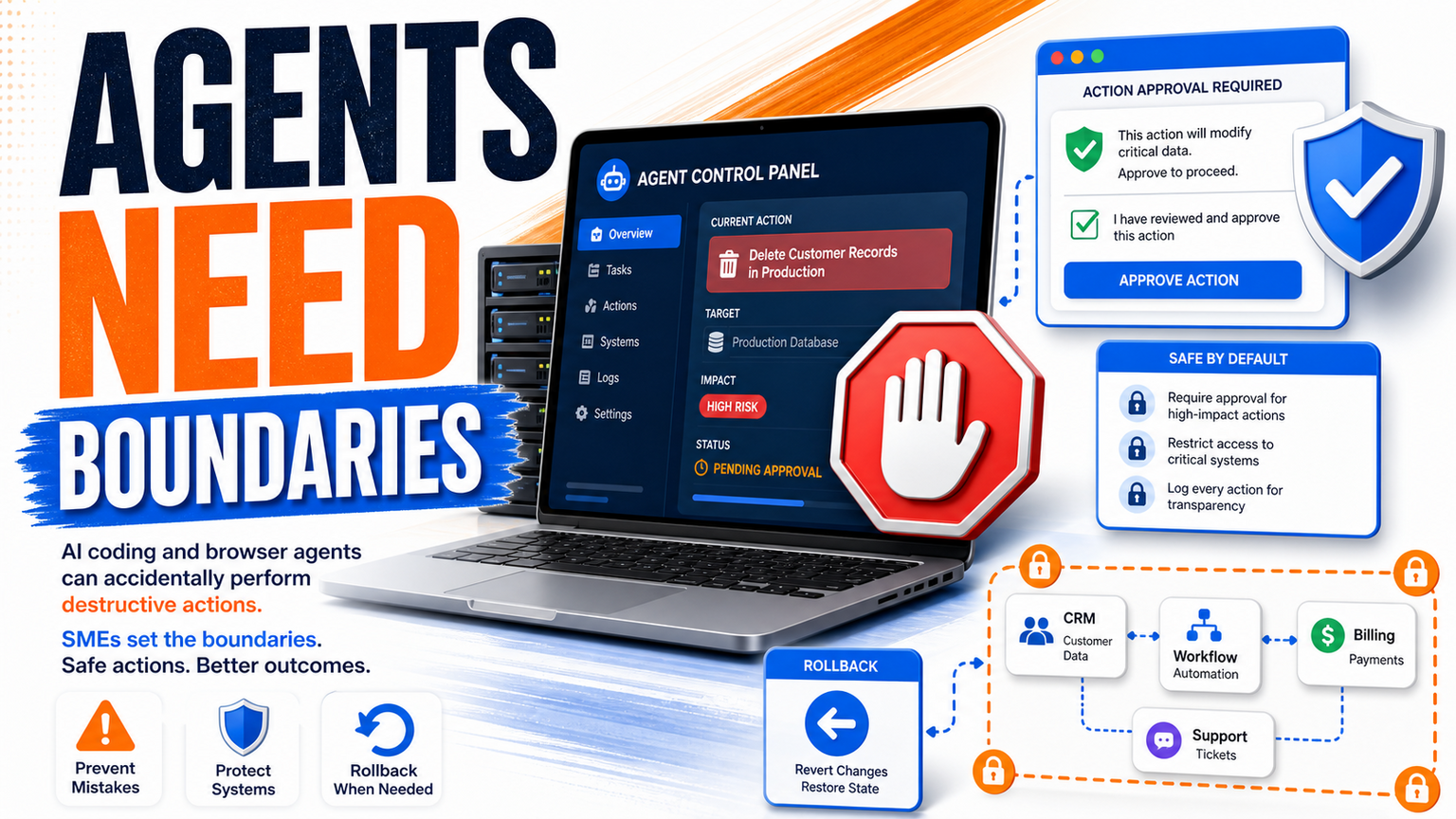
Claude deletion stories are a useful warning for small and mid-sized businesses: do not let AI agents touch live systems until the workflow around the action is controlled. The useful lesson is not that every AI coding tool is dangerous. It is that any agent that can edit files, submit forms, change records, run scripts, or operate a browser needs narrow permissions, approval gates, rollback plans, and logs before it becomes part of daily operations.
Treat this as a social and news-signal topic, not as a claim that every incident has been independently verified from primary logs. The business point is still practical: SMEs need action boundaries before AI agents touch systems.
What this means for SMEs
Most SMEs are not trying to build frontier AI labs. They want faster support, cleaner CRM updates, document processing, reporting, website follow-up, and browser-based admin work. That makes AI agents attractive because the agent can move from suggestion to action. It can open a dashboard, update a record, generate a document, send a message, or run a checklist.
That same shift creates the risk. A chatbot that gives a bad answer can be corrected by a person. An agent that clicks, deletes, submits, uploads, or changes live records can create operational damage before anyone notices. In a small business, the affected system might be the customer database, invoicing tool, booking portal, ecommerce admin, helpdesk, or a shared document folder. The issue is rarely one dramatic failure. It is usually an unclear boundary between what the AI may recommend and what it may actually do.
This is where GOFTUS frames AI automation differently. A business should not start by asking, "Which agent is smartest?" It should start by asking, "Which workflow can be safely delegated, what can go wrong, who approves exceptions, and where is the action logged?" The model matters, but the workflow around the model decides whether the result is usable.
Thirumurugan's view
Thirumurugan's view is simple: agent autonomy should increase only after the business can describe the stop rules. If an AI agent cannot explain the target system, the action type, the data it will touch, the approval level, and the rollback path, it should not be allowed to act on production systems.
For UK, US, and EU SMEs, the safest starting point is a controlled workflow with three lanes. Lane one is advice only: the agent drafts a reply, prepares a CRM note, summarizes a document, or recommends a next step. Lane two is prepared action: the agent fills the form or queues the change, but a human approves it. Lane three is limited automation: the agent can complete low-risk repeated actions inside a narrow workflow, with logs and alerts.
This is especially relevant for browser with ai controls. Many SME tools do not have perfect APIs. Staff still update portals, CRMs, supplier dashboards, government forms, booking systems, and support tools through the browser. AI controlled browser automation can help, but only when the browser agent has allowed websites, field-level boundaries, approval prompts, password limits, download rules, and a clear stop condition.
What SMEs should do next
Start with a small action inventory. List the actions your team wants AI to handle: creating CRM tasks, updating support tickets, moving files, drafting quotes, extracting invoice fields, checking order status, or preparing weekly reports. Then mark each action as advice, prepare for approval, or allowed automation.
Next, define the danger points. Could the agent delete data, overwrite a customer record, send an external message, submit a payment, expose personal data, or change a live configuration? If yes, the first build should include human approval and an audit log. If no, the action may be suitable for a low-risk automation lane after testing.
Then connect the agent to the real workflow. A good SME system should not end at a clever AI response. It should update the CRM, create the support task, attach the document, notify the owner, and record what happened. GOFTUS can help map that workflow through /services, build controlled agent flows through /agents, and review the safest first use case through /contact.
For customer-facing workflows, the same logic applies before the agent touches a browser or backend tool. Use FAQ automation service at /services#faq-automation to answer repeated questions, capture intent, and route complex issues. Only then add browser-based workflow automation for the tasks that require controlled action in portals or internal tools.
The market gives SMEs many useful options. Zapier, Make, n8n, Bardeen, Gumloop, Lindy, Relevance AI, and Stack AI can connect apps and automate task steps. Consultancies such as Faculty AI, Deeper Insights, Waracle, Brainpool AI, LeewayHertz, Markovate, SoluLab, BairesDev, Addepto, STX Next, Netguru, and 10Clouds can support larger AI projects.
The gap appears when an SME needs operational ownership after the demo. Tools automate tasks. GOFTUS automates the workflow around the task. That means defining permissions, approvals, logs, fallback routes, handoffs, review cycles, and measurable outcomes before the agent receives broader autonomy.
A competitor can build a bot that updates records. GOFTUS would ask which records, under which conditions, who approves risky changes, what happens when fields are missing, how exceptions reach staff, and how the business learns from mistakes. That is the difference between a clever agent and a controlled workflow system.
AI agents are becoming capable enough to touch real business systems, not just chat about them. The latest Claude deletion discussions are a useful reminder that autonomy without boundaries is not an SME strategy.
If your business is exploring AI agents, start with safe workflow control. Separate advice from action. Require approval for risky changes. Log every browser or system step. Keep rollback paths visible. Use AI where it reduces manual work, but make the business process stronger at the same time.
GOFTUS helps SMEs build this layer through practical AI automation, browser with ai controls, CRM and support handoffs, document workflows, FAQ automation, and agentic systems that stay accountable to human operators.
Should SMEs stop using AI coding or browser agents?
No. SMEs should use them carefully. The goal is not to avoid AI agents, but to keep them inside narrow workflows with approvals, logs, stop rules, and rollback plans.
What is the safest first agent workflow?
Start with advice or prepared action. Let the agent draft, summarize, classify, or queue the next step. Add direct action only after the process has clear limits and review.
Where should browser controls fit?
Use browser controls when the business needs AI to work inside web tools without reliable APIs. Limit sites, fields, credentials, submissions, downloads, and high-risk clicks.
These are used as headline-level cross-checks and cautionary context.
GOFTUS framing: the article focuses on SME workflow design, human approval gates, browser with ai controls, logs, rollback paths, and service links to /services, /agents, /services#faq-automation, and /contact.