Claude Cowork Shows SMEs Need Reporting Workflow Proof
Claude Cowork turns reporting time into a workflow control lesson for SMEs: verify numbers, route exceptions and keep human approval visible.
# Claude Cowork Shows SMEs Need Reporting Workflow Proof Meta description: Anthropic's Claude Cowork example shows why SME reporting automation needs verified numbers, task routing and human review before decisions. #
Claude Cowork Shows SMEs Need Reporting Workflow Proof
Meta description: Anthropic's Claude Cowork example shows why SME reporting automation needs verified numbers, task routing and human review before decisions.
Quick answer
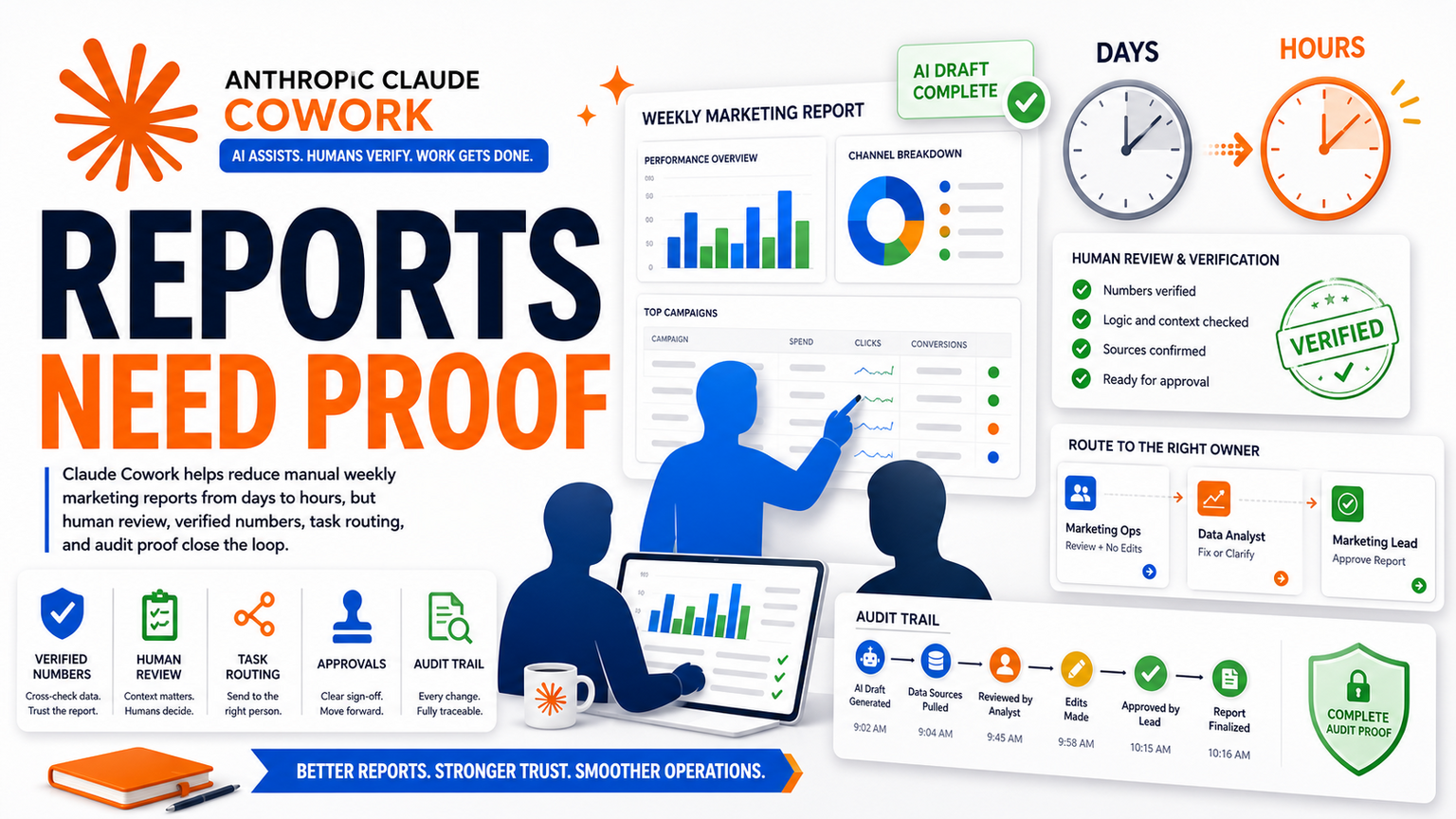
A fresh PPC Land report on Anthropic's own marketing operations shows Claude Cowork being used to compress a weekly marketing metrics build from days to hours, while keeping human review, source checking, scheduled tasks and follow-up routing in the loop. For UK, US and EU SMEs, the lesson is not simply that an AI agent can draft a report faster. It is that reporting automation only becomes useful when the surrounding workflow proves where the numbers came from, who approved them and what action happens next.
Hajikreena's view is that this is the practical version of AI automation most business owners should care about. A dashboard is useful. A chatbot is useful. But neither fixes the messy middle where numbers live across CRM, spreadsheets, Slack, call notes, warehouse tables and team memory. GOFTUS builds around that middle layer: pull the evidence, check it, flag gaps, route the next task and keep a clean audit trail.
Why this signal matters now
PPC Land reported on July 18, 2026 that Anthropic's marketing operations team rebuilt two internal workflows around Claude Cowork. One focused on the weekly metrics review. Another focused on event and campaign setup across CRM, marketing automation and event platforms. The report describes scheduled tasks, custom skills, source verification, Asana follow-ups and a separate audit step for event builds.
The strongest detail for SME operators is the nature of the bottleneck. The manual problem was finding scattered metrics, reconciling definitions and checking whether systems disagreed. Sales has one figure, marketing has another, finance uses a third export and the founder still asks someone to assemble the truth before Monday's meeting.
A live Reddit signal adds a useful caution. A current r/Anthropic hot RSS item discusses a user's claim about an automated account decision and a slow appeal path. That is not proof of Anthropic's internal systems. It is adjacent context showing why automated decisions need explanation and review.
What this means for SMEs
SMEs should read the Claude Cowork example as a workflow pattern, not as a prompt-writing trick. The target is not, "write me a report." The target is, "collect the inputs, show the source for each number, flag conflicts, draft the narrative, create tasks for follow-up and ask a human to approve the final version."
That distinction matters because business reporting often crosses sensitive data. Customer records, pipeline values, support issues and financial forecasts should not be blended by an unsupervised agent without boundaries. A safe reporting workflow needs scoped connectors, logging, source citations, exception rules and a clear human owner.
GOFTUS usually starts by mapping the repeated decision rather than the tool: weekly pipeline review, support backlog review, campaign performance, finance variance review or supplier chase list. Then we define the data sources, allowed actions, approval gate and escalation route.
Competitor lens
Faculty AI, Deeper Insights, Waracle and Brainpool AI can help larger UK organisations with AI strategy or specialist builds. LeewayHertz, Markovate, SoluLab and BairesDev often position around delivery capacity in the US market. Addepto, STX Next, Netguru and 10Clouds are credible European software and data partners. SaaS tools such as Zapier, n8n, Relevance AI, Lindy, Gumloop, Bardeen, Make and Stack AI can connect apps quickly.
The gap is not that those tools are bad. The gap is ownership of the operating workflow. Tools automate tasks. GOFTUS automates the workflow around the task. That means we do not stop at "agent drafts report." We design the intake, permissions, source checks, human review, exception handling, CRM or task updates, monitoring and monthly improvement loop.
For an SME, that difference is commercial. A disconnected automation may save one person time this week and create confusion next month. A governed workflow keeps the business moving even when a number is missing, a definition changes or a team member leaves.
What operators should build next
Start with one recurring report that already causes friction. Pick the report where someone spends time collecting screenshots, reconciling exports or chasing updates before a decision meeting.
List each source. Mark whether the agent can read it, summarize it, query it or only request human input. Then decide what the agent must never do. It may prepare a pipeline movement summary but not change deal stages. It may draft an email but not send it without approval.
Next, add proof. Every important figure should point to a source, timestamp or named system. Every exception should become a task. Every final report should show who approved it.
GOFTUS can turn this into a practical build through AI automation services, AI agents, reporting automation, CRM follow-up and internal knowledge assistants. If your team is already using n8n, Zapier, Make or spreadsheets, we can often keep the useful parts and add the missing control layer.
Summery for SMEs
Claude Cowork's reported marketing operations use case is a strong reminder that the future of SME automation is not only chat. It is verified, scheduled and reviewed work. The winning workflow collects the messy evidence, drafts the answer, explains the gaps and moves the next task to the right person.
If your business has repeated reporting, support triage, lead follow-up or document review work, the first question is not "which AI tool should we buy?" The better question is "which workflow needs proof, approval and improvement every week?" GOFTUS can help scope that through a lightweight diagnostic and turn it into a measured build.
FAQ
Is Claude Cowork proof that SMEs should automate weekly reports?
It is proof that the workflow is worth examining. SMEs should not copy Anthropic's stack blindly, but they should look for the same pattern: repeated reporting, scattered data, manual reconciliation and decisions delayed by missing context. GOFTUS helps translate that pattern into a controlled reporting workflow with source checks, review gates and follow-up actions.
Can tools like n8n or Zapier handle this without GOFTUS?
They can handle useful parts of the chain, especially app triggers and routine data movement. The harder work is deciding what should happen when sources disagree, a metric is missing or a human must approve a decision. GOFTUS designs that operating layer around the tools so the automation is safe enough to run every week.
What is the safest first reporting automation project?
Choose a report that is repeated, painful and low enough risk to pilot safely. Weekly sales pipeline movement, support backlog themes, marketing campaign notes or supplier follow-ups are good starting points. Avoid high-risk financial or legal decisions until the evidence, logging and approval process has already been tested.