ChatGPT Governance for SMEs: How to Let Staff Use AI Without Breaking Workflows
ChatGPT governance helps SMEs set safe workflow rules before staff AI use touches CRM, support, finance, or documents.
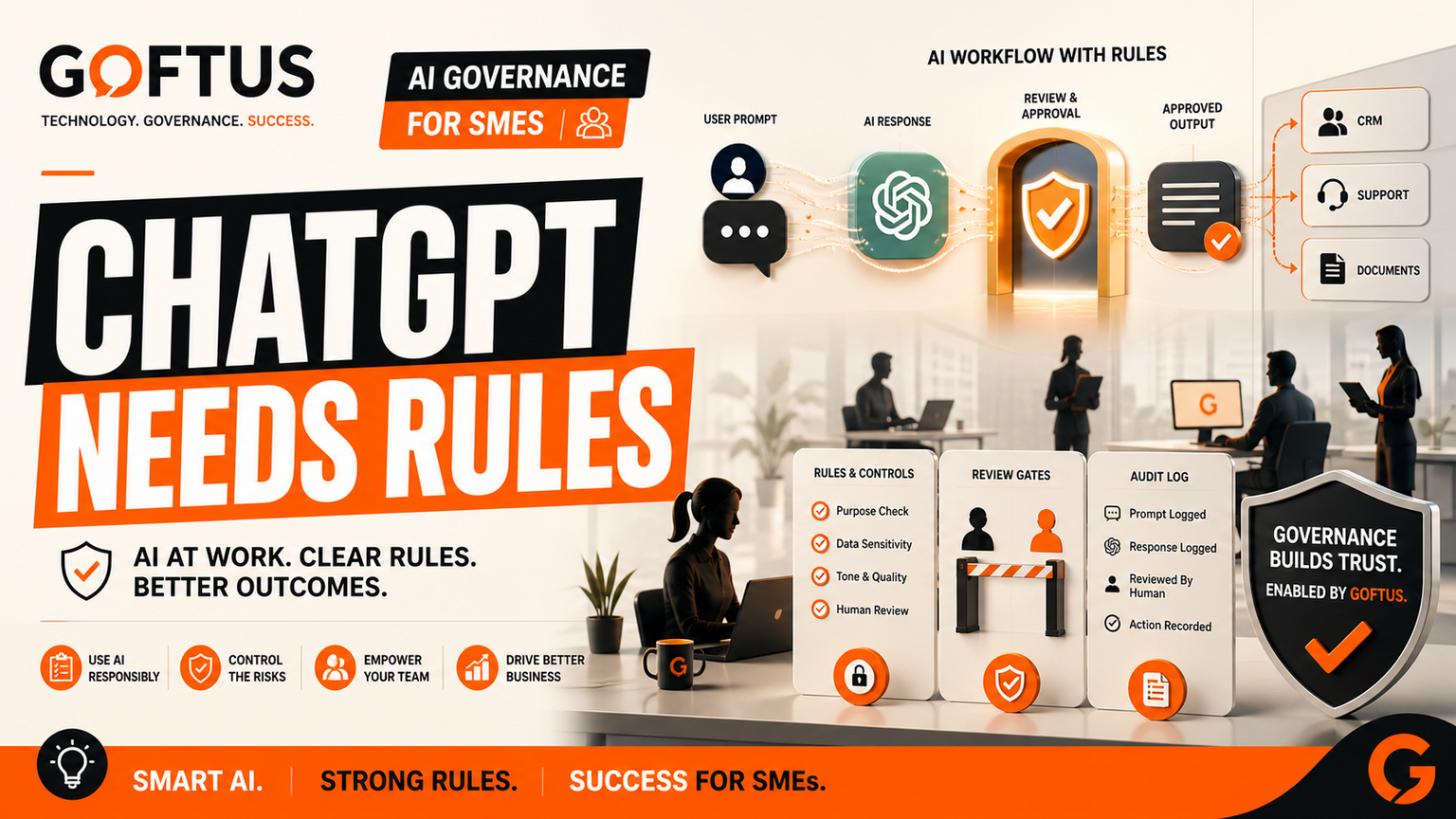
# ChatGPT Governance for SMEs: How to Let Staff Use AI Without Breaking Workflows **Meta description:** ChatGPT governance helps SMEs set approval, privacy, and workflow rules before staff AI use touches CRM, support, f
ChatGPT Governance for SMEs: How to Let Staff Use AI Without Breaking Workflows
Meta description: ChatGPT governance helps SMEs set approval, privacy, and workflow rules before staff AI use touches CRM, support, finance, documents, and customer replies.
ChatGPT governance is the practical set of rules, approvals, logs, and workflow boundaries that lets staff use AI without turning every answer, document, CRM note, or customer reply into an unmanaged experiment. For UK, US, and EU SMEs, the question is no longer whether employees will try ChatGPT or Claude at work. Many already do. The real question is whether the business knows which tasks are safe, which tasks need review, and which tasks should never be automated without a human owner.
Treat that Reddit thread as operator sentiment, not verified market proof. It shows a familiar pattern for SMEs: enthusiasm arrives faster than governance.
GOFTUS turns that signal into a buyer problem: how can a business allow staff AI use while protecting customer workflows? The answer is not a blanket ban and not a free-for-all. It is a managed workflow layer around AI prompts, outputs, approvals, CRM updates, support replies, document changes, and browser-based actions. If your team is already experimenting, start with the GOFTUS services path at /services and define the first safe workflow before adding more tools.
What this means for SMEs
Unmanaged AI use usually begins with small shortcuts. A salesperson asks ChatGPT to rewrite a follow-up email. A support agent pastes a customer issue into an AI tool. An operations assistant asks for a policy summary. A founder uses AI to draft a supplier response. Each action can be helpful in isolation, but the business risk appears when nobody owns the surrounding workflow.
The output may be wrong. It may include sensitive information. It may use a tone that does not match the company. It may update a customer record without context. It may create a reply that sounds confident but misses a legal, pricing, or delivery boundary. The risk is not simply the model. The risk is the missing rulebook around where AI fits inside daily work.
A useful ChatGPT governance setup starts with task categories. Low-risk tasks can include rewriting internal notes, creating first drafts from non-sensitive content, summarising public information, or brainstorming FAQs. Medium-risk tasks need review, such as customer emails, sales proposals, support replies, document changes, or CRM notes. High-risk tasks should require explicit approval or stay manual, such as pricing commitments, refunds, hiring decisions, legal statements, security changes, payments, and browser actions that submit forms or alter records.
Once the task categories are clear, SMEs need logs and handoffs. Who asked the AI? Which source content was used? Was customer data included? Who approved the final message? Did the output update CRM, support, finance, documents, or reporting? Without those answers, AI use becomes invisible work. Invisible work is hard to improve and hard to defend when something goes wrong.
Bharatvaj's view is that SMEs should stop treating staff AI use as a culture debate and start treating it as workflow design. People will use AI when they are under pressure, especially in sales, support, admin, reporting, and document work. The business should give them safe lanes instead of pretending every prompt can be controlled by policy text alone.
A simple first version can be built in days. Create an approved prompt library for common tasks. Add a rule that customer-facing outputs need human review. Keep sensitive data out of public tools unless the tool and contract allow it. Route approved AI outputs into the right system, such as CRM, support, documents, or reporting. Review the failures monthly. That is governance as an operating system, not governance as a PDF.
This is where GOFTUS differs from a tool-only approach. A SaaS app may help staff draft, summarise, classify, or automate. GOFTUS designs the control path around the action: when AI can help, when a person must approve, where the record should go, what gets logged, and how the process improves next month.
What SMEs should do next
Start by mapping the five places staff already use AI or want to use it. Common places are sales follow-up, customer support, proposal writing, internal knowledge search, spreadsheet analysis, website research, and document processing. For each task, write down the input, the output, the business system touched, the human reviewer, and the failure that would matter most.
Then build a three-lane governance model. Lane one is safe drafting, where AI helps with internal wording but does not touch customers or records. Lane two is reviewed workflow assistance, where AI prepares a response, summary, or CRM note that a human checks before use. Lane three is controlled automation, where AI can trigger a defined workflow only after approval rules and stop conditions are in place.
For browser-based tools, add stricter rules. AI should not freely submit forms, download files, or change customer records without boundaries. The same governance model can connect to /agents when a business is ready for AI agents.
A practical GOFTUS engagement usually starts with a workflow diagnostic. The £100 Startup Kit can identify where AI is already being used, which workflows are safe to automate, and which tasks need human review before action. From there, GOFTUS can build the controlled automation layer around the tools the business already uses.
Faculty AI, Deeper Insights, Waracle, Brainpool AI, LeewayHertz, Markovate, SoluLab, BairesDev, Addepto, STX Next, Netguru, and 10Clouds can all be useful partners for larger AI projects. Zapier, n8n, Relevance AI, Lindy, Gumloop, Bardeen, Make, and Stack AI can also help teams connect tasks quickly.
The missing piece for many SMEs is not another automation button. It is ownership of the workflow around the button. Tools automate tasks. GOFTUS automates the workflow around the task. That means approvals, logs, exception routing, CRM and support handoff, document control, browser boundaries, and monthly improvement. For a small business, that operating layer is what turns staff AI enthusiasm into reliable work.
Staff may be trying ChatGPT because it saves time, but unmanaged use can create privacy, quality, tone, recordkeeping, and customer-risk problems.
SMEs do not need to ban AI to stay safe. They need a short list of approved tasks, a review rule for customer-facing outputs, clear data boundaries, logs for important work, and automation handoffs into CRM, support, documents, reporting, or agent workflows. GOFTUS helps build that layer through /services so AI use becomes measurable workflow improvement rather than hidden experimentation.
Should SMEs ban ChatGPT at work?
Usually no. A ban can push usage underground. A safer first step is to define approved tasks, sensitive-data rules, human review points, and systems where AI outputs may be used.
What should a ChatGPT governance workflow include?
It should include task categories, prompt guidance, data boundaries, approval gates, output logs, exception handling, and clear handoffs into CRM, support, documents, or reporting.
When should staff AI use become an AI agent workflow?
Only when the task is narrow, repeatable, reviewed, and logged. If the workflow touches customers, records, browser actions, or finance, connect it to /agents only after approval rules and stop conditions exist.
Direct article bodies were not all independently scraped.
SEO pipeline: source signal triggers the topic, while the evergreen buyer keyword is chatgpt governance.