Approval Workflows for AI Coding Agents Before They Change Business Systems
Use approval workflows to let AI coding agents prepare changes while humans control CRM, finance, support, and production systems.
# Approval Workflows for AI Coding Agents Before They Change Business Systems Meta description: Approval workflows help SMEs use AI coding agents safely with review gates, audit logs, and human sign-off before key busin
Approval Workflows for AI Coding Agents Before They Change Business Systems
Meta description: Approval workflows help SMEs use AI coding agents safely with review gates, audit logs, and human sign-off before key business systems change.
Quick answer
Approval workflows are the practical way to let AI coding agents help a small or mid-sized business without handing them uncontrolled access to the systems that run the company. Treat that as a signal of operator attention, not as proof that every business should switch agents on by default.
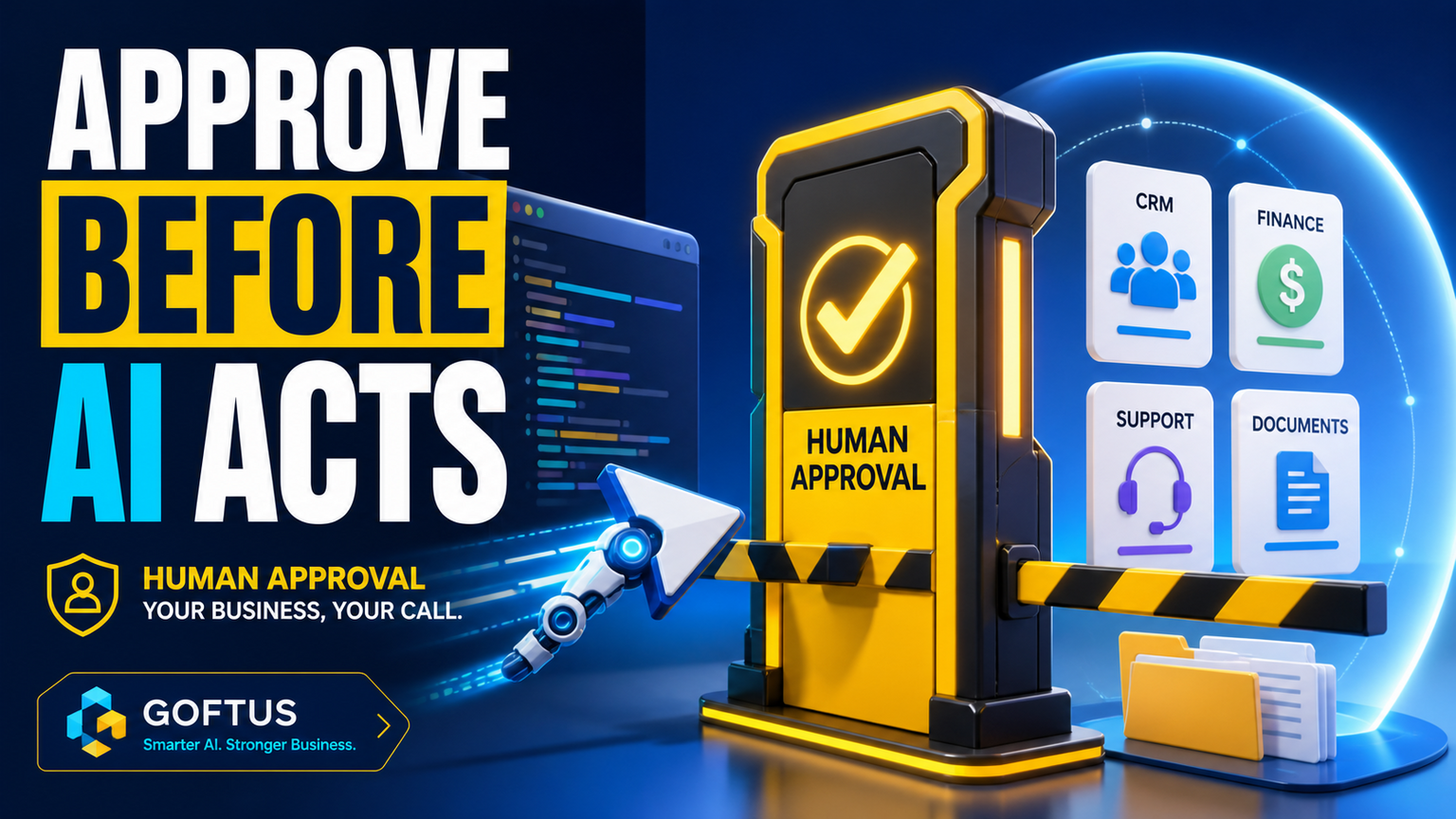
For SMEs in the UK, US, and Europe, the buyer problem is simpler than the model headline. Teams need an approval workflow that decides what an AI coding agent may prepare, what it may test, what it may merge, and what must wait for a person. GOFTUS designs those lanes so AI can speed up useful work while humans keep control of CRM, finance, support, website, document, and production changes.
What this means for SMEs
AI coding agents are moving from autocomplete into action. They can read repositories, propose fixes, run tests, draft database migrations, update documentation, and sometimes operate across connected tools. That is valuable for businesses with thin technical teams, but it also changes the risk profile. A bad code suggestion is one thing. A bad workflow change that updates pricing logic, customer records, permissions, billing routes, or support triage is a business incident.
The answer is not to ban agents. The answer is to give them lanes. A safe approval workflow separates observation, preparation, testing, review, and action. The agent can inspect a bug report, prepare a pull request, draft release notes, or suggest an automation change. A person still approves the merge, deployment, data change, customer message, or finance action.
This matters for non-technical owners too. Many SMEs do not have a full platform team to watch every integration. A business may use a CRM, accounting tool, helpdesk, website CMS, spreadsheets, n8n, Zapier, Make, or custom scripts. When an AI agent touches those systems indirectly through code, it can affect staff workload and customer experience. Approval gates make those effects visible before they go live.
Where approval workflows should sit
Start where the agent can cause business impact. Put approval before database migrations, API key changes, production deploys, CRM field changes, customer email logic, payment or invoice rules, browser-based submissions, and support routing changes. Lower-risk work, such as documentation drafts or local test generation, can have lighter review.
A useful workflow has five parts. First, define the action boundary: what the agent can read, prepare, test, and propose. Second, log the evidence: ticket, files changed, tests run, risks found, and rollback plan. Third, route the approval to the right owner, not just the nearest developer. Fourth, record the decision so the business can audit what happened later. Fifth, review exceptions monthly so the workflow improves instead of becoming bureaucracy.
GOFTUS often connects this pattern to wider AI agents work. A coding agent that changes a support automation, CRM process, or browser workflow should not be treated as only a development tool. It is part of an operational system. The same approve-before-action pattern can support customer support automation, document automation, reporting automation, and browser with AI controls when agents act inside web apps.
What SMEs should do next
Pick one workflow where AI coding assistance is already tempting. Common examples include fixing website forms, adding CRM automation, improving support triage, updating a document parser, or building a reporting dashboard. Write down the systems touched, the data involved, the person who owns the outcome, and the worst mistake that would matter to customers or finance.
Then create three lanes. Green lane work can be prepared and tested by AI with normal review. Amber lane work needs named approval before merge or deployment. Red lane work is not allowed without a separate human plan, such as payment changes, permission changes, customer-facing promises, or bulk data updates.
The GOFTUS services approach is deliberately practical. We map the workflow, build the automation, add approvals and logs, connect the right tools, and keep improving the system. If the first step is unclear, the £100 Startup Kit diagnostic can identify which agent workflows are safe to automate now and which need controls first.
Competitor lens
Faculty AI, Deeper Insights, Waracle, Brainpool AI, LeewayHertz, Markovate, SoluLab, BairesDev, Addepto, STX Next, Netguru, and 10Clouds can all be useful partners for data, software, and AI delivery. SaaS tools such as Zapier, n8n, Relevance AI, Lindy, Gumloop, Bardeen, Make, and Stack AI can also help teams automate tasks quickly.
The gap for SMEs is usually not the existence of another tool. It is ownership of the workflow around the tool. Who approves the change? Who sees the log? Who handles exceptions? Which systems are out of bounds? What happens if an agent prepares a change that looks correct but would break a customer handoff?
Tools automate tasks. GOFTUS automates the workflow around the task. That means practical design, integration, monitoring, review, and improvement around the business outcome, not only a clever agent demo.
Summery for SMEs
Claude and AI coding news should not push SMEs into uncontrolled automation. The better response is to build approval workflows that let agents prepare useful work while people stay accountable for production, customer, finance, and support outcomes. Start with one workflow, define safe lanes, log evidence, and require human sign-off where business systems can change.
FAQ
Should an SME let an AI coding agent change production systems automatically?
Usually no. Let the agent prepare code, tests, notes, and a rollback plan first. Require approval before production deployment, database changes, customer communication, or finance logic changes.
What is the first approval workflow to build for AI coding agents?
Start with the workflow that touches customer or revenue systems, such as CRM automation, support routing, website forms, billing logic, or reporting. Those changes need clear owners and logs.
How does GOFTUS help with AI agent approval workflows?
GOFTUS maps the business process, builds the automation, adds review gates, connects tools, and monitors exceptions through practical /services and /agents work.
Source notes
RSS headline-level access was used where direct article retrieval was not required for the buyer-problem framing.
GOFTUS angle: translate stronger or more automatic coding agents into approval workflow design for SMEs before agents change CRM, finance, support, documents, browser tasks, or production systems.